Mostrando entradas con la etiqueta agua. Mostrar todas las entradas

4 dic 2012

water technology


microorganism


RIVER RESTORATION

veden_taika


RESULTS:

Improves dissolved oxygen

Low energy, chemical free treatment

Odour filtration

Aesthetic cleantech

Reduced algae

Advanced tratment standards for BOD, COD, NH3.


Natural Treatment

The Biomatrix system is an engineered floating ecology designed to optimize powerful ecological treatment processes within an attractive feature of the aquatic landscape.  The Biomatrix combines the latest developments in ecological engineering with new biofilm research and traditional wastewater treatment processes.  Whole system engineered ecologies provide an energy efficient, low life cycle cost treatment solution.


The Form

img_6961

The systems are designed in sections, which can be configured in attractive natural shapes.  The Biomatrix unit can be designed to blend with the existing waterscape in strategic locations where performance can be optimized.  The system can be configured along the edge of the waterway, or centrally as islands or archipelagos.

Floating Structures

The Biomatrix system can incorporate variable levels of buoyancy from 10kg/m2 to over 100 kg/m2. The use of different levels of buoyancy allow areas of walkways, floating bridges, pavilions, boat docking sites or public artworks to be integrated with the treatment system.

Biomatrix systems are ideally suited for contaminated canals, rivers, lakes and reservoirs; as well as providing effective treatment of high strength waste in purpose built lagoons and treatment cells.

The Biomatrix provides the foundation and the substrate to support a diversity of life forms from many different phylogenetic kingdoms. These include the bacteria, fungi, algae, protozoa, annelids, mollusks, insects, vertebrates (including frogs and turtles), and higher plants. This multitude of life forms, in concert, have the capability to treat wastes, pathogens and toxins. The basic technological and scientific principles governing the design of natural treatment systems have been well articulated and subjected to scientific review.

salo-biomatrix 
TREATMENT PROCESSES WITHIN BIOMATRIX SYSTEMS CAN EFFECTIVELY:
  • Improve water clarity
  • Remove and stabilize nutrients
  • Reduce algae
  • Breakdown industrial chemicals
  • Remove Biological and Chemical Oxygen Demand
  • Filter out Suspended Solids and particulate
     
     
 WASTEWATER TREATMENT

six1


ECOLOGICAL TOOLBOX

ecological-toolbox

3 oct 2012

Networking Nature


Year: 2012
Location: Palazzo Bembo, Venice
Typology: Installation for the Venice Architecture Biennale 2012
Strategy: Creating a self sufficient ecosystem where it is impossible to see the dividing line between living machines and artificial organisms
Design and making: Studiomobile
Water network automation: Angelo Semeraro

" For the Venice Architecture Biennale 2012, Studiomobile explores a future scenario where men are forced to live in an unusual landscape shaped by environmental changes. At present, more than half the world's population lives and works in a coastal strip 200 kilometres wide, and in the near future sea is expected to characterize even more urban settlements. But not only adaptation is required. Next strategy will be assimilation, an approach characterized by embracing the changing conditions and taking advantage of the resulting opportunities. Frequently, changes perceived as negative open up new possibilities and innovative opportunities. We imagine new communities based on movement, living in flexible, self-sufficient, and nomadic structures. We believe that seawater is poised to become soon a key resource for urban environment
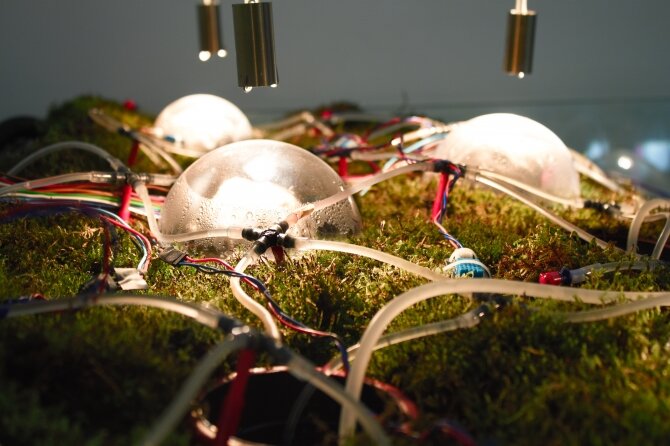
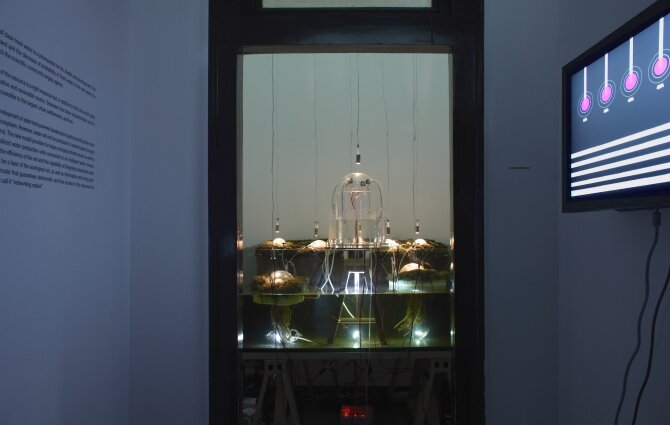
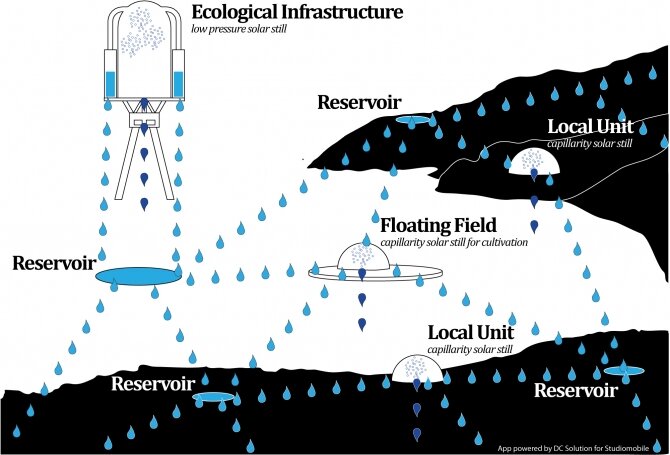
The ecosystem Networking Nature lives off seawater. Within a glass tank filled with salt water, some solar stills extract fresh water by exploiting the heat produced by small lamps. Seawater evaporates and the steam condenses into fresh water, which is collected in tanks and then supplied. 
However, water is not produced in isolated systems under central control. The new model provides for a large ecological infrastructure as well as small local production units connected to a network able to integrate the production of fresh water and to supply it where needed. It's a Smart Water Network controlled by sensors that read the local lack of water and, through an Arduino board, activate the pumps providing the water where there is a peak of demand. The Smart Water Network will be a layer of the ecological network as well as the Smart Power Grid and the communications network. This strategy not only gives response to the preservation of the environment, but it is also a radically new model that ensures free and democratic access to the resources to everybody.
Studiomobile's installations are working living machineswhere nature and built landscape live in symbiosis. They suggest a future immaginary where it is impossible to see the dividing line between naturalized architecture and plugged nature and between living machines and artificial organisms."


10 sept 2012

msunduza dry toilet


The project area:
Swaziland is a small kingdom with a population of 1.2 million people located in southern Africa by the Mozambiqian and South-African border. Swaziland is experiencing a rapid urbanisation as people are fleeing the rural poverty and end up living in the informal areas around the cities.


Diarrheal diseases and insecurity:
In Msunduza, which is the oldest and the largest community of 16 000 inhabitants in the capital, Mbabane, sanitation solutions are diverse. The majority use a traditional pit latrine, but also a bucket or a “flying toilet”, where faeces are thrown into the environment. With children playing in the polluted streets, diarrhoeal diseases and cholera prevail. Additionally, insufficient sanitation causes social problems and security issues, especially to women and girls.

The project objectives are: :
• Improved sanitation hygiene and knowledge on sanitation
• Increased and more efficient composting and home gardening
• Improved livelihood and participation in the project area
• Sustainable and healthy sanitation culture

Dry toilets and environmental education:
Project activities include building dry toilets to households and to public places, improving hand washing possibilities, giving sanitation and hygiene education and encouraging home gardening and composting.
Thus far, the Msunduza Dry Sanitation Project has funded the construction of 33 toilets, and the environmental and sanitation education provided by the project has reached the inhabitants of Msunduza. The Project has also acted as a supporter for a youth group of one of the communities. In 2013 the project funding will reach its end. Focus of the last phase is to sustain the attainments of the project and to create a responsible exit strategy. This is mainly done through capacity building and by bringing together participants from different levels and sectors of the society.


Working experience from practicals:
Students from the Department of Sustainable Development in the Turku University of Applied Sciences have contributed to the project as part of their obligatory practical training. Students also receive valuable international working experience from working in a development cooperation project. Apart from practical training, Msunduza Dry Sanitation Project has been a topic for several Bachelor Theses and offered possibilities to work as a student assistant.


Benefits of dry sanitation:
Dry sanitation offers a sustainable solution for the improvement of sanitation for the disadvantaged. Dry toilets function without water, which has become scarcity in the regions battling with sanitation problems. Additionally, dry toilets provide a lucrative fertiliser turning waste into a resource.


Project implementation:
The Department of Sustainable Development in the Turku University of Applied Sciences has worked in Msunduza since the year 2004.
The Project is being implemented in cooperation with the Global Dry Toilet Association of Finland, Turku University of Applied Sciences and the Salvation Army in Swaziland as a local partner. The Project was initiated in 2007 and it is funded by the Ministry for Foreign Affairs of Finland.


The Msunduza Dry Sanitation Project 2007-2013


Msunduza is the oldest and partially informal township in Mbabane. The township of about 16 000 people is located close to the city centre on steep hills. The main features of the area are very steep topography, inadequate infrastructure and petty road network. The project is focusing on the poorest communities of Msunduza, where sanitation facilities are scarce and often in poor condition. The project implementation in Msunduza is done in collaboration with the Salvation Army of Swaziland and the Sanitation Experts, who are local volunteers trained to educate the communities of Msunduza. During the project, cooperation with the City Council of Mbabane, the local leaders of Msunduza and the University of Swaziland has been emphasized as well. In the unofficial areas of Msunduza, water and sewage systems are lacking and the waste management services are largely inadequate. Hence, the sanitation solutions are diverse as people use pit latrines, buckets or even plastic bags. In some areas wastewater from the water closets is piped into septic tanks, which flood in to the yards and streets, when emptying the tanks fails. With children playing in the polluted streets and due to the lacking awareness on environmental health, cholera and other diarrhoeal diseases prevail.
The aim of the project is to improve the poor sanitation and sanitation hygiene of the area. The project activities include e.g. building of dry toilets, disseminating information on safe sanitation and increasing awareness on the linkage between hygiene and health. In the long run, the aim is to increase composting, home gardening and, furthermore, to improve the food security of households through provision of composted material from the dry toilets as a fertilizer in home gardens. Improvement of hygiene and food security is essential in Swaziland, where 26 % of the people are HIV infected. The Swazi culture is also very traditional and male-dominated, thus the project also aims to improve the position of women and children in the community through environmental and hygiene education.


More Information:


MSUNDUZA DRY SANITATION PROJECT EVALUATION REPORT (2011)
Jonna Heikkilä
Turku University of Applied Sciences
jonna.heikkila@turkuamk.fi

23 dic 2011

breathing construction: archytipe

Pioneering Timber Construction

Value: £450k; client: The Horniman Museum; complete: 1995


London Wildlife Trust Education Centre & Centre for Understanding the Environment, Horniman Museum Architype’s Centre for Understanding the Environment at the Horniman Museum in South London was built as an expressive, highly visual demonstration of ecological building. The design incorporates a natural passive ventilation system routed through large section hollow prefabricated timber beams and columns, integrating structure and services. The building collects rainwater, recycles its own greywater through reed beds, generates electricity through photo-voltaic cells, heats water through solar collectors, and utilizes the reed bed water for auditorium cooling. 
 
The centre won a ‘Green Building of the Year’ award in 1997
 
Our award winning and much loved centre for the London Wildlife Trust creates an idyllic garden within a residential street. The building itself was the first in the UK to employ a ‘breathing’ construction using recycled newspaper insulation. The orientation of the building is designed to maximise solar gain in autumn, winter and spring. In summer, natural through-ventilation is created and solar shade maximised. Non-toxic paints, stains and floor finishes are used throughout. 
 
Community Enterprise Times Environment Award, 1992; Green Building of the Year Awards Commendation, 1993

Value: £56k; client: London Wildlife Trust; complete: 1992

27 sept 2011

Wangari Maathai


1940-2011
It is with great sadness that the family of Professor Wangari Maathai announces her passing away on 25th September, 2011, at the Nairobi Hospital, after a prolonged and bravely borne struggle with cancer.
Professor Maathai's departure is untimely and a very great loss to all who knew her - as a mother, relative, co-worker, colleague, role model, and heroine; or who admired her determination to make the world a more peaceful, healthier, and better place.


intro

biography


Wangari Maathai shares the inspiring hummingbird story about how each of us can make a difference.


holistic development


taking root: the vision of Wangari Maathai

On receiving the news of being awarded the Nobel Peace Prize, 2004
“It is evident that many wars are fought over resources which are now becoming increasingly scarce. If we conserved our resources better, fighting over them would not then occur…so, protecting the global environment is directly related to securing peace…those of us who understand the complex concept of the environment have the burden to act. We must not tire, we must not give up, we must persist.”

Wangari Maathai was the founder of the Green Belt Movement, an environmentalist, a civil society and women's rights activist, and a former parliamentarian. You can read about her life and her organization in her books (see below). You can also scan condensed versions of her life and achievements, including being awarded the 2004 Nobel Peace Prize.


Since winning the Nobel Peace Prize, Wangari Maathai had become a spokesperson for a number of important initiatives.

Both before and since she won the Nobel Peace Prize, Wangari Maathai spoke about, and was interviewed on, a range of subjects. You can read these articles, interviews, and statements, by visiting the themed sections listed at the bottom of this page, and in the menu bar on the side of each page.


8 sept 2011

CRADLE TO CRADLE. CAPITULO 4. philosophy


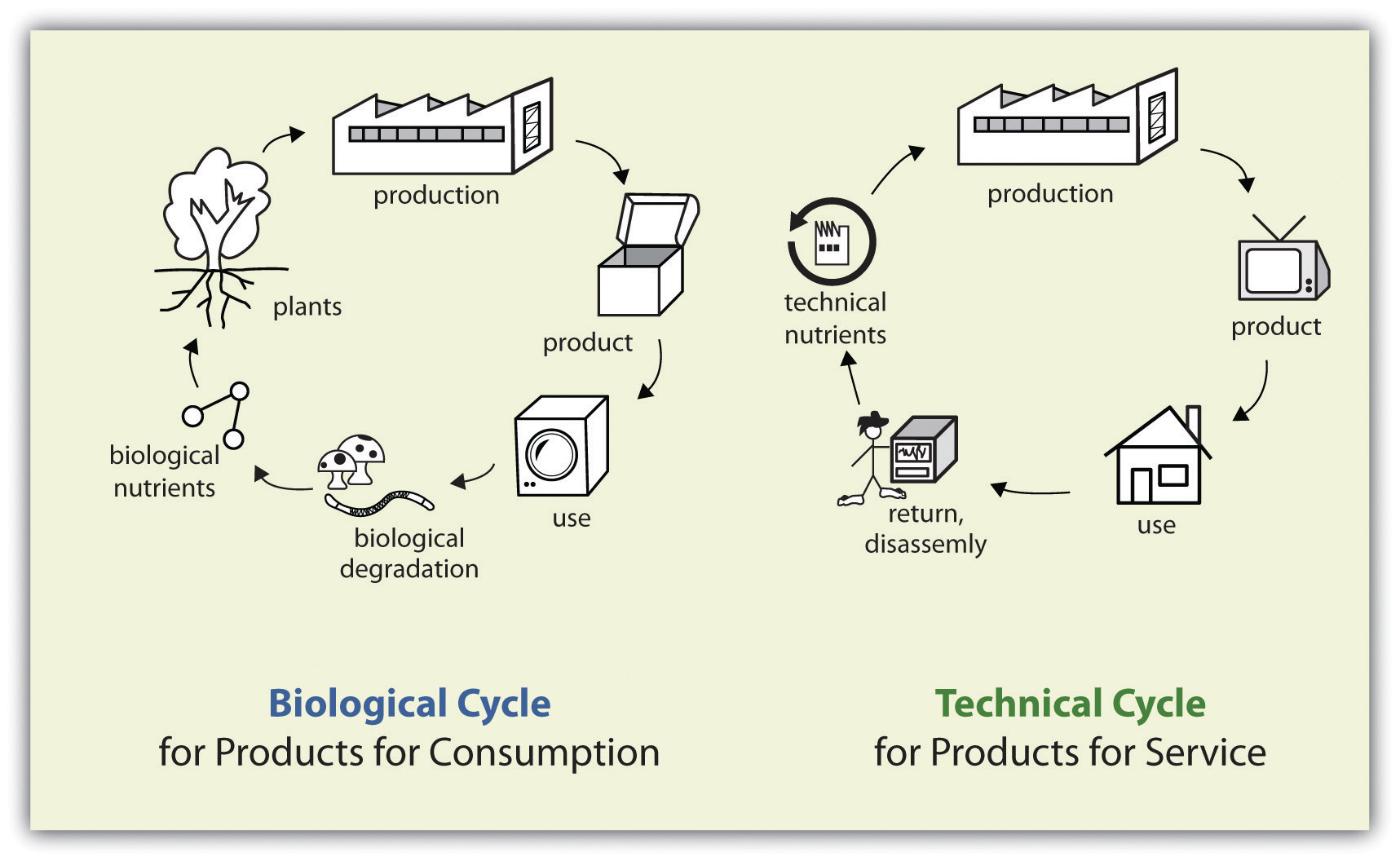
In the nature, flowers and leaves from Cherry tree fall off on the ground and become nutrients to the soil which are in turn absorbed back to plants. Ants get food from plants and also leave nutrients back to the plants. Therefore, human also can be a partner with the nature. Learn the biological cycle of the nature and make it the technical cycle.
We can design new products that can be decomposed after use and become nutrients to the Earth, or that can be reused to become a new material for a new product. No need to dispose, burn or bury under the ground; no more burden to the earth. We can color our world, not to destroy it. 


Why Being "Less bad" is No Good

After a long term of efforts, environmentalists suggested many methods that can decrease the damage to the environment from the industry. Reduce, Reuse, Recycle and Restrictions, these are the “less bad” policy. Most people think “Reduce” is the best method that can satisfy the ecology, but no matter how much toxic waste is reduced from the process, emission is limited or raw materials are cut down, none of them can prevent the earth from being destroyed by the waste, it just postpones the time of destruction. Even there is just a little amount of dangerous emission, it will affect the biological system and harm the world. For example, there are 100,000 people die annually in the US since 1995 because of tiny particles. No kidding.


Reuse seems to provide a means for the waste to go “away”, but if the waste contains toxic contaminants, it will come back in another form. In developing countries, people will recycle sewage sludge into animal food. Normally, the sewage sludge contains heavy metals, dioxins and endocrine disrupters. When sewage sludge is used to farm or fertilize plants, flowers or vegetables, the harmful substances would go into the animals and our body.
For recycling, is it good for the environment? It depends on what kind of items is being recycled. Most book or magazine publishers, they usually use fancy and colorful papers to attract consumers to buy their products, and they never think about environmentalism. After the fancy and colorful papers are recycled, factories need to put a large amount of bleach and other chemical processes to make them blank so that they can be reused. Also, the fibers of the recycled papers are short and less smooth than virgin paper, so small particles will be easily released into the air and inhaled into human body. Some people get allergies from newspapers because most newspapers are made from recycled paper.

Governments play as a guardian and regulator; they force companies to regulate their products to conform to their rules under punishment, but less rewards are granted to the companies who take initiatives. The point is, if they follow the rule, they need to pay more and more money to regulate their products. Therefore, companies will never be ardent to solve the problem and will not make any effort or spend more time to work for a new design. It in turn makes companies legally pollute the area by their thoughtless designs.

The concept of eco-efficiency in the public is creating more goods and services, while using fewer resources and creating less waste and pollution. Unfortunately, Eco-efficiency is not a perfect concept because it doesn’t reach deep enough. We can not rely on eco-efficiency to save the environment. In the long term, it will let the industry finish off all the resources. For instance, one of the energy-efficient building in Germany, it successfully decreases the number of the standard rate of oil used. It achieves a better insulation – less air comes into the building. On the other hand, due to smaller and lack-proof windows, it reduces air-exchange rate, and increases the poor indoor air pollution. In turn, more air-freshener machines are needed in the room and more money has to be spent on electricity. At the same time, more fossil fuel is used to transform into electrical power.

Our goal is zero waste and zero emission. “Be less bad” is a failure, because it will keep producing a bad design and destruct the environmental system.


Eco-effectiveness

For generation after generation, a Cherry Tree will grow flowers, fruits and await an animal to eat its fruit and drop down the seed somewhere else so as to grow another Cherry Tree. No one will complain the flowers falling all over the ground, and think the flowers are wasted. In fact, the flowers, fruits and leaves of a tree will decompose and break down into nutrients for soil, plants, insect and animals. This process is a zero burden to the nature. Can the house human build become a zero burden to the nature like the Cherry Tree?


Let’s compare the big energy saving eco-efficient house that human build and the house by Cherry Tree, and see if Cherry Tree can build a house like human. The human-built house will have a closed window to minimize air infiltration. A better thermal insulation system can prevent cold or warm air loss, so human will use dark-tinted glass for windows to prevent excessive use of air-conditioning as sun light directly enters the room heating up the temperature. Hence, the electricity cost is reduced, less fossil fuel energy is used by the power plant, and less emission is released and causes air pollution. As a result, the house will be energy saving and environmental friendly.

For the house built by Cherry Tree, Sun-light enters the house during the day-time. With an open and un-tinted window, fresh air will cool down and flow around the house. At night, the cool evening air will decrease the room temperature and re-fresh around house. There are layers of soil with grass covering the building roof. It can be a new home for animals and birds. Also, it can absorb rain to cool down the house temperature and prevent ultraviolet.

Both houses function as energy-efficient, but the Cherry Tree one design is more complicated for people working there.


It might sound strange to build a house by using nature system, but back in the time in Europe, there were a lot of old farms that was built with stones, wood and sod. Grass was placed on top of the roof as well. One of the projects the author did was building a garden on the roof of Chicago’s City Hall. After the project was done, Mayor Richard Daley predicted all house roofs in the whole city would become all green similar to the one of Chicago’s City Hall. The functions of the green roof are to provide a new home for many birds and other animals, cool down the temperature of the building, and flower, and to grow plant and food by natural sun light.
The good design should be:

1. Building that, like trees, produce more energy than they consume and purify their own waste water.
2. Factories that produce effluents that are drinking water.
3. Products that, when their useful life is over, do not become useless waste but can be tossed onto the ground to decompose and become food for plants and animals and nutrients for soil; or, alternately, that can return to industrial cycles to supply high-quality raw materials for new products.
4. Billions, even trillions, of dollars’ worth of material accrued for human and natural purposes each year
5. Transportation that improves the quality of life while delivering goods and services.
6. A world of abundance, not one of limits, pollutions, and waste.


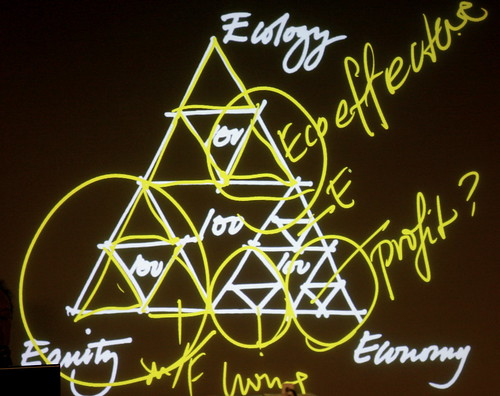
A good design should consider different factors, it can not just concentrate on its own profitability. We can conceptualize and creatively examine a proposed design based on a visualization tool. The tool is a graph of triangle. 


First, the bottom right is the area of Economy. In this area, we can think about whether a manufacturing design is based on its own profitability. If the answer is yes, then it is not a good design. Second, the area between Economy and Equity is the question about whether a manufactory pays a reasonable amount of salary to its workers? Is it good enough to maintain workers’ living standard? Third, the area of Equity, does the manufactory pay an equal salary between male and female? Fourth, the area between Equity and Ecology, will the workers absorb toxic chemicals during the production in the factory? Fifth, the top area of Ecology, does it apply the rule of nature during the process of production? Waste equals food?Finally, the area between Ecology and Economy, does the factory wants to cut down the cost of design to produce a product that will damage the environment? This is a valuable tool to help manufactories reconsider their design of products.