Mostrando entradas con la etiqueta agriculture. Mostrar todas las entradas

20 abr 2020

rob greenfield: Live simply and you will live free


Simple and Sustainable Living in My Tiny House 


Be the Change in the Messed up World | ​Rob ​Greenfield | TEDxIHEParis


My 44 Possessions: Everything I Own Fits in My Backpack | Minimalism


30 Days of Wearing My Trash


Rob Greenfield on Money, Health Insurance, Age and Death


Rob Greenfield is an adventurer, environmental activist, humanitarian, and dude making a difference. He is dedicated to leading the way to a more sustainable and just world.
Rob is the creator of The Food Waste Fiasco, a campaign that strives to end food waste and hunger in the U.S. He has dove into more than two thousand dumpsters across the United States to demonstrate how nearly half of all food in the U.S. is wasted while 50 million (1 in 7) Americans are food insecure.
Rob has cycled across the U.S. three times on a bamboo bicycle bringing his message of sustainability and earth-friendly living to the United States. His first bike ride across the U.S. is also a book, Dude Making a Difference.
In 2016 he landed in Rio, Brazil without a penny in his pocket. He was on a mission to travel to Panama, 7,000 miles and 7 countries away, while relying only on the goodness of humanity. This adventure is a six episode series called Free Ride on Discovery Channel playing worldwide. His travels have taken him to 6 continents and 45 countries.
Rob donates 100% of his media income to grassroots nonprofit organizations and his financial net worth is kept to a bare minimum. His financial vows are more than a list of resolutions, they speak to his steadfast commitment to live simply and live free. By living in this manner he aims to show that true happiness, health, and freedom do not come from an accumulation of money and possessions but rather from a deep connection to our surroundings, the earth’s resources that are freely available to us all, relationships, and love.
All of Rob’s extreme adventures and activism campaigns are meant to bring attention to important environmental and social issues and to inspire positive change. They may appear unattainable to some people but within them are an abundance of simple lessons and tips that can be adapted into any life to live in a manner that is beneficial to the earth, community, and self. Through his life he inspires others to make simple, small changes that grow into great change within them and society.
The Early Years
Rob grew up in the Northwoods of Wisconsin in the small town of Ashland and had a passion for the outdoors from a young age. He spent seven years in Boy Scouts and achieved the top rank of Eagle Scout. In 2005 he left his hometown to attend University of Wisconsin – La Crosse where he earned a Bachelors of Science with a major in Biology, minor in Chemistry, and a focus in Aquatic Science. During his summer breaks he worked 80+ hours per week selling educational books door-to-door and learned the skills of sales and marketing. In 2011 he moved to San Diego where he started his own marketing company, The Greenfield Group.
During much of Rob’s teens and early 20’s his life was focused on money, nice possessions, and the pursuit of women. He had the goal of being a millionaire by age 30. His life took a great turn when at the age of 24 he started to become aware of the environmental and social issues of his generation. He learned through books and documentaries that he was contributing to many of these problems through his daily actions including the food he was eating, the car he was driving, and the stuff he was buying and consuming. At that point he began his transformation from a Drunk Dude to Dude Making a Difference
He started with small changes such as shopping local, reducing the amount of trash he created, eating a more whole food, local diet, removing chemical products from his life, and using reusable bags and water bottles. Building on the success of these small changes he took greater leaps of change such as getting rid of his car, pulling all his money out of investments and banks harmful to the environment, and decreasing his dependency on money all together. Since he began his transformation he has adapted hundreds of small changes into his life in an effort to live for the benefit of many and to not harm the lives of any. In 2014 he canceled his last bill and since then has been living completely bill, debt, and credit card free. Over time he dissolved his company and started a nonprofit, Happy Healthy and Free.
Rob lived off the grid in a 50 square foot tiny home in San Diego, California. He grew his own food, lived purely on rain water (approximately two gallons per day), harnessed energy from the sun using solar panels, created near zero waste, and composted humanure (it is what it sounds like). After living this Teeny Greeny lifestyle for one year, Rob auctioned off his tiny house and raised enough money ($10,000) to build 10 tiny houses for people without homes in San Diego.
After five years of downsizing and simplifying his life he was down to just 111 possessions, all that fit into his backpack. He then traveled for two years in the service of others.
Rob is known by many as “The Trash man” for his month long project wherein he consumed like the average American for one month and wore all the trash he created.  The purpose of this project was to create a shocking visual of how much garbage just one person generates.
His third bike ride across the USA, Green Riders – Good Deeds on Bikes, was joined by over 30 others, planting gardens and doing good deeds across the USA.
In 2017 he moved to Orlando to embark on his current project to grow and forage 100% of his food for a year. He lives in a 100 square foot tiny house that he built with nearly exclusively second hand materials with friends. During this time, he illustrates alternatives to the wasteful globalized food system. He also explores whether it is possible to positively influence such a system while living outside it.
Rob’s adventures and his life have caught the attention of the world and he has been featured on thousands of media outlets including National Geographic, BBC, CBS This Morning, Discovery Channel, USA Today, LA Times, The Guardian, Huffington Post and many more.

Much more info at  robgreenfield.org

16 oct 2012

Life is easy


Jon Jandai -- Life is easy. 

Why do we make it so hard? Jon is a farmer from northeastern Thailand. He founded the Pun Pun Center for Self-reliance, an organic farm outside Chiang Mai, with his wife Peggy Reents in 2003. Pun Pun doubles as a center for sustainable living and seed production, aiming to bring indigenous and rare seeds back into use. It regularly hosts training on simple techniques to live more sustainably. Outside of Pun Pun, Jo is a leader in bringing the natural building movement to Thailand, appearing as a spokesperson on dozens of publications and TV programs for the past 10 years. He continually strives to find easier ways for people to fulfill their basic needs.


22 ago 2012

Eathouse (www.ateliergras.nl)


vertical aquaponic veggie & fish farm

AQUAPONICS:

Aquaponics is an integrated form of a re-circulating aquaculture system (usually, freshwater fish farming) and hydroponics. In these systems, plants within hydroponic components utilize nutrient rich fish waste as fertilizer. In doing so the plant grow area filters the wastewater — allowing for its reuse in the fish-rearing component.


This low-cost vertical aquaponic system can grow leafy greens, herbs and raise fish for a small family year round, and it fits in a 5' by 3' space. Sean Brady, the aquaponics projects coordinator at the Center for Sustainable Aquaponics and Nourish the Planet in Loveland, Colo., showed us how to build a system from scrap he found around the greenhouse. We published a version of this how-to guide at engineeringforchange.org, and it's one of the good ones, so we'd like to share it with Instructables, too.

What it is
A vertical aquaponic system grows vegetables without soil in columns above a fish tank. By growing vertically, you can produce about twice the amount of plants as you can with a hydroponic system of the same area. One five-foot tower can produce more than 200 heads of lettuce per year. And it uses a small fraction of the water needed to grow crops in soil.

The system puts fish waste to work as fertilizer for crops. A small pump draws nutrient-rich water from the fish tank to the tops of the vertical columns. The water trickles down through the roots of the plants, gathering oxygen from the air as it falls back into the tank. It releases almost no waste and, because it's soil free, there's no need for fertilizer or most pesticides.
You do have to replace lost water as needed, power the pump and feed the fish. Try raising crickets for fish food, or buy them flakes. It might not be too hard to power one of these pumps with a small solar panel or some other renewable energy. If anyone has an idea, please share.
 
For more information on aquaponics, please see CSA's and NTP's sites. 

9 abr 2012

Indian Man Single-Handedly Plants a Forest


Way back in 1953, French author Jean Giono wrote the epic tale The Man Who Planted Trees. It seemed so real that readers thought the central character, Elzeard Bouffier , was a living individual until the author clarified he had created the person only to make his readers fall in love with trees. 

Assam's Jadav Payeng has never heard of Giono's book. But he could be Bouffier. He has single-handedly grown a sprawling forest on a 550-hectare sandbar in the middle of the Brahmaputra. It now has many endangered animals, including at least five tigers, one of which bore two cubs recently.


The place lies in Jorhat, some 350 km from Guwahati by roadt. At one point on the stretch, a smaller road has to be taken for some 30 km to reach the riverbank. There, if one is lucky, boatmen will ferry you across to the north bank. A trek of another 7 km will then land you near Payeng's door. Locals call the place 'Molai Kathoni' (Molai's woods) after Payeng's pet name, Molai.

A little over 30 years ago, a teenager named Jadav "Molai" Payeng began burying seeds along a barren sandbar near his birthplace in northern India's Assam region to grow a refuge for wildlife. Not long after, he decided to dedicate his life to this endeavor, so he moved to the site where he could work full-time creating a lush new forest ecosystem. Incredibly, the spot today hosts a sprawling 1,360 acre of jungle that Payeng planted single-handedly.


The Times of India recently caught up with Payeng in his remote forest lodge to learn more about how he came to leave such an indelible mark on the landscape:

It all started way back in 1979 when floods washed a large number of snakes ashore on the sandbar. One day, after the waters had receded, Payeng , only 16 then, found the place dotted with the dead reptiles. That was the turning point of his life.


"The snakes died in the heat, without any tree cover. I sat down and wept over their lifeless forms. It was carnage . I alerted the forest department and asked them if they could grow trees there. They said nothing would grow there. Instead, they asked me to try growing bamboo. It was painful, but I did it. There was nobody to help me. Nobody was interested," says Payeng, now 47.


He watered the plants morning and evening and pruned them. After a few years, the sandbar was transformed into a bamboo thicket. "I then decided to grow proper trees. I collected and planted them. I also transported red ants from my village, and was stung many times. Red ants change the soil's properties . That was an experience," Payeng says, laughing.


Soon, there were a variety of flora and fauna which burst in the sandbar, including endangered animals like the one-horned rhino and Royal Bengal tiger. "After 12 years, we've seen vultures. Migratory birds, too, have started flocking here. Deer and cattle have attracted predators," claims Payeng . He says locals recently killed a rhino which was seen in his forest at another forest in Sibsagar district.


Payeng talks like a trained conservationist. "Nature has made a food chain; why can't we stick to it? Who would protect these animals if we, as superior beings, start hunting them?"

The Assam state forest department learnt about Payeng's forest only in 2008 when a herd of some 100 wild elephants strayed into it after a marauding spree in villages nearby. They also destroyed Payeng's hutment . It was then that assistant conservator of forests Gunin Saikia met Payeng for the first time.


"We were surprised to find such a dense forest on the sandbar. Locals, whose homes had been destroyed by the pachyderms, wanted to cut down the forest, but Payeng dared them to kill him instead. He treats the trees and animals like his own children. Seeing this, we, too, decided to pitch in," says Saikia. "We're amazed at Payeng. He has been at it for 30 years. Had he been in any other country, he would have been made a hero."


Almere by MVRDV


MVRDV presents urban plan Almere Oosterwold
inhabitants create their own neighbourhoods


Almere, Netherlands
2008/ -
Concept Structure Vision
Client: Municipality of Almere
Program: 60.000 apartments and 100.000 work places


A rich mix of initiatives with a green agricultural character


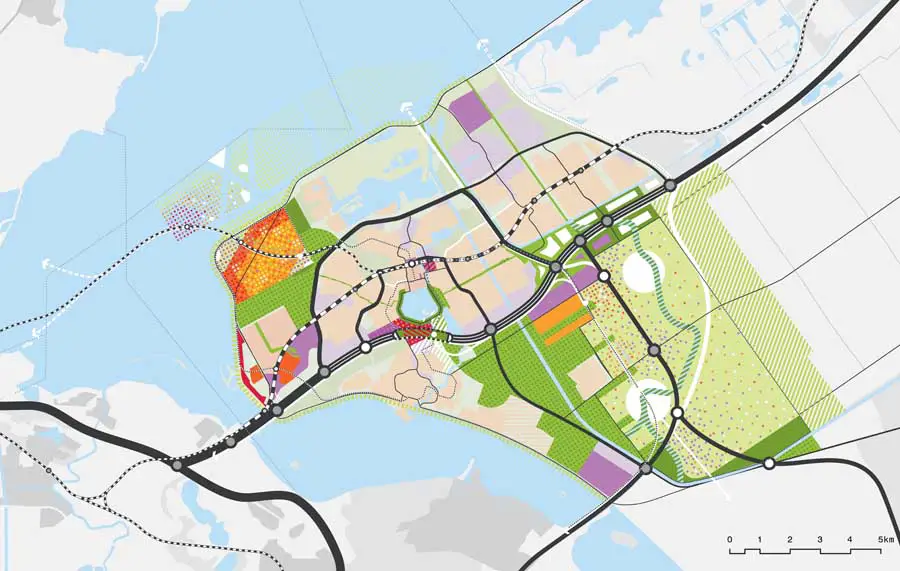
Dutch new town Almere plans to grow with 60,000 houses, 100,000 working places and all related facilities. By this Almere will grow into the fifth city of the Netherlands in an effort to relief and to offer qualities to the urbanised west of the Netherlands. MVRDV was commissioned to collaborate with the city to design a concept structure vision to accommodate this growth. 

The growth will take place in 4 main areas:

Almere IJ-land: Together with West 8 and William McDonough, MVRDV worked on the unique opportunity to design a series of urban and nature reserve islands. The new rail connection to Amsterdam and a needed ecological intervention in the IJ-lake offered the potential to propose the creation of a living area with 5,000 up to 10,000 homes, combined with this nature development. IJ-land combines ecological and infrastructural interventions with the possibility to live and work in a natural riparian environment. The island could also be part of the possible Dutch bid for the 2028 Olympic Games.

Almere Pampus: This area will combine the feeling of a coastal town with high density and make room for 20,000 homes, all streets are all leading to the boulevard at the lake. The existing maintenance harbour will be reused for leisure and floating villages. There will be a new train station with a plaza at the coast.

Almere Centre: The current centre will grow and extend to the southbank of the Weerwater , turning the central lake into the Weerwater-park and  becoming in time the cultural and economical heart of the city. On the junction of the new axis, a motorway and the rail connection the motorway will be covered which makes it possible to develop  up to 5,000 homes, offices and public amenities. The central station will be developed into an economical hub and will be surrounded with new program.  

Oosterwold: This large area in the east offers room for up to 18,000 new homes and a variety of functions such as business and retail centres. It will be developed following individual and collective initiatives, from small scale to large scale, with plots that are always surrounded by nature development, urban agriculture or local parks. The area will reserve areas for future development after 2030.


Together the proposals form the new framework to accompany the growth of the city until 2030. Together with the entire board of  city councilors and the mayor, Adri Duivesteijn, city councilor of Almere and Winy Maas of MVRDV, presented the concept structure vision to the ministers of Transport, Public Works and Water Management (V&W), Camiel Eurlings and minister of Housing, Spatial Planning and the Environment, Jacqueline Cramer (VROM) on June 26th. The design of IJland has been a collaboration with Adriaan Geuze of West8 and William McDonough of McDonough and Partners.

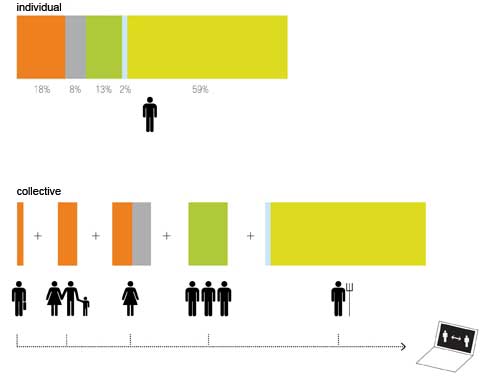
The farmland to the east of the town will be the site for this flex space, which will combine urban farming, living, and leisure. Half of it will be for food-producing farms that will feed Almere with local, sustainable foods. The rest of the space is up to the town’s residents. Under MVRDV‘s plan, the only restrictions are that the area remains 59% urban agriculture, 2% water, 13% public green space, 8% roads, and 18% construction, which will ensure that Almere Oosterworld retains its urban/rural character.

Concept: the program can be realised by an individual or divided in parts by a collective


This new urban planning system makes the government a facilitator instead of a director – it serves to help realize the wishes of the people actually living in new towns and small cities. The Dutch government and MVRDV feel that a town centered around its residents’ needs will inspire more pride and responsibility in the people who live there.


Design:
Winy Maas, Jacob van Rijs en Nathalie de Vries with Jeroen Zuidgeest and Klaas Hofman, Martine Vledder, Sabina Favaro, Hui Hsin Liao, Francesco Pasquale, Fokke Moerel, Paul Kroese, Johannes Schele, Stefan de Koning, Oana Rades, Silke Volkert, Fabian Wagner, Wouter Oostendorp, Marta Pozo,Naiara Arregi, Jaap van Dijk, Marta Gierczynska, Daniel Marmot, Pablo Munoz Paya, Di Miao, Manuel Galipeau.


+info: MVRDV

18 mar 2012

permaculture (chapter 1)

What is permaculture?


Permaculture is an approach to designing human settlements and agricultural systems that mimic the relationships found in natural ecologies.
Permaculture is sustainable land use design. This is based on ecological and biological principles, often using patterns that occur in nature to maximise effect and minimise work. Permaculture aims to create stable, productive systems that provide for human needs, harmoniously integrating the land with its inhabitants. The ecological processes of plants, animals, their nutrient cycles, climatic factors and weather cycles are all part of the picture. Inhabitants’ needs are provided for using proven technologies for food, energy, shelter and infrastructure.
Elements in a system are viewed in relationship to other elements, where the outputs of one element become the inputs of another.
Within a Permaculture system, work is minimised, “wastes” become resources, productivity and yields increase, and environments are restored.
Permaculture principles can be applied to any environment, at any scale from dense urban settlements to individual homes, from farms to entire regions.


 The origins of permaculture

Franklin Hiram King coined the term permanent agriculture in his classic book from 1911, Farmers of Forty Centuries: Or Permanent Agriculture in China, Korea and Japan. In this context, permanent agriculture is understood as agriculture that can be sustained indefinitely.

In 1929, Joseph Russell Smith took up the term as the subtitle for Tree Crops: A Permanent Agriculture, a book in which he summed up his long experience experimenting with fruits and nuts as crops for human food and animal feed. A revised and updated edition was published in 1950.[2] Smith observed, "Forest -- field -- plow -- desert -- that is the cycle of the hills under most plow agricultures... When we develop an agriculture that fits this land, it will become an almost endless vista of green, crop-yielding trees.". Smith saw the world as an inter-related whole and suggested mixed systems of trees and crops underneath.

The work of Howard T. Odum was also an early influence on Permaculture, especially for Holmgren. Odum focused on system ecology, in particular the maximum power principle, which claims that natural systems tend to maximize the energy embodied in a system. For example, the total calorific value of woodland is very high with its multitude of plants and animals. It is an efficient converter of sunlight into biomass. A wheat field, on the other hand, has much less total energy and often requires a large energy input in terms of fertilizer if the wheat and straw are harvested and removed from the field.

The definition of permanent agriculture as that which can be sustained indefinitely was supported by Australian P. A. Yeomans in the 1973 book "Water for Every Farm." who introduced an observation-based approach to land use in Australia in the 1940s, based partially on his understanding of geology. Yeomans introduced Keyline Design as a way of managing water supply and distribution. Holmgren based his EcoVillage design on the keyline principle, Other early influences were the work of Esther Deans, who pioneered No-Dig Gardening methods, and Masanobu Fukuoka who, in the late 1930s in Japan, began advocating no-till orchards, gardens and natural philosophy.

Other recent influences include the Vegetable Aquaculture and Animal enClosures (VAC) system in Vietnam which is a government-supported system to recycle resources.

In the mid 1970s, Australians Bill Mollison and David Holmgren started to develop ideas about stable agricultural systems. This was a result of rapid growth of destructive industrial-agricultural methods. They saw that these methods were poisoning the land and water, reducing biodiversity, and removing billions of tons of topsoil from previously fertile landscapes. They announced their permaculture approach with the publication of Permaculture One in 1978.

The term permaculture initially meant "permanent agriculture" but was quickly expanded to also stand for "permanent culture" as it was seen that social aspects were integral to a truly sustainable system.


After Permaculture One, Mollison further refined and developed the ideas by designing hundreds of permaculture sites and organizing this information into more detailed books. Mollison lectured in over 80 countries and taught his two-week Design Course to many hundreds of students. By the early 1980s, the concept had broadened from agricultural systems design towards complete, sustainable human habitats.
By the mid 1980s, many of the students had become successful practitioners and had themselves begun teaching the techniques they had learned. In a short period of time permaculture groups, projects, associations, and institutes were established in over one hundred countries. In 1991 a four-part Television documentary by ABC productions called "The Global Gardener" showed permaculture applied to a range of worldwide situations, bringing the concept to a much broader public.
.
The first recorded modern practice of permaculture as a systematic method was by Austrian farmer Sepp Holzer in the 1960s, but the method was scientifically developed by Australians Bill Mollison and David Holmgren and their associates during the 1970s in a series of publications.
The word permaculture is described by Mollison as a portmanteau of permanent agriculture, and permanent culture.
Both the mentor (Mollison) and the student (Holmgren) developed concepts that can help humans to create enduring agriculture systems. Since then it has been constantly developed by a huge range of people in many different countries and it is now a worldwide phenomenon with a multitude of different strands and approaches.
The intent is that, by training individuals in a core set of design principles, those individuals can design their own environments and build increasingly self-sufficient human settlements — ones that reduce society's reliance on industrial systems of production and distribution that Mollison identified as fundamentally and systematically destroying Earth's ecosystems.

While originating as an agro-ecological design theory, permaculture has developed a large international following. This "permaculture community" continues to expand on the original ideas, integrating a range of ideas of alternative culture, through a network of publications, permaculture gardens, intentional communities, training programs, and internet forums. In this way, permaculture has become a form of architecture of nature and ecology as well as an informal institution of alternative social ideals.

The principles encompass those stated in Introduction to Permaculture, by Bill Mollison & Reny Mia Slay:
  • Relative location.
  • Each element performs many functions.
  • Each important function is supported by many elements.
  • Efficient energy planning: zone, sector and slope.
  • Using biological resources.
  • Cycling of energy, nutrients, resources.
  • Small-scale intensive systems; including plant stacking and time stacking.
  • Accelerating succession and evolution.
  • Diversity; including guilds.
  • Edge effects.
  • Attitudinal principles: everything works both ways, and permaculture is information and imagination-intensive.

and those in Permaculture, a Designers' Manual, by Bill Mollison:   
  • Work with nature rather than against.
  • The problem is the solution.
  • Make the least change for the greatest possible effect.
  • The yield of a system is theoretically unlimited (or only limited by the imagination and information of the designer).
  • Everything gardens (or modifies its environment).


The Ethics of Permaculture

The ethics that underpin permaculture are:
  • Earth care
  • People care
  • Fair shares
These ethics specifically maintain that we can develop systems where the planet and its inhabitants achieve and develop a state of well-being through using resources in a balanced way. In particular, resources should not be simply frittered away in the name of personal gain and individual profit which ultimately results in the depletion and destruction of our natural eco systems.

Modern permaculture is a system design tool. It is a way of:
1. looking at a whole system or problem
2. observing how the parts relate
3. planning to mend sick systems by applying ideas learned from long-term sustainable working systems
4. seeing connections between key parts


Why Use Permaculture?

A key question in the development of a Permanent Culture is why permaculture should be central to its development and proliferation?
The answer to this is simple, modern agricultural methods and methods of taking resources from the natural world are very destructive and completely unsustainable in the long term. They are detrimental towards the survival of the land, the people, and flora and fauna that make the land their habitat. The Permaculture way of doing things still provides us with our basic needs, only without all of the profiteering, exploitation and ecological degradation that is part and parcel of Capitalism and its control of abuse of resources
Not only will permaculture and its tools help us to create sustainable agricultural systems whilst enhancing the fertility of the locale eco systems, but it is also capable of improving how we build our homes in terms of ecological architecture and building design. There are many examples of eco-build houses that work on the principles of permaculture, indeed, as permaculture has flourished and gathered momentum over the last 3 decades so too has sustainable low impact houses. There are currently communities all over the UK living in low impact homes, including the Lammas Project in Pembrokeshire, Land Matters in Devon, Tinkers Bubble in Dorset, to name but a few.


Permaculture Creates Independence

When you have no control over the basic resources that you need to survive, you are effectively a slave reliant on others to meet these needs. Often these ‘others’ are large corporations driven by money and profit and not by human needs and compassion for people. This can be plainly seen with the recent speculative trading on food that caused food riots by increasing the cost of food, thereby making it inaccessible to many. Ironically, it is often these very areas that produce large quantities of food for the rest of the world, but then cannot afford to buy the food they produce.
Having a sound grasp of permaculture can help us extricate ourselves from these issues and practices, as it provides a way to meet your needs outside of the capitalist system whilst living an ecologically sound existence. Permaculture has the ability to give us complete thus reducing reliance on those organisations whose operations we have no control over. Permaculture principles are not only about food: they can also be applied to many aspects of life.

Permaculture in Action

There are many examples of why permaculture is a sustainable alternative to the current system which has an underlying assumption of there being an unlimited pool of natural resources.
One particular project that shows precisely why permaculture should replace the capitalist model is the Greening of the Desert project that is taking place in Jordan under the guidance of Australian permaculture pioneer Geoff Lawton. This project has reclaimed an area of extremely arid desert and converted it back into fertile productive land. This land now provides members of the local community with a new and sustainable supply of resources in an area of land previously written off. The Greening of the desert project really shows that permaculture can achieve results from the most extreme landforms in terms of their usability both now and in the future.


Rising to the challenge: From built in obsolescence to a permanent culture

The temporary Culture of built-in obsolescence that is at the core of consumer capitalism puts the profit motive of a few individuals before planet and people, it takes no account of, and has no interest in the extremely negative effects it has on the ecology of the planet, and the well being of any of its inhabitants. The future cannot be a Capitalist Neoliberal one, the continual and insatiable economic growth demanded to maintain it’s economically would destroy the planet as the Banks and global financiers ask us to pay off their Debts, these debts are three times the size of our planets usable resources in terms of putting a cost to them.

In order to move away from this very serious mess that Capitalism and individual human greed has created we need ideas and practices that are the exact opposite to that which now enslaves us.
Built in obsolescence needs to be ‘Built to last’ local food groups and collectives need to flourish and shove supermarkets out of their respective areas, instead of being consumers, we should be looking at we can stop consuming. Workers need to run and manage their places of work and be valued for the experts that they are within their given field. There are a lot of issues to address in terms of bringing about a Permanent Culture, but these issues are pulled together and solutions found within permacultures ever developing storehouse of knowledge and practices.
In permaculture systems the fertility and health of a particular system is not only maintained but it is also enhanced, this is the exact opposite of agriculture where the soil loses its own fertility every year and has to feed with oil based fertilizers.
Permaculture is able to replicate natural eco systems, within a food growing context this means less work for us as each part of the eco system works together to maintain itself, less work means less energy use which equates to food production without the need of fossil fuels.
Permaculture applications are not quick-fix solutions. Its design principles insist on a slow and gradual integration as a means of developing a sustainable and resilient Permanent Culture. This makes the adoption of these models crucial as the sooner people begin to utilise permaculture principles, the more likely a smooth transition to a new way of living will occur. Within the ethics and principles of permaculture there is a possible future that is ours to mould, a future where division, exploitation and control are things of the past. Any system of ideas that has the care of the earth and people and the limitation of resources at its heart has the ability transform societies and ways of thinking that are quite literally evolutionary as opposed to the knuckle dragging savagery of Capitalism.


+ info:
http://www.permanentculturenow.com/introduction-to-permaculture/
http://codegreencommunity.com/page/permaculture-1 
http://www.permaculture.org.uk/