Mostrando entradas con la etiqueta cradle. Mostrar todas las entradas

29 dic 2018

A problem cannot be effectively solved without understanding it fully in the first place [basic carbon vocabulary - MUST READ]


Climate change is the result of breakdowns in the carbon cycle caused by us:
IT IS A DESIGN FAILURE. 
***    ***    *** 

Anthropogenic greenhouse gases in the atmosphere make airborne carbon a material in the wrong place, at the wrong dose and wrong duration

It is WE who have made carbon a toxin—like lead in our drinking water. In the right place, carbon is a resource and tool.

The world’s current carbon strategy aims to promote a goal of zero. Predominant language currently includes words such as “low carbon,” “zero carbon,” “negative carbon,” and even a “war on carbon.”

The design world needs values-based language that reflects a safe, healthy and just world. In this new paradigm, by building urban food systems and cultivating closed-loop flows of carbon nutrients, carbon can be recognized as an asset rather than a toxin, and the life-giving carbon cycle can become a model for human designs.

***    ***    *** 

The new language signals positive intentions, leading us to do more good rather than simply less bad. It identifies three categories of carbon:

  • *** Living carbon: organic, flowing in biological cycles, providing fresh food, healthy forests and fertile soil; something we want to cultivate and grow
  • *** Durable carbon: locked in stable solids such as coal and limestone or recyclable polymers that are used and reused; ranges from reusable fibers like paper and cloth, to building and infrastructure elements that can last for generations and then be reused
  • *** Fugitive carbon: has ended up somewhere unwanted and can be toxic; includes carbon dioxide released into the atmosphere by burning fossil fuels, ‘waste to energy’ plants, methane leaks, deforestation, much industrial agriculture and urban development
Working carbon is a subset of all three categories and defined as a material being put to human use. For example, working living carbon is cultivated in agricultural systems. Working durable carbon is recycled, reused and reprocessed in circular technical systems; and working fugitive carbon includes fossil fuels used for power.


The new language also identifies three strategies for carbon management and climate change:

  • *** Carbon positive: actions converting atmospheric carbon to forms that enhance soil nutrition or to durable forms such as polymers and solid aggregates; also recycling of carbon into nutrients from organic materials, food waste, compostable polymers and sewers
  • *** Carbon neutral: actions that transform or maintain carbon in durable Earth-bound forms and cycles across generations; or renewable energy such as solar, wind and hydropower that do not release carbon
  • *** Carbon negative: actions that pollute the land, water and atmosphere with various forms of carbon, for example, CO2 and methane into the atmosphere or plastics in the ocean
Offering an inspiring model for climate action begins with changing the way we talk about carbon. 

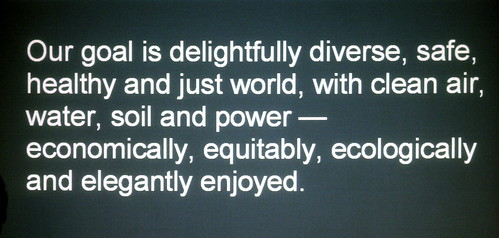
Our goal is for all to embrace this new language and work toward a Carbon Positive design framework; and in doing so we may together support a delightfully diverse, safe, healthy and just world—with clean air, soil, water and energy—that is economical, equitable, ecological, and elegantly enjoyed.

Related Articles


8 sept 2011

CRADLE TO CRADLE. CAPITULO 4. philosophy


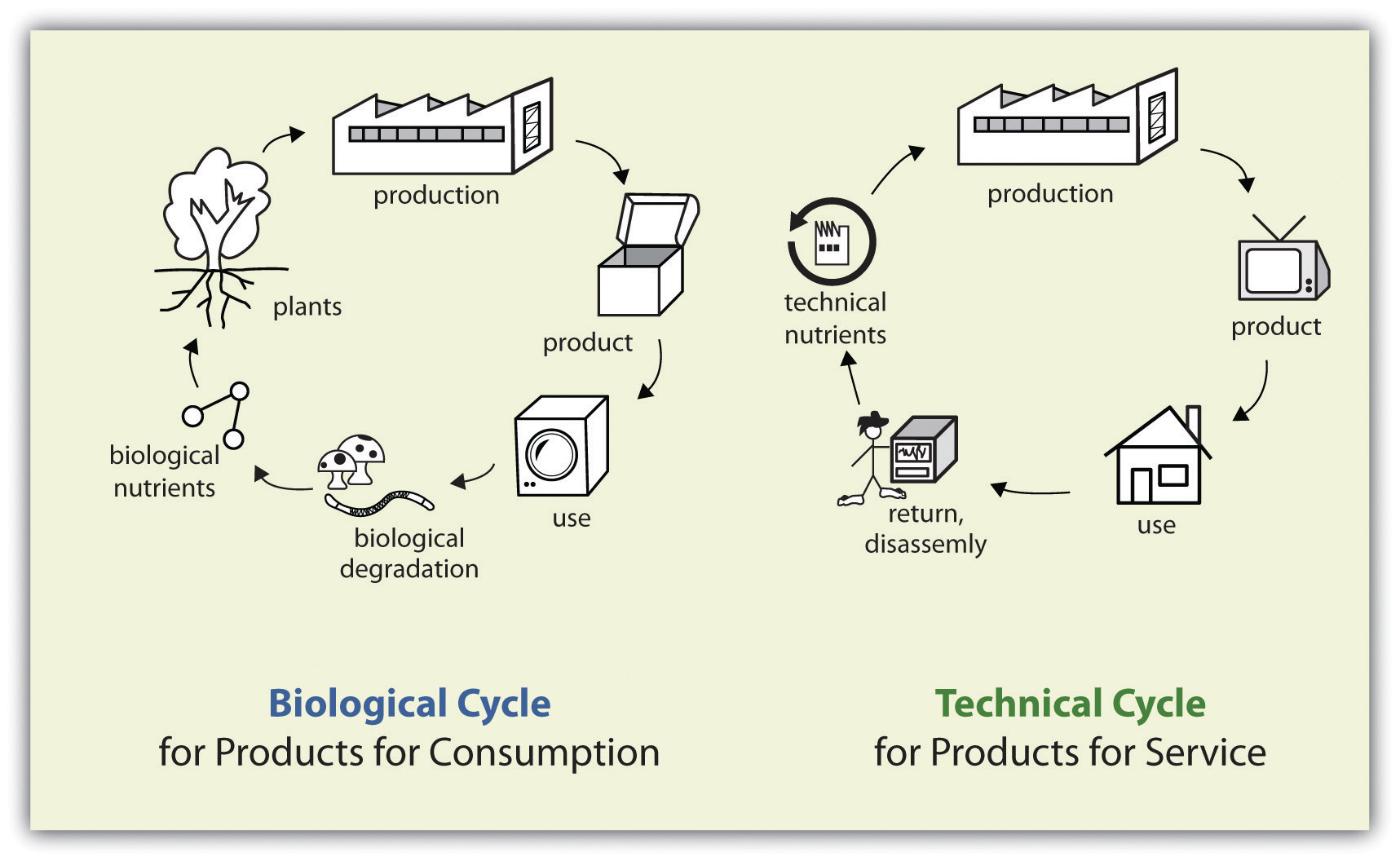
In the nature, flowers and leaves from Cherry tree fall off on the ground and become nutrients to the soil which are in turn absorbed back to plants. Ants get food from plants and also leave nutrients back to the plants. Therefore, human also can be a partner with the nature. Learn the biological cycle of the nature and make it the technical cycle.
We can design new products that can be decomposed after use and become nutrients to the Earth, or that can be reused to become a new material for a new product. No need to dispose, burn or bury under the ground; no more burden to the earth. We can color our world, not to destroy it. 


Why Being "Less bad" is No Good

After a long term of efforts, environmentalists suggested many methods that can decrease the damage to the environment from the industry. Reduce, Reuse, Recycle and Restrictions, these are the “less bad” policy. Most people think Reduceis the best method that can satisfy the ecology, but no matter how much toxic waste is reduced from the process, emission is limited or raw materials are cut down, none of them can prevent the earth from being destroyed by the waste, it just postpones the time of destruction. Even there is just a little amount of dangerous emission, it will affect the biological system and harm the world. For example, there are 100,000 people die annually in the US since 1995 because of tiny particles. No kidding.


Reuse seems to provide a means for the waste to go “away”, but if the waste contains toxic contaminants, it will come back in another form. In developing countries, people will recycle sewage sludge into animal food. Normally, the sewage sludge contains heavy metals, dioxins and endocrine disrupters. When sewage sludge is used to farm or fertilize plants, flowers or vegetables, the harmful substances would go into the animals and our body.
For recycling, is it good for the environment? It depends on what kind of items is being recycled. Most book or magazine publishers, they usually use fancy and colorful papers to attract consumers to buy their products, and they never think about environmentalism. After the fancy and colorful papers are recycled, factories need to put a large amount of bleach and other chemical processes to make them blank so that they can be reused. Also, the fibers of the recycled papers are short and less smooth than virgin paper, so small particles will be easily released into the air and inhaled into human body. Some people get allergies from newspapers because most newspapers are made from recycled paper.

Governments play as a guardian and regulator; they force companies to regulate their products to conform to their rules under punishment, but less rewards are granted to the companies who take initiatives. The point is, if they follow the rule, they need to pay more and more money to regulate their products. Therefore, companies will never be ardent to solve the problem and will not make any effort or spend more time to work for a new design. It in turn makes companies legally pollute the area by their thoughtless designs.

The concept of eco-efficiency in the public is creating more goods and services, while using fewer resources and creating less waste and pollution. Unfortunately, Eco-efficiency is not a perfect concept because it doesn’t reach deep enough. We can not rely on eco-efficiency to save the environment. In the long term, it will let the industry finish off all the resources. For instance, one of the energy-efficient building in Germany, it successfully decreases the number of the standard rate of oil used. It achieves a better insulation – less air comes into the building. On the other hand, due to smaller and lack-proof windows, it reduces air-exchange rate, and increases the poor indoor air pollution. In turn, more air-freshener machines are needed in the room and more money has to be spent on electricity. At the same time, more fossil fuel is used to transform into electrical power.

Our goal is zero waste and zero emission. “Be less bad” is a failure, because it will keep producing a bad design and destruct the environmental system.


Eco-effectiveness

For generation after generation, a Cherry Tree will grow flowers, fruits and await an animal to eat its fruit and drop down the seed somewhere else so as to grow another Cherry Tree. No one will complain the flowers falling all over the ground, and think the flowers are wasted. In fact, the flowers, fruits and leaves of a tree will decompose and break down into nutrients for soil, plants, insect and animals. This process is a zero burden to the nature. Can the house human build become a zero burden to the nature like the Cherry Tree?


Let’s compare the big energy saving eco-efficient house that human build and the house by Cherry Tree, and see if Cherry Tree can build a house like human. The human-built house will have a closed window to minimize air infiltration. A better thermal insulation system can prevent cold or warm air loss, so human will use dark-tinted glass for windows to prevent excessive use of air-conditioning as sun light directly enters the room heating up the temperature. Hence, the electricity cost is reduced, less fossil fuel energy is used by the power plant, and less emission is released and causes air pollution. As a result, the house will be energy saving and environmental friendly.

For the house built by Cherry Tree, Sun-light enters the house during the day-time. With an open and un-tinted window, fresh air will cool down and flow around the house. At night, the cool evening air will decrease the room temperature and re-fresh around house. There are layers of soil with grass covering the building roof. It can be a new home for animals and birds. Also, it can absorb rain to cool down the house temperature and prevent ultraviolet.

Both houses function as energy-efficient, but the Cherry Tree one design is more complicated for people working there.


It might sound strange to build a house by using nature system, but back in the time in Europe, there were a lot of old farms that was built with stones, wood and sod. Grass was placed on top of the roof as well. One of the projects the author did was building a garden on the roof of Chicago’s City Hall. After the project was done, Mayor Richard Daley predicted all house roofs in the whole city would become all green similar to the one of Chicago’s City Hall. The functions of the green roof are to provide a new home for many birds and other animals, cool down the temperature of the building, and flower, and to grow plant and food by natural sun light.
The good design should be:

1. Building that, like trees, produce more energy than they consume and purify their own waste water.
2. Factories that produce effluents that are drinking water.
3. Products that, when their useful life is over, do not become useless waste but can be tossed onto the ground to decompose and become food for plants and animals and nutrients for soil; or, alternately, that can return to industrial cycles to supply high-quality raw materials for new products.
4. Billions, even trillions, of dollars’ worth of material accrued for human and natural purposes each year
5. Transportation that improves the quality of life while delivering goods and services.
6. A world of abundance, not one of limits, pollutions, and waste.


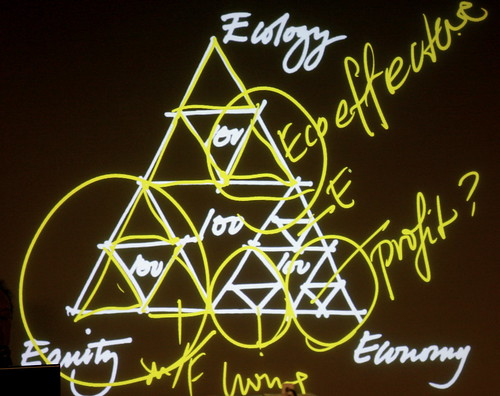
A good design should consider different factors, it can not just concentrate on its own profitability. We can conceptualize and creatively examine a proposed design based on a visualization tool. The tool is a graph of triangle. 


First, the bottom right is the area of Economy. In this area, we can think about whether a manufacturing design is based on its own profitability. If the answer is yes, then it is not a good design. Second, the area between Economy and Equity is the question about whether a manufactory pays a reasonable amount of salary to its workers? Is it good enough to maintain workers’ living standard? Third, the area of Equity, does the manufactory pay an equal salary between male and female? Fourth, the area between Equity and Ecology, will the workers absorb toxic chemicals during the production in the factory? Fifth, the top area of Ecology, does it apply the rule of nature during the process of production? Waste equals food?Finally, the area between Ecology and Economy, does the factory wants to cut down the cost of design to produce a product that will damage the environment? This is a valuable tool to help manufactories reconsider their design of products.

19 jul 2011

CRADLE TO CRADLE. CAPITULO 3. interview

You talk about the Next Industrial Revolution, where industry and environment come together in harmony. What does this look like?
It looks at the idea as Francis Crick said in 1962, that in order for something to be vital it has to have growth, it has to have a free form of energy, and it has to have an open system of chemicals. So if we think about a tree, it has to have some cells that grow, even for simple reproduction, and it has to have free energy from outside the system, in this case natural sunlight, and it needs an open system of chemicals that synthesize within its metabolism for the benefit of the organism, its reproduction, and its ecosystem.
If we saw human industry in a similar way we’d realize that there’s something relatively new in evolutionary terms that we call technical nutrition. Not just biological nutrition, which is the living thing powered by the sun and ‘consumed’ by other organisms as they breakdown (or, as we say, ‘waste equals food’), but actually seeing human artifice and technology as something that is put into the same kind of cycle. These are what we call technical nutrients. Take aluminum for example. Our species has made 680 million tons of aluminum since 1880 and we still know where 440 million tons are. So the idea would be that you would design two kinds of things, one is what we call ‘products of consumption’, those things that are literally biologically consumed and go back to soil, or ‘products of service’, things from which we want the service, but not necessarily the molecular potential. With something like a computer or a car or carpet, the user is a ‘customer’ not a ‘consumer’. These are services and in fact, when you finish with a synthetic carpet, for example, you should be able to either return it back to industry forever and remake carpets or other useful things. So biological and technical nutrition - that’s the protocol we initiated and have been continuously championing and developing.
What is the difference between eco-efficiency and what you call eco-effectiveness?
Eco-efficiency (doing more with less) as a strategy is well meaning but not necessarily adequate to the task. Being efficient means that you’re probably doing something right, in terms of using the least to do the most, but the problem is that if you’re doing the wrong thing, it might be pernicious because it perpetuates the wrong system with the erroneous thought that things are getting better. For someone to tell a company to be more eco-efficient and please make twice as many cardboard boxes out of the trees in Indonesia, sounds like a factor 2 efficiency. Even if they said make it factor 4 or factor 10, you still haven’t really solved the problem, because it’s still goodbye to Indonesian forests. Why would you use something as beautiful and as diverse as a tree for something as prosaic as a cardboard box that’s used once or even twice, and then put into a chlorine-laden ‘recycling’ loop that is actually continuously down-cycling all the materials and destroying water quality? From our design perspective, the question really needs to be, ‘With eco-efficiency, is being less bad being good, or is it simply being bad, just less so?’ With eco-effectiveness, on the other hand, we ask the question, ‘Am I doing the right thing?’ And then we start to do it efficiently, so we can create prosperity and growth.
So we’re not interested in being less bad. We’re interested in being 100% good.
Right. That means you have to design with positive principles and positive goals. Modern industrial culture doesn’t seem to have principles, except something like: ‘If brute force isn’t working, you are not using enough of it.’ While its goals are unclear, its de facto goal appears to be to create ecological and human tragedy. If you play a game, you have to have a clear goal; in chess, you’re going to take a king. So we have an end game in mind because without this strategy becomes meaningless. What we seek is a delightfully diverse, safe, healthy and just world, with clean water, air, soil and power, that is economically, equitably, ecologically, and elegantly enjoyed.
How did you get turned onto the idea of changing the world of design?
I grew up in Hong Kong, so I was in a place with four hours of water every fourth day during the dry season and six million people on forty square miles. I saw a lot of optimization of very precious resources. Then, as we went to the Pacific Northwest for the summers with my grandparents and saw astonishing abundance - fresh water, big forests, pure springs, salmon. I went from a world of extreme limits to a world of extreme abundance, and yet my grandparents were also very careful and kept the spring clean, composted organic waste, and saved rubber bands and aluminum foil and so on. So I always thought the world was something you took care of, and it hopefully got better because you were there. And I also saw in Chinese agriculture a perpetual agriculture: farmers for forty centuries farming the same piece of ground. So that was the context in which I grew up. When I came to the United States to live as a teenager, I entered a world of profligacy and seeming wanton abandon of things in a take-make-waste production system, with a cradle-to-grave ‘throw it away’ philosophy. I think this, in many ways, was the result of something I, personally, had not lived through - nuclear threat. While I was a child in Hong Kong, third graders in the U.S. were being taught how to dive under their desks because Armageddon may appear at any instant. When you sense that everything could end in an instant, you live as if there might not be a tomorrow. This became embedded in the culture - modern culture actually created geo-political and physical threats (global terrorism, weapons of mass destruction, biological warfare) that could destroy us all tomorrow - so many industrialized countries have a ‘get it while we can’ attitude rather than a continuous long-term prosperity in mind.
What goes on in a cradle-to-cradle cycle?
Cradle-to-cradle essentially says that you have an open metabolism of chemicals that are manifesting benefit for living systems or technical systems. They’re not contaminating each other and they are designed to either replace themselves in cycles or get better as they go through the system. Typically what we call recycling today is down-cycling in our lexicon. Things are actually getting lower in quality as they go through the process. Clear milk jugs will be transformed into a park bench that’s on its way to a landfill or an incinerator, getting contaminated by various additives and dyes and losing its quality through the system. We’ve been looking at nylon fibers, for example, that can be chemically recycled, and actually up-cycled. They get better as they come back and go through the new cycle because mechanical properties have been improved, thereby increasing the quality of the fiber. Essentially, cradle-to-cradle says that if things relate and can improve soil health, then we may return them to soil.
What does your fractal triangle diagram mean to you?
We use this triangle known as the Sierpinski gasket, or fractal tile, to be able to navigate the relationships between ecology, equity, and economy. It’s a fractal way of looking at the entire universe that’s self-similar. Cost, performance, and aesthetics meet life, liberty, and the pursuit of happiness!
William McDonough is an architect and co-author of Cradle to Cradle with Michael Braungart.

William McDonough Interview. March 23, 2004 - four years old and very UltraFuture. From massivechange.com

13 jun 2011

CRADLE TO CRADLE. CAPITULO 2. William McDonough

William McDonough.

William McDonough is a world-renowned architect and designer and winner of three U.S. presidential awards: the Presidential Award for Sustainable Development (1996), the National Design Award (2004); and the Presidential Green Chemistry Challenge Award (2003). Time magazine recognized him as a "Hero for the Planet" in 1999, stating that "his utopianism is grounded in a unified philosophy that—in demonstrable and practical ways—is changing the design of the world."
Mr. McDonough is the founding principal of William McDonough + Partners, Architecture and Community Design, an internationally recognized design firm practicing ecologically, socially, and economically intelligent architecture and planning in the U.S. and abroad. He is also the cofounder and principal, with German chemist Michael Braungart, of McDonough Braungart Design Chemistry (MBDC), which employs a comprehensive Cradle to Cradle design protocol to chemical benchmarking, supply-chain integration, energy and materials assessment, clean-production qualification, and sustainability issue management and optimization.

A CELEBRATION OF ABUNDANCE.......


CRADLE TO CRADLE. CAPITULO 1. LIBRO

RECOMENDACIÓN ESPECIAL de ekuazion


William McDonough's book, written with his colleague, the German chemist Michael Braungart, is a manifesto calling for the transformation of human industry through ecologically intelligent design. Through historical sketches on the roots of the industrial revolution; commentary on science, nature and society; descriptions of key design principles; and compelling examples of innovative products and business strategies already reshaping the marketplace, McDonough and Braungart make the case that an industrial system that "takes, makes and wastes" can become a creator of goods and services that generate ecological, social and economic value.
In Cradle to Cradle, McDonough and Braungart argue that the conflict between industry and the environment is not an indictment of commerce but an outgrowth of purely opportunistic design. The design of products and manufacturing systems growing out of the Industrial Revolution reflected the spirit of the day-and yielded a host of unintended yet tragic consequences.
Today, with our growing knowledge of the living earth, design can reflect a new spirit. In fact, the authors write, when designers employ the intelligence of natural systems—the effectiveness of nutrient cycling, the abundance of the sun's energy—they can create products, industrial systems, buildings, even regional plans that allow nature and commerce to fruitfully co-exist.
Cradle to Cradle maps the lineaments of McDonough and Braungart's new design paradigm, offering practical steps on how to innovate within today's economic environment. Part social history, part green business primer, part design manual, the book makes plain that the re-invention of human industry is not only within our grasp, it is our best hope for a future of sustaining prosperity.
In addition to describing the hopeful, nature-inspired design principles that are making industry both prosperous and sustainable, the book itself is a physical symbol of the changes to come. It is printed on a synthetic 'paper,' made from plastic resins and inorganic fillers, designed to look and feel like top quality paper while also being waterproof and rugged. And the book can be easily recycled in localities with systems to collect polypropylene, like that in yogurt containers. This 'treeless' book points the way toward the day when synthetic books, like many other products, can be used, recycled, and used again without losing any material quality—in cradle to cradle cycles.