Mostrando entradas con la etiqueta basura. Mostrar todas las entradas

20 abr 2020

rob greenfield: Live simply and you will live free


Simple and Sustainable Living in My Tiny House 


Be the Change in the Messed up World | ​Rob ​Greenfield | TEDxIHEParis


My 44 Possessions: Everything I Own Fits in My Backpack | Minimalism


30 Days of Wearing My Trash


Rob Greenfield on Money, Health Insurance, Age and Death


Rob Greenfield is an adventurer, environmental activist, humanitarian, and dude making a difference. He is dedicated to leading the way to a more sustainable and just world.
Rob is the creator of The Food Waste Fiasco, a campaign that strives to end food waste and hunger in the U.S. He has dove into more than two thousand dumpsters across the United States to demonstrate how nearly half of all food in the U.S. is wasted while 50 million (1 in 7) Americans are food insecure.
Rob has cycled across the U.S. three times on a bamboo bicycle bringing his message of sustainability and earth-friendly living to the United States. His first bike ride across the U.S. is also a book, Dude Making a Difference.
In 2016 he landed in Rio, Brazil without a penny in his pocket. He was on a mission to travel to Panama, 7,000 miles and 7 countries away, while relying only on the goodness of humanity. This adventure is a six episode series called Free Ride on Discovery Channel playing worldwide. His travels have taken him to 6 continents and 45 countries.
Rob donates 100% of his media income to grassroots nonprofit organizations and his financial net worth is kept to a bare minimum. His financial vows are more than a list of resolutions, they speak to his steadfast commitment to live simply and live free. By living in this manner he aims to show that true happiness, health, and freedom do not come from an accumulation of money and possessions but rather from a deep connection to our surroundings, the earth’s resources that are freely available to us all, relationships, and love.
All of Rob’s extreme adventures and activism campaigns are meant to bring attention to important environmental and social issues and to inspire positive change. They may appear unattainable to some people but within them are an abundance of simple lessons and tips that can be adapted into any life to live in a manner that is beneficial to the earth, community, and self. Through his life he inspires others to make simple, small changes that grow into great change within them and society.
The Early Years
Rob grew up in the Northwoods of Wisconsin in the small town of Ashland and had a passion for the outdoors from a young age. He spent seven years in Boy Scouts and achieved the top rank of Eagle Scout. In 2005 he left his hometown to attend University of Wisconsin – La Crosse where he earned a Bachelors of Science with a major in Biology, minor in Chemistry, and a focus in Aquatic Science. During his summer breaks he worked 80+ hours per week selling educational books door-to-door and learned the skills of sales and marketing. In 2011 he moved to San Diego where he started his own marketing company, The Greenfield Group.
During much of Rob’s teens and early 20’s his life was focused on money, nice possessions, and the pursuit of women. He had the goal of being a millionaire by age 30. His life took a great turn when at the age of 24 he started to become aware of the environmental and social issues of his generation. He learned through books and documentaries that he was contributing to many of these problems through his daily actions including the food he was eating, the car he was driving, and the stuff he was buying and consuming. At that point he began his transformation from a Drunk Dude to Dude Making a Difference
He started with small changes such as shopping local, reducing the amount of trash he created, eating a more whole food, local diet, removing chemical products from his life, and using reusable bags and water bottles. Building on the success of these small changes he took greater leaps of change such as getting rid of his car, pulling all his money out of investments and banks harmful to the environment, and decreasing his dependency on money all together. Since he began his transformation he has adapted hundreds of small changes into his life in an effort to live for the benefit of many and to not harm the lives of any. In 2014 he canceled his last bill and since then has been living completely bill, debt, and credit card free. Over time he dissolved his company and started a nonprofit, Happy Healthy and Free.
Rob lived off the grid in a 50 square foot tiny home in San Diego, California. He grew his own food, lived purely on rain water (approximately two gallons per day), harnessed energy from the sun using solar panels, created near zero waste, and composted humanure (it is what it sounds like). After living this Teeny Greeny lifestyle for one year, Rob auctioned off his tiny house and raised enough money ($10,000) to build 10 tiny houses for people without homes in San Diego.
After five years of downsizing and simplifying his life he was down to just 111 possessions, all that fit into his backpack. He then traveled for two years in the service of others.
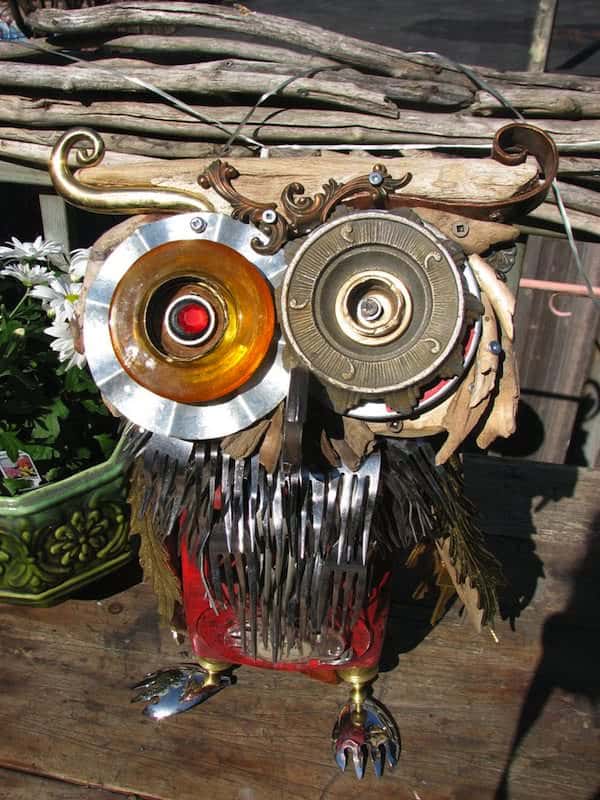
Rob is known by many as “The Trash man” for his month long project wherein he consumed like the average American for one month and wore all the trash he created.  The purpose of this project was to create a shocking visual of how much garbage just one person generates.
His third bike ride across the USA, Green Riders – Good Deeds on Bikes, was joined by over 30 others, planting gardens and doing good deeds across the USA.
In 2017 he moved to Orlando to embark on his current project to grow and forage 100% of his food for a year. He lives in a 100 square foot tiny house that he built with nearly exclusively second hand materials with friends. During this time, he illustrates alternatives to the wasteful globalized food system. He also explores whether it is possible to positively influence such a system while living outside it.
Rob’s adventures and his life have caught the attention of the world and he has been featured on thousands of media outlets including National Geographic, BBC, CBS This Morning, Discovery Channel, USA Today, LA Times, The Guardian, Huffington Post and many more.

Much more info at  robgreenfield.org

3 sept 2011

nek chand...chandigarh (India)


One day 36 years ago, Nek Chand, a humble transport official in the north Indian city of Chandigarh, began to clear a little patch of jungle to make himself a small garden area. He set stones around the little clearing and before long had sculpted a few figures recycled from materials he found at hand. Gradually Nek Chand's creation developed and grew; before long it covered several acres and comprised of hundreds of sculptures set in a series of interlinking courtyards.


After his normal working day Chand worked at night, in total secrecy for fear of being discovered by the authorities.When they did discover Chand's garden, local government officials were thrown into turmoil. The creation was completely illegal - a development in a forbidden area which by rights should be demolished. The outcome, however, was the enlightened decision to give Nek Chand a salary so that he could concentrate full-time on his work, plus a workforce of fifty labourers. Nek Chand's great work received immediate recognition and was inaugurated as The Rock Garden of Chandigarh.
Now over twenty five acres of several thousand sculptures set in large mosaic courtyards linked by walled paths and deep gorges, Nek Chand's creation also combines huge buildings with a series of interlinking waterfalls. The Rock Garden is now acknowledged as one of the modern wonders of the world. Over 5000 visitors each day, some 12 million people so far, walk around this vast creation - the greatest artistic achievement seen in India since the Taj Mahal. 


WOrld BOttle by Alfred Frederick Heineken


By the time Alfred Frederick Heineken inherited the Heineken corporation in 1951, it had grown from a small, local Amsterdam brewery to a leading brand worldwide. On a visit to Curaçao, a Caribbean island belonging to the Netherlands Antilles, in 1957, Freddy Heineken saw first-hand evidence that the locals certainly enjoyed his product — hundreds of green glass bottles littered the beaches. Glass, while a valuable resource, was not so valuable that it was worth shipping the empties all the way back to Amsterdam, though the bottles sold domestically could be cleaned and re-filled up to 30 times. The litter was not helping the brand's image.
While tourists were well catered for, and the local oil refinery brought further wealth to parts of Curaçao, society was split into different social groups, the discrepancies between which would eventually lead to protests and even riots. While the wealthy lived in beautiful houses, the poorer inhabitants — usually the local Afro-Caribbean population — had to make do with ramshackle huts piled up out of whatever could be scavenged, due to the island's lack of building materials. If they already had to use rubbish, Heineken reasoned, might they not use his rubbish, the material that he could not reasonably bring back home? And could he not find a way to make it more suitable for building houses?


Of course, the idea of using bottles to build houses was nothing new. As early as the 3rd Century AD, the Romans were embedding empty amphorae in their concrete walls to make their buildings lighter and use less material. Later, glass bottles were ubiquitous, and, before the invention of a bottle deposit, free. They offer some degree of insulation and, if not embedded fully, let light through without the need for expensive windows. Building the first course of an outside wall out of bottles set upright even prevents scorpions from climbing into the house.
For many people, using discarded bottles to make houses was a simple economic necessity. Others, especially in the USA, were built as follies and roadside attractions, as advertisements for businesses, or simply for the pleasure of their often somewhat eccentric owners and inhabitants. Buddhist monks in Thailand have even constructed an entire temple from about one million brown and green beer bottles.
However, making a straight wall out of cylindrical bottles that end in a narrower neck is a challenging process, and one that takes a lot of mortar. These mortar joints not only mean a lot of extra work and extra material, like sand, cement, and water, they also add to the weight of the finished building and create hundreds of thermal bridges


The World Bottle
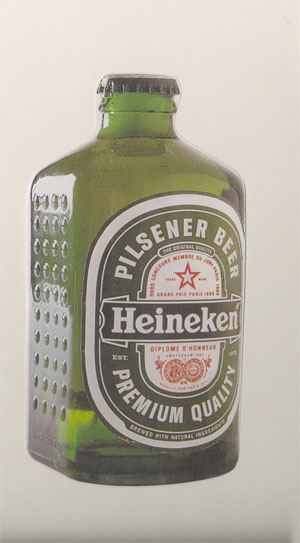
Heineken decided that the way to solve these problems was to design a bottle whose primary purpose was to be a building material, but could hold his product until it got there - the World Bottle, abbreviated 'WOBO', which he described as 'a brick that holds beer'.
The entrepreneur mentioned the idea during a business lunch with his lawyer, who said that he had a nephew who might be interested. The young architect John Habraken was hired to design the new bottle soon after. He experimented with various construction methods, hoping to find a product that would be easy to stack and not dependent on mortar — but still able to function well as a bottle.
The first prototype to be presented was of a bottle to be stacked vertically, with a long neck and a bulbous body indented at both sides to hold the neck of the next bottle. It required little material — the thickest glass would be in the relatively fragile neck — and interlocked, so that little or no mortar would be required. The Heineken marketing department shot down the idea, however, deciding that the bottle didn't look 'butch' enough, more suitable for wine than for beer.
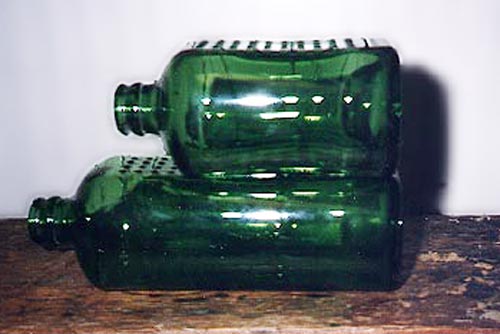
Habraken tried again with a new design — thicker, nearly rectangular, and more like a regular brick, to be stacked horizontally. The neck was short, and fit into a depression in the bottom of the next bottle; the necks faced in different directions in alternating courses to create a bond. Two sides were covered in small bumps for better grip, but this bottle still required a thin layer of mortar, cement with a silicone additive. The empty bottles could be stuffed with insulating materials like styrofoam, wool, or plant matter where light wasn't required, and openings for regular windows and doors as well as corners could be made by combining the 500ml full brick bottles with the 350ml half bricks.


In 1963, Heineken used his influence as an important client to persuade the factory that made the bottles for his brewery to interrupt their usual work. A small lot of about 60,000 bottle bricks was produced. Heineken used 1,000 of them to build a simple shed in his backyard — three metres square, one window, one door, and timber supports for the corrugated tin roof, because the bottle necks proved problematic in the junction between it and the wall. Dismantled after his death in 2002, it would remain the only WOBO house ever built, though some bricks were later used as siding for a garage and for a wall in the Heineken museum. Most of the bottles were simply lost, and are now valuable collectors' items.


A Good Idea Shot Down
Unfortunately, this new bottle design also failed to convince the Heineken marketing advisors.
They were afraid that WOBO might damage the Heineken image. Especially in America, Heineken was marketed as an upmarket product at the time. They didn’t think it was a good idea to associate it with rubbish and poor people. They thought that the only way to promote this would be to convince Marilyn Monroe to live in a WOBO-house.
— John Habraken, in an interview by Anneke Bokern
Besides the problem of the product's image, the special bottles would have been more expensive to make and transport than the regular ones, since they required more glass. The leftover beer bricks were put into storage, the production lines returned to normal, and the idea was all but forgotten.


Despite today's environmental concerns and the growing realisation that we're facing a severe shortage of resources in the near future, mountains of packaging are still carted all over the world and then simply thrown away. The United States of America, which notoriously use the most resources per capita worldwide, produce over 200 million metric tonnes of waste per year. One third of that is discarded packaging. 

But it's not just bottles and tins that are a problem. Even large packaging materials like shipping containers suffer from re-using difficulties, since it costs 40% less to manufacture a new one in China than to send an empty one back from the US. Ideally, packaging that is no longer needed can be 'upcycled', a term coined by William McDonough and Michael Braungart in their 2002 design book Cradle to Cradle to mean directly turning discarded packaging into something new and even more useful with a minimum of processing.


Though ultimately discarded, Heineken's idea seems more relevant than ever today. Perhaps it's time to recycle it.
The group Instant Architekten, based in Berlin and Zürich, received the Red Dot Design Award in 2007 for the United Bottle. They propose a new shape for the 50 billion PET bottles currently circulating in Europe, about 90% of which are currently returned, thanks to the bottle deposit. Their design looks a bit unusual at first — a nearly rectangular bottle, ridged at the top and bottom — but its advantages are soon made clear. The ridges allow the bottles to interlock when stacked, which makes them easier to carry and means that more can fit on a standard pallet. With a smooth centre left free for a large label, they could easily replace the current round bottle design on supermarket shelves.
Where it really comes into its own, however, is its secondary use: the United Bottle was created as a response to the dual problems faced in disaster-relief situations, drinking water distribution and emergency shelters. In the event of a crisis, bottles could immediately be taken to the areas where they are needed, either full or to be filled on-site — because the bottles are clear and not overly deep, they can be used for solar drinking water disinfection. They serve as water reservoirs, and, once emptied, can be filled with local materials like sand, earth, sawdust, wool, or feathers to build temporary houses to be roofed with tarps or UN tent blankets, or even more permanent structures.


26 ago 2011

basurama (capítulo 1) presentación


creatividad y basura

DESDE EKUAZION RECOMENDAMOS LA PÁGINA WEB DE BASURAMA, EN LA QUE DISFRUTAREIS DE SUS ORIGINALES FORMAS DE REIVINDICACIÓN.

SUS ACCIONES POR TODO EL PLANETA, NO DEJAN A NADIE INDIFERENTE. 
UNA INTERESANTE MANERA DE EXPONER SU VISIÓN SOBRE LOS SISTEMAS PRODUCTIVOS ACTUALES Y SUS DESHECHOS. 

ARTE, ARQUITECTURA Y MUCHO MÁS SE FUSIONAN CON CREATIVIDAD EN SUS TRABAJOS.

NO TE PIERDAS SUS VIDEOS, ALGUNOS EJEMPLOS AL FINAL DE ESTA ENTRADA.


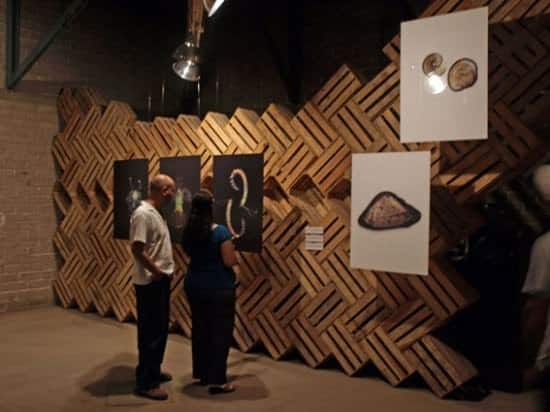
Basurama es un colectivo dedicado a la investigación, a la producción  y a la gestión cultural desde 2001 que ha centrado su área de estudio y actuación en los procesos productivos, la generación de desechos que éstos implican y sus posibilidades creativas.


Nacido en la Escuela de Arquitectura de Madrid ha ido evolucionando y adoptando nuevas formas desde sus orígenes. Pretende estudiar fenómenos inherentes a la producción masiva de basura real y virtual en la sociedad de consumo aportando nuevas visiones que actúen como generadores de pensamiento y actitud. Detecta resquicios dentro de estos procesos de generación y consumo que no sólo plantean interrogantes sobre nuestra forma de explotar los recursos, sino también sobre nuestra forma de pensar, de trabajar, de percibir la realidad.
Basurama se ha propuesto encontrar los residuos allí donde no sería tan obvio hallarlos y estudiar la basura en todos sus formatos. Con el tiempo Basurama se ha convertido en un evento pluridisciplinar en el que se desarrollan simultáneamente actividades dispares pero con un enfoque común. Tienen cabida todo tipo de talleres, ponencias, conciertos, proyecciones, concursos y edición de publicaciones. Se pretende también establecer una plataforma para que entren en contacto y trabajen juntos personajes del entramado social que ocupan lugares muy diferentes y sin embargo no están muy alejados. Basurama ha realizado proyectos en Bruselas, San Sebastián, São Paulo, Linz, Caracas, Palma de Mallorca, Corea, México DF, Santo Domingo, Buenos Aires, Lima y tiene su base en Madrid.


presentación de basurama


VIDEOS DE PROYECTOS:

diseño de sobra: workshop y Seoul


spermola sobre ruedas


110% sostenible:capítulo 64 Murcia


Taller en Brasilia
 I love M30


RUS Santo Domingo: Tsunami de Basura