Mostrando entradas con la etiqueta reacciones. Mostrar todas las entradas

18 dic 2015

ABETENIM SECONDARY SCHOOL PROJECT: Updates


The preliminary design of Abetenim Community Secondary School is completed. Please, take a look!


THE BUILDING CHALLENGE! 
Next step is the building workshops to begin the construction of the units of the rural community school with community labor. To do this, Nka Foundation is issuing a building challenge to architecture schools/firms, building workshop leaders, service learning school teams, humanitarian organizations, construction volunteers and others around the world to join hands with us to make this community school project happen for the village of Abetenim. Some of the units in the preliminary site plan are not finalized, each building workshop may refine or create own design. Together, we will help 600 rural youths gain access to quality education and a better future.

Now, we are crowdfunding to cover costs of building materials and tools to get some of the units up. See it: https://www.gofundme.com/bxbzyjfy Please, spread the word as far as you can and tell your friends and others in your networks about this project on Facebook, Twitter, Email and everywhere else. It’d be great if you could consider writing a post about the school building, sharing it with your followers, or even donating. Everybody can help, donation amount starts from $1. Donate what you can. If you are interested in leading a building workshop or volunteering on the construction, email us via info@nkafoundation.org / www.nkafoundation.org


16 nov 2015

school @ Abetenim, Ghana


At Abetenim, Nka Foundation is building an arts village to provide stable places for arts and design practitioners from the region and other countries to live, work, learn and create. We are building the arts village by exploring what resources the community already has, such as red earth and vernacular methods of construction and by mobilizing these rural assets to design and build modern mud houses.
With the help of international partners, volunteers and donations from the international public, the Foundation has helped the Abetenim community to build a junior secondary school and kindergarden units. The population of Abetenim and the surounding villages is in the increase. Seeing that a senior secondary school is now needed, the community has marked a10-acre site, if Nka could raise the funds for the construction of the first buildings to get the senior secondary school open to its first class of the envisaged 600 student poulation. Though the construction will be by community labor, the fund is needed for materials and other site-based expenses. The community really needs the help. Will you join us in giving these rural students the best opportunities available? 


Site Plan of the School by Nilesh Patel, Australia


Abetenim is a village in the Ejisu-Juaben District (http://ejisujuaben.ghanadistricts.gov.gh) in the Ashanti Region of Ghana. The standard of living is rather low. The village is dotted by mud houses, built in ways that tell of abject economic poverty. More than 75% of the people in Abetenim live below the poverty line as defined by the United Nations by subsisting on less than $2USD per day. So, please donate to this cause, share the campaign, and help us build this school!   

 Abetenim

Give Hope. Change Lives

Education is a foundation for rural development! Today, the population of the population of the Abetenim is about 1,000 people, with 60% of them between the ages of 1 to 25 years. About 98% of the adults in the village are unable to read or write proficiently because they did not gain elementary school education. Nka Foundation wants to assist the community to build a senior secondary school in order to cultivate new generations who will help drive the development of their community. We focus on the education of the younger generation in view that in the next 10 to 15 years, the youth of today (9- to 15-year olds) will be educated adult leaders in the community, who will in turn influence the upcoming generation. In light of this, we recruited a design team of architects, engineers and designers from www.onlinevolunteering.org to help us design the school, to be built incrementally. That means, the school will be built in phases over the next five years. Now, we are crowdfunding to raise money for the construction of the first phase involving classrooms, staff room and offices to get the school started by August 2016. 

We Can’t do it alone! And You Can Help!

We've got the land, architectural drawing, community labor, students and teachers; now we initially need $20,000 to transform our vision into reality. This is why we are here asking you to support our efforts by donating money, time or you can come to volunteer at the construction site in Ghana for 1 week or more from April 2 to December 31, 2016. Together, we will build a school that will impact the lives of those growing up in poverty, their children, and generations to come.

How YOU Can Help

By making a pledge! There’s no getting around it. It works in partnerships.  So, take a look at the rewards we offer and sow a seed by donating generously and help us to reach that goal! Every bit counts! And of course, you can increase your pledge at any time. Our goal for the school’s first phase is to raise at least €21,900.  €20,000 to cover materials and other construction expenses for the first four buildings AND the small fee charged by the funding platform and costs of getting out rewards to donors. We expect to reach our funding goal, even exceed it. Should we exceed our goal, things get even more exciting. We will move on to the second phase of the school construction. 

Charitable Matching? Yes, Everything Helps!

If your company does charitable matching, we would encourage you to submit your generous donation to help accelerate our fundraising. Your donation could do twice as much! You can email info@nkafoundation.org for the TaxID number for your paperwork.

What Your Corporate Donations Can Do

The project is offering naming opportunities for philanthrophists and corporations looking to invest in the lives of the younger generations. Be a part of this! Let’s create change where it is most needed.  Any of the naming opportunities can be dedicated in the names of individuals, families, foundations, or corporations of your choosing. They’ll make great Christmas presents! You will have to send us the name of your choice and we will engrave it and afix it permanently on the Wall of Donor in the administrative building in the school. And if you allow us, we will post another engrave plate on that name at the entrance to the unit that you donation helped build. Your pledge can be fulfilled over the course of a single year or several years, whichever you prefer. If you are a millionaire, who can give to the poor, adopt this school building project. Remember, we are a nonprofit organization. Every penny we raise goes toward funding our projects.

  • $2,000 - Classroom, 12 naming opportunities available.

  • $5,000 - Dormitory Room, 8 naming opportunities available

  • $10,000 - Science Labs, 3 naming opportunities available (Physics, Chemistry, and Biology Labs)

  • $15,000 – School Cafeteria, 1 naming opportunity available

  • $20,000 – Administrative Building, 1 naming opportunities available (offices, a large teachers room, visitors lounge and a Sick Bay.

  • $30,000 - Library, 1 naming opportunity available


Other Ways You Can Help

Here are other ways you can help us reach our target:
(1) Spread the word about the campaign to your own networks. It doesn’t take much time to send a tweet, update your Facebook status or email to a colleague about this project. Ask them to share about this campaign and encourage their friends and colleagues to back us too. Together, we can sow a seed to change the rural world.
(2) Be Our Ambassador at the Christmas Celebrations: Tell your family members, friends and colleagues that instead of giving you a Christmas present that they can make a donation to this project on your behalf.
(3) Come to Abetenim and Help us! We would like to invite mission teams, builders Without Borders, engineers without borders, Youth Without Borders, sans frontières, school teams, and others who would be interested in traveling to Ghana to participate in the construction of the school. If interested, please email us for an invitation. It is not all work! The weekends can be used for cultural excursions, sight-seeing trips to national parks for the wildlife or for attending community events such as weddings, religeous functons, funerals, and festivals. If you are an entrepreneur or an indigenous arts advocate, you can spend the rest of the period collaborating with indigenous musicians, storytellers, weavers, bronze casters, leather workers, or contemporary practitioners.
Make sure to follow us on twitter @ nkaprojects and use the #Abetenim hashtag! If you would like to make a monthly donation, volunteer, or do an internship on this school project for university credits, please send us an e-mail to info@nkafoundation.org / www.nkafoundation.org. 
Thanks in advance for your generosity, or as they say in the Ashanti Region:  
MEDA WO ASE!


REWARDS

For $1 or more

THANK YO! Card for supporting our school project + photo updates on the project

 For $25 or more

We will take a picture of whatever you would like to see of Abetenim and nearby villages i.e. the sunrise, moon as it looks, children at play, a laughing/smiling face, palm oil processing, cocoa trees, a shadow … so go ahead send us your request. We exhibit all of the pics on our Facebook and we will email you the picture you requested.
  

For $50 or more

You will receive a copy of a short film documenting the challenges and successes of this project + we'll list you as a donor in the credits line in the film + all of the rewards in any of the above contribution levels.


For $70 or more

EXCLUSIVE PHOTO ALBUM (min. 50 images) detailing the program and the participants + Glass Beads Necklace + all of the rewards in any of the above contribution levels.


 For $100 or more

YOU ARE AWESOME!    In addition to the above, you will receive a guest certificate of appreciation that guarantees donor a 2-day stay in Abetenim to see the project you helped fund. This offer is redeemable until November 8, 2018 + all of the rewards in any of the above contribution levels.

For $2,000

The "yourname" Dormitory!  We will reward you with the opportunity to name a school dormitory after you, or another name of your choice. We will engrave the name on a plate and put it on our Wall of Donors in the school. And we will issue you a Certificate of Appreciation that guarantees donor a 3-day stay in Abetenim to see the project you helped fund. Offer is transferable, so it will make a unique Christmas gift.

For $5,000

The "yourname" Classroom!   We will reward you with the opportunity to name one classroom after you, or another name of your choice. We will engrave the name on two plates and put one on our Wall of Donors and the other plate inside the unit that your donation helped build. 

 For $10,000

SCHOOL PROJECT BOARD MEMBER! and we will reward you with the opportunity to name one of the Science Labs, (Physics, Chemistry or Biology) after you, or another name of your choice. We will engrave the name on two plates and put one on our Wall of Donors and the other at the entrance to the unit that your donation helped build. You are welcome to join ourSchool Board of Advisors to guide, counsel and advise the school for educational growth.

For $15,000

DREAM MAKER!  We will reward you with the opportunity to name the School Cafeteria after you or your company. We will engrave the name on two plates for our Wall of Donors and forthe entrance to the Cafeteria. PLUS  a mixed-media painting on canvas by an African artist, a keepsake and reminder to you that you help make the Abetenim dream school come. The minimum resale value of each painting is $600.

For $20,000

YOU ARE REALLY AMAZING!   You will receive the opportunity to name the school’s administrative building after you or your company PLUS a mixed-media painting on canvas by an African artist, a keepsake from the arts village in recognition of your pioneering help. The minimum resale value of painting is $600. We are inviting you be our special guest at the dedication ceremony in a Durbar to clelebrate the completion of the school building project.

For $30,000

GUEST OF HONOUR INVITATION!   We will name the school library after you or your company. If you allow us, we will ship to you a mixed-media painting on canvas by an African artist, a keepsake for your awesome contribution. You will be on our School Board of Advisors and you are much welcome as the Guest of Honor at the dedication ceremony in a Durbar to clelebrate the completion of the school building project. This invitation includes one-week accommodation and food at Abetenim town and a guided tour of regional sites.

More info at NKA foundations or eKuazion

18 mar 2012

permaculture (chapter 1)

What is permaculture?


Permaculture is an approach to designing human settlements and agricultural systems that mimic the relationships found in natural ecologies.
Permaculture is sustainable land use design. This is based on ecological and biological principles, often using patterns that occur in nature to maximise effect and minimise work. Permaculture aims to create stable, productive systems that provide for human needs, harmoniously integrating the land with its inhabitants. The ecological processes of plants, animals, their nutrient cycles, climatic factors and weather cycles are all part of the picture. Inhabitants’ needs are provided for using proven technologies for food, energy, shelter and infrastructure.
Elements in a system are viewed in relationship to other elements, where the outputs of one element become the inputs of another.
Within a Permaculture system, work is minimised, “wastes” become resources, productivity and yields increase, and environments are restored.
Permaculture principles can be applied to any environment, at any scale from dense urban settlements to individual homes, from farms to entire regions.


 The origins of permaculture

Franklin Hiram King coined the term permanent agriculture in his classic book from 1911, Farmers of Forty Centuries: Or Permanent Agriculture in China, Korea and Japan. In this context, permanent agriculture is understood as agriculture that can be sustained indefinitely.

In 1929, Joseph Russell Smith took up the term as the subtitle for Tree Crops: A Permanent Agriculture, a book in which he summed up his long experience experimenting with fruits and nuts as crops for human food and animal feed. A revised and updated edition was published in 1950.[2] Smith observed, "Forest -- field -- plow -- desert -- that is the cycle of the hills under most plow agricultures... When we develop an agriculture that fits this land, it will become an almost endless vista of green, crop-yielding trees.". Smith saw the world as an inter-related whole and suggested mixed systems of trees and crops underneath.

The work of Howard T. Odum was also an early influence on Permaculture, especially for Holmgren. Odum focused on system ecology, in particular the maximum power principle, which claims that natural systems tend to maximize the energy embodied in a system. For example, the total calorific value of woodland is very high with its multitude of plants and animals. It is an efficient converter of sunlight into biomass. A wheat field, on the other hand, has much less total energy and often requires a large energy input in terms of fertilizer if the wheat and straw are harvested and removed from the field.

The definition of permanent agriculture as that which can be sustained indefinitely was supported by Australian P. A. Yeomans in the 1973 book "Water for Every Farm." who introduced an observation-based approach to land use in Australia in the 1940s, based partially on his understanding of geology. Yeomans introduced Keyline Design as a way of managing water supply and distribution. Holmgren based his EcoVillage design on the keyline principle, Other early influences were the work of Esther Deans, who pioneered No-Dig Gardening methods, and Masanobu Fukuoka who, in the late 1930s in Japan, began advocating no-till orchards, gardens and natural philosophy.

Other recent influences include the Vegetable Aquaculture and Animal enClosures (VAC) system in Vietnam which is a government-supported system to recycle resources.

In the mid 1970s, Australians Bill Mollison and David Holmgren started to develop ideas about stable agricultural systems. This was a result of rapid growth of destructive industrial-agricultural methods. They saw that these methods were poisoning the land and water, reducing biodiversity, and removing billions of tons of topsoil from previously fertile landscapes. They announced their permaculture approach with the publication of Permaculture One in 1978.

The term permaculture initially meant "permanent agriculture" but was quickly expanded to also stand for "permanent culture" as it was seen that social aspects were integral to a truly sustainable system.


After Permaculture One, Mollison further refined and developed the ideas by designing hundreds of permaculture sites and organizing this information into more detailed books. Mollison lectured in over 80 countries and taught his two-week Design Course to many hundreds of students. By the early 1980s, the concept had broadened from agricultural systems design towards complete, sustainable human habitats.
By the mid 1980s, many of the students had become successful practitioners and had themselves begun teaching the techniques they had learned. In a short period of time permaculture groups, projects, associations, and institutes were established in over one hundred countries. In 1991 a four-part Television documentary by ABC productions called "The Global Gardener" showed permaculture applied to a range of worldwide situations, bringing the concept to a much broader public.
.
The first recorded modern practice of permaculture as a systematic method was by Austrian farmer Sepp Holzer in the 1960s, but the method was scientifically developed by Australians Bill Mollison and David Holmgren and their associates during the 1970s in a series of publications.
The word permaculture is described by Mollison as a portmanteau of permanent agriculture, and permanent culture.
Both the mentor (Mollison) and the student (Holmgren) developed concepts that can help humans to create enduring agriculture systems. Since then it has been constantly developed by a huge range of people in many different countries and it is now a worldwide phenomenon with a multitude of different strands and approaches.
The intent is that, by training individuals in a core set of design principles, those individuals can design their own environments and build increasingly self-sufficient human settlements — ones that reduce society's reliance on industrial systems of production and distribution that Mollison identified as fundamentally and systematically destroying Earth's ecosystems.

While originating as an agro-ecological design theory, permaculture has developed a large international following. This "permaculture community" continues to expand on the original ideas, integrating a range of ideas of alternative culture, through a network of publications, permaculture gardens, intentional communities, training programs, and internet forums. In this way, permaculture has become a form of architecture of nature and ecology as well as an informal institution of alternative social ideals.

The principles encompass those stated in Introduction to Permaculture, by Bill Mollison & Reny Mia Slay:
  • Relative location.
  • Each element performs many functions.
  • Each important function is supported by many elements.
  • Efficient energy planning: zone, sector and slope.
  • Using biological resources.
  • Cycling of energy, nutrients, resources.
  • Small-scale intensive systems; including plant stacking and time stacking.
  • Accelerating succession and evolution.
  • Diversity; including guilds.
  • Edge effects.
  • Attitudinal principles: everything works both ways, and permaculture is information and imagination-intensive.

and those in Permaculture, a Designers' Manual, by Bill Mollison:   
  • Work with nature rather than against.
  • The problem is the solution.
  • Make the least change for the greatest possible effect.
  • The yield of a system is theoretically unlimited (or only limited by the imagination and information of the designer).
  • Everything gardens (or modifies its environment).


The Ethics of Permaculture

The ethics that underpin permaculture are:
  • Earth care
  • People care
  • Fair shares
These ethics specifically maintain that we can develop systems where the planet and its inhabitants achieve and develop a state of well-being through using resources in a balanced way. In particular, resources should not be simply frittered away in the name of personal gain and individual profit which ultimately results in the depletion and destruction of our natural eco systems.

Modern permaculture is a system design tool. It is a way of:
1. looking at a whole system or problem
2. observing how the parts relate
3. planning to mend sick systems by applying ideas learned from long-term sustainable working systems
4. seeing connections between key parts


Why Use Permaculture?

A key question in the development of a Permanent Culture is why permaculture should be central to its development and proliferation?
The answer to this is simple, modern agricultural methods and methods of taking resources from the natural world are very destructive and completely unsustainable in the long term. They are detrimental towards the survival of the land, the people, and flora and fauna that make the land their habitat. The Permaculture way of doing things still provides us with our basic needs, only without all of the profiteering, exploitation and ecological degradation that is part and parcel of Capitalism and its control of abuse of resources
Not only will permaculture and its tools help us to create sustainable agricultural systems whilst enhancing the fertility of the locale eco systems, but it is also capable of improving how we build our homes in terms of ecological architecture and building design. There are many examples of eco-build houses that work on the principles of permaculture, indeed, as permaculture has flourished and gathered momentum over the last 3 decades so too has sustainable low impact houses. There are currently communities all over the UK living in low impact homes, including the Lammas Project in Pembrokeshire, Land Matters in Devon, Tinkers Bubble in Dorset, to name but a few.


Permaculture Creates Independence

When you have no control over the basic resources that you need to survive, you are effectively a slave reliant on others to meet these needs. Often these ‘others’ are large corporations driven by money and profit and not by human needs and compassion for people. This can be plainly seen with the recent speculative trading on food that caused food riots by increasing the cost of food, thereby making it inaccessible to many. Ironically, it is often these very areas that produce large quantities of food for the rest of the world, but then cannot afford to buy the food they produce.
Having a sound grasp of permaculture can help us extricate ourselves from these issues and practices, as it provides a way to meet your needs outside of the capitalist system whilst living an ecologically sound existence. Permaculture has the ability to give us complete thus reducing reliance on those organisations whose operations we have no control over. Permaculture principles are not only about food: they can also be applied to many aspects of life.

Permaculture in Action

There are many examples of why permaculture is a sustainable alternative to the current system which has an underlying assumption of there being an unlimited pool of natural resources.
One particular project that shows precisely why permaculture should replace the capitalist model is the Greening of the Desert project that is taking place in Jordan under the guidance of Australian permaculture pioneer Geoff Lawton. This project has reclaimed an area of extremely arid desert and converted it back into fertile productive land. This land now provides members of the local community with a new and sustainable supply of resources in an area of land previously written off. The Greening of the desert project really shows that permaculture can achieve results from the most extreme landforms in terms of their usability both now and in the future.


Rising to the challenge: From built in obsolescence to a permanent culture

The temporary Culture of built-in obsolescence that is at the core of consumer capitalism puts the profit motive of a few individuals before planet and people, it takes no account of, and has no interest in the extremely negative effects it has on the ecology of the planet, and the well being of any of its inhabitants. The future cannot be a Capitalist Neoliberal one, the continual and insatiable economic growth demanded to maintain it’s economically would destroy the planet as the Banks and global financiers ask us to pay off their Debts, these debts are three times the size of our planets usable resources in terms of putting a cost to them.

In order to move away from this very serious mess that Capitalism and individual human greed has created we need ideas and practices that are the exact opposite to that which now enslaves us.
Built in obsolescence needs to be ‘Built to last’ local food groups and collectives need to flourish and shove supermarkets out of their respective areas, instead of being consumers, we should be looking at we can stop consuming. Workers need to run and manage their places of work and be valued for the experts that they are within their given field. There are a lot of issues to address in terms of bringing about a Permanent Culture, but these issues are pulled together and solutions found within permacultures ever developing storehouse of knowledge and practices.
In permaculture systems the fertility and health of a particular system is not only maintained but it is also enhanced, this is the exact opposite of agriculture where the soil loses its own fertility every year and has to feed with oil based fertilizers.
Permaculture is able to replicate natural eco systems, within a food growing context this means less work for us as each part of the eco system works together to maintain itself, less work means less energy use which equates to food production without the need of fossil fuels.
Permaculture applications are not quick-fix solutions. Its design principles insist on a slow and gradual integration as a means of developing a sustainable and resilient Permanent Culture. This makes the adoption of these models crucial as the sooner people begin to utilise permaculture principles, the more likely a smooth transition to a new way of living will occur. Within the ethics and principles of permaculture there is a possible future that is ours to mould, a future where division, exploitation and control are things of the past. Any system of ideas that has the care of the earth and people and the limitation of resources at its heart has the ability transform societies and ways of thinking that are quite literally evolutionary as opposed to the knuckle dragging savagery of Capitalism.


+ info:
http://www.permanentculturenow.com/introduction-to-permaculture/
http://codegreencommunity.com/page/permaculture-1 
http://www.permaculture.org.uk/

3 sept 2011

WOrld BOttle by Alfred Frederick Heineken


By the time Alfred Frederick Heineken inherited the Heineken corporation in 1951, it had grown from a small, local Amsterdam brewery to a leading brand worldwide. On a visit to Curaçao, a Caribbean island belonging to the Netherlands Antilles, in 1957, Freddy Heineken saw first-hand evidence that the locals certainly enjoyed his product — hundreds of green glass bottles littered the beaches. Glass, while a valuable resource, was not so valuable that it was worth shipping the empties all the way back to Amsterdam, though the bottles sold domestically could be cleaned and re-filled up to 30 times. The litter was not helping the brand's image.
While tourists were well catered for, and the local oil refinery brought further wealth to parts of Curaçao, society was split into different social groups, the discrepancies between which would eventually lead to protests and even riots. While the wealthy lived in beautiful houses, the poorer inhabitants — usually the local Afro-Caribbean population — had to make do with ramshackle huts piled up out of whatever could be scavenged, due to the island's lack of building materials. If they already had to use rubbish, Heineken reasoned, might they not use his rubbish, the material that he could not reasonably bring back home? And could he not find a way to make it more suitable for building houses?


Of course, the idea of using bottles to build houses was nothing new. As early as the 3rd Century AD, the Romans were embedding empty amphorae in their concrete walls to make their buildings lighter and use less material. Later, glass bottles were ubiquitous, and, before the invention of a bottle deposit, free. They offer some degree of insulation and, if not embedded fully, let light through without the need for expensive windows. Building the first course of an outside wall out of bottles set upright even prevents scorpions from climbing into the house.
For many people, using discarded bottles to make houses was a simple economic necessity. Others, especially in the USA, were built as follies and roadside attractions, as advertisements for businesses, or simply for the pleasure of their often somewhat eccentric owners and inhabitants. Buddhist monks in Thailand have even constructed an entire temple from about one million brown and green beer bottles.
However, making a straight wall out of cylindrical bottles that end in a narrower neck is a challenging process, and one that takes a lot of mortar. These mortar joints not only mean a lot of extra work and extra material, like sand, cement, and water, they also add to the weight of the finished building and create hundreds of thermal bridges


The World Bottle
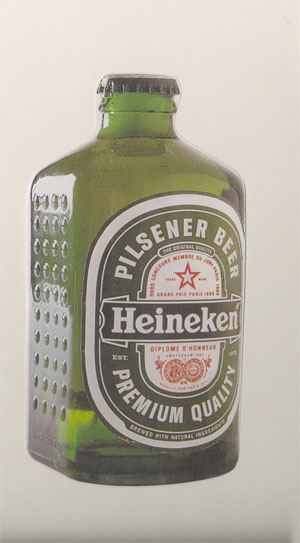
Heineken decided that the way to solve these problems was to design a bottle whose primary purpose was to be a building material, but could hold his product until it got there - the World Bottle, abbreviated 'WOBO', which he described as 'a brick that holds beer'.
The entrepreneur mentioned the idea during a business lunch with his lawyer, who said that he had a nephew who might be interested. The young architect John Habraken was hired to design the new bottle soon after. He experimented with various construction methods, hoping to find a product that would be easy to stack and not dependent on mortar — but still able to function well as a bottle.
The first prototype to be presented was of a bottle to be stacked vertically, with a long neck and a bulbous body indented at both sides to hold the neck of the next bottle. It required little material — the thickest glass would be in the relatively fragile neck — and interlocked, so that little or no mortar would be required. The Heineken marketing department shot down the idea, however, deciding that the bottle didn't look 'butch' enough, more suitable for wine than for beer.
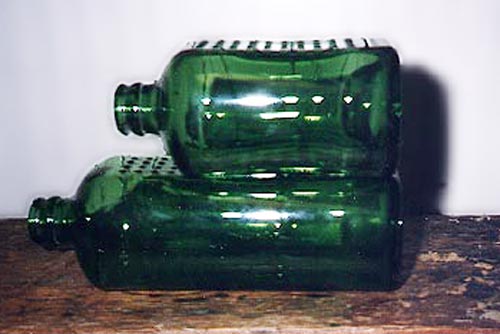
Habraken tried again with a new design — thicker, nearly rectangular, and more like a regular brick, to be stacked horizontally. The neck was short, and fit into a depression in the bottom of the next bottle; the necks faced in different directions in alternating courses to create a bond. Two sides were covered in small bumps for better grip, but this bottle still required a thin layer of mortar, cement with a silicone additive. The empty bottles could be stuffed with insulating materials like styrofoam, wool, or plant matter where light wasn't required, and openings for regular windows and doors as well as corners could be made by combining the 500ml full brick bottles with the 350ml half bricks.


In 1963, Heineken used his influence as an important client to persuade the factory that made the bottles for his brewery to interrupt their usual work. A small lot of about 60,000 bottle bricks was produced. Heineken used 1,000 of them to build a simple shed in his backyard — three metres square, one window, one door, and timber supports for the corrugated tin roof, because the bottle necks proved problematic in the junction between it and the wall. Dismantled after his death in 2002, it would remain the only WOBO house ever built, though some bricks were later used as siding for a garage and for a wall in the Heineken museum. Most of the bottles were simply lost, and are now valuable collectors' items.


A Good Idea Shot Down
Unfortunately, this new bottle design also failed to convince the Heineken marketing advisors.
They were afraid that WOBO might damage the Heineken image. Especially in America, Heineken was marketed as an upmarket product at the time. They didn’t think it was a good idea to associate it with rubbish and poor people. They thought that the only way to promote this would be to convince Marilyn Monroe to live in a WOBO-house.
— John Habraken, in an interview by Anneke Bokern
Besides the problem of the product's image, the special bottles would have been more expensive to make and transport than the regular ones, since they required more glass. The leftover beer bricks were put into storage, the production lines returned to normal, and the idea was all but forgotten.


Despite today's environmental concerns and the growing realisation that we're facing a severe shortage of resources in the near future, mountains of packaging are still carted all over the world and then simply thrown away. The United States of America, which notoriously use the most resources per capita worldwide, produce over 200 million metric tonnes of waste per year. One third of that is discarded packaging. 

But it's not just bottles and tins that are a problem. Even large packaging materials like shipping containers suffer from re-using difficulties, since it costs 40% less to manufacture a new one in China than to send an empty one back from the US. Ideally, packaging that is no longer needed can be 'upcycled', a term coined by William McDonough and Michael Braungart in their 2002 design book Cradle to Cradle to mean directly turning discarded packaging into something new and even more useful with a minimum of processing.


Though ultimately discarded, Heineken's idea seems more relevant than ever today. Perhaps it's time to recycle it.
The group Instant Architekten, based in Berlin and Zürich, received the Red Dot Design Award in 2007 for the United Bottle. They propose a new shape for the 50 billion PET bottles currently circulating in Europe, about 90% of which are currently returned, thanks to the bottle deposit. Their design looks a bit unusual at first — a nearly rectangular bottle, ridged at the top and bottom — but its advantages are soon made clear. The ridges allow the bottles to interlock when stacked, which makes them easier to carry and means that more can fit on a standard pallet. With a smooth centre left free for a large label, they could easily replace the current round bottle design on supermarket shelves.
Where it really comes into its own, however, is its secondary use: the United Bottle was created as a response to the dual problems faced in disaster-relief situations, drinking water distribution and emergency shelters. In the event of a crisis, bottles could immediately be taken to the areas where they are needed, either full or to be filled on-site — because the bottles are clear and not overly deep, they can be used for solar drinking water disinfection. They serve as water reservoirs, and, once emptied, can be filled with local materials like sand, earth, sawdust, wool, or feathers to build temporary houses to be roofed with tarps or UN tent blankets, or even more permanent structures.


26 ago 2011

basurama (capítulo 1) presentación


creatividad y basura

DESDE EKUAZION RECOMENDAMOS LA PÁGINA WEB DE BASURAMA, EN LA QUE DISFRUTAREIS DE SUS ORIGINALES FORMAS DE REIVINDICACIÓN.

SUS ACCIONES POR TODO EL PLANETA, NO DEJAN A NADIE INDIFERENTE. 
UNA INTERESANTE MANERA DE EXPONER SU VISIÓN SOBRE LOS SISTEMAS PRODUCTIVOS ACTUALES Y SUS DESHECHOS. 

ARTE, ARQUITECTURA Y MUCHO MÁS SE FUSIONAN CON CREATIVIDAD EN SUS TRABAJOS.

NO TE PIERDAS SUS VIDEOS, ALGUNOS EJEMPLOS AL FINAL DE ESTA ENTRADA.


Basurama es un colectivo dedicado a la investigación, a la producción  y a la gestión cultural desde 2001 que ha centrado su área de estudio y actuación en los procesos productivos, la generación de desechos que éstos implican y sus posibilidades creativas.


Nacido en la Escuela de Arquitectura de Madrid ha ido evolucionando y adoptando nuevas formas desde sus orígenes. Pretende estudiar fenómenos inherentes a la producción masiva de basura real y virtual en la sociedad de consumo aportando nuevas visiones que actúen como generadores de pensamiento y actitud. Detecta resquicios dentro de estos procesos de generación y consumo que no sólo plantean interrogantes sobre nuestra forma de explotar los recursos, sino también sobre nuestra forma de pensar, de trabajar, de percibir la realidad.
Basurama se ha propuesto encontrar los residuos allí donde no sería tan obvio hallarlos y estudiar la basura en todos sus formatos. Con el tiempo Basurama se ha convertido en un evento pluridisciplinar en el que se desarrollan simultáneamente actividades dispares pero con un enfoque común. Tienen cabida todo tipo de talleres, ponencias, conciertos, proyecciones, concursos y edición de publicaciones. Se pretende también establecer una plataforma para que entren en contacto y trabajen juntos personajes del entramado social que ocupan lugares muy diferentes y sin embargo no están muy alejados. Basurama ha realizado proyectos en Bruselas, San Sebastián, São Paulo, Linz, Caracas, Palma de Mallorca, Corea, México DF, Santo Domingo, Buenos Aires, Lima y tiene su base en Madrid.


presentación de basurama


VIDEOS DE PROYECTOS:

diseño de sobra: workshop y Seoul


spermola sobre ruedas


110% sostenible:capítulo 64 Murcia


Taller en Brasilia
 I love M30


RUS Santo Domingo: Tsunami de Basura