Mostrando entradas con la etiqueta eco. Mostrar todas las entradas
Mostrando entradas con la etiqueta eco. Mostrar todas las entradas
11 abr 2020


29 dic 2016
27 mar 2012
School in Cambodia


Sra Pou Vocational School
WHERE: Sra Pou, Cambodia
WHEN: 2010 – 2011
MATERIALS: Sun dried mud bricks made
from the local red earth
FEATURES:
Hole pattern in the walls = daylight + natural ventilation
Bright and colorful handmade shutters
Large covered porch
creates an = outdoor community room


Images ©Architects Rudanko + Kankkunen
5 sept 2011
Bután: desarrollo sostenible y el Índice de Felicidad Interior Bruta

Desde ekuazion os invitamos a conocer un poquito más de Bután.

Un país que se desarrolla sin prisas, aprendiendo de los errores, tomando un camino diferente.... el camino del medio...
Su desarrollo sostenible se basa en el concepto del
que se basa en los siguientes pilares:
Buena gestión de los asuntos públicos
Desarrollo económico equilibrado
Conservación del medio ambiente
Preservación y fomento de la cultura

Estos pilares recuerdan bastante al triángulo empleado por William McDonough en su teoría de "cradle to cradle":
ecology-economy-equity
ecology-economy-equity
4 ago 2011
GLOBAL FOOTPRINT (1)

The Ecological Footprint is a resource accounting tool used widely as a management and communication tool by governments, businesses, educational institutions and NGOs to answer a specific resource question: How much of the biological capacity of the planet is required by a given human activity or population?
The Ecological Footprint measures the amount of biologically productive land and sea area an individual, a region, all of humanity, or a human activity requires to produce the resources it consumes and absorb the carbon dioxide emissions, and compares this measurement to how much land and sea area is available.
Biologically productive land and sea includes area that 1) supports human demand for food, fiber, timber, energy and space for infrastructure and 2) absorbs the carbon dioxide emissions from the human economy. Biologically productive areas include cropland, forest and fishing grounds, and do not include deserts, glaciers and the open ocean.
Current Ecological Footprint Standards (www.footprintstandards.org) use global hectares as a measurement unit – which makes data and results globally comparable.
Personal Footprint
You’ve probably heard of the Ecological Footprint - the metric that allows us to calculate human pressure on the planet and come up with facts, such as: If everyone lived the lifestyle of the average American we would need 5 planets.
How much land area does it take to support your lifestyle? Take this quiz to find out your Ecological Footprint, discover your biggest areas of resource consumption, and learn what you can do to tread more lightly on the earth.
There are a number of online Ecological Footprint calculators in use today. When evaluating other Ecological Footprint calculators, the most important consideration is whether the calculator is actually measuring the Ecological Footprint and not just using the term footprint as a proxy for general environmental impact. These calculators may offer interesting insights but they are not aligned with the international Ecological Footprint Standards, which were adopted in 2006 in order to ensure that Footprint studies were both credible and consistent.
The Ecological Footprint as defined by the Ecological Footprint standards calculates how much biologically productive area is required to produce the resources required by the human population and to absorb humanity's carbon dioxide emissions. Approximately 90 percent of all leading Ecological Footprint practitioners worldwide have joined Global Footprint Network and have agreed to adhere to these standards and to use a common set of data.
For globally comparable and credible Ecological Footprint calculator results, look for transparent information on the methodology used, and check to see if the calculator was created by a Global Footprint Network partner, as partnership requires compliance with Ecological Footprint standards.
Biocapacity is shorthand for biological capacity, which is the ability of an ecosystem to produce useful biological materials and to absorb carbon dioxide emissions.
Overshoot, which in this context is shorthand for ecological overshoot, occurs when a population’s demand on an ecosystem exceeds the capacity of that ecosystem to regenerate the resources it consumes and to absorb its carbon dioxide emissions.
The Ecological Footprint is often used to calculate global ecological overshoot, which occurs when humanity’s demand on the biosphere exceeds the available biological capacity of the planet. By definition, overshoot leads to a depletion of the planet’s life supporting biological capital and/or to an accumulation of carbon dioxide emissions.
Ecological Footprints can be calculated for individuals, groups of people (such as a nation), and activities (such as manufacturing a product).
The Ecological Footprint of a person is calculated by considering all of the biological materials consumed and all of the carbon dioxide emissions generated by that person in a given year. All these materials and emissions are then individually translated into an equivalent number of global hectares.
To accomplish this, the amount of material consumed by that person (tonnes per year) is divided by the yield of the specific land or sea area (annual tonnes per hectare) from which it was harvested, or where its waste material was absorbed. The number of hectares that result from this calculation are then converted to global hectares using yield and equivalence factors. The sum of the global hectares needed to support the resource consumption and absorb their carbon dioxide emissions that person's Ecological Footprint.
The Ecological Footprint of a group of people, such as a city or a nation, is simply the sum of the Ecological Footprint of all the residents of that city or nation. It is also possible to construct an Ecological Footprint of production for a city or nation, which instead sums the Ecological Footprint of all resources extracted and CO2 emissions generated within the borders of the city or nation.
The Ecological Footprint of an activity, such as producing a good (an airplane) or service (providing insurance) in the human economy, is calculated by summing the Ecological Footprint of all of the material consumed and CO2 emitted during that activity. When calculating the Footprint of a business or an organization, the activities to be included within the boundaries of that organization must be clearly defined.
A global hectare is a common unit that encompasses the average productivity of all the biologically productive land and sea area in the world in a given year. Biologically productive areas include cropland, forest and fishing grounds, and do not include deserts, glaciers and the open ocean.
Using a common unit, i.e., global hectares, allows for different types of land to be compared using a common denominator. Equivalence factors are used to convert physical hectares of different types of land, such as cropland and pasture, into the common unit of global hectares.
Global hectares can also be converted into global acres.
The term Ecological Footprint, capitalized, is a proper name referring to a specific research question: how much of the biological capacity of the planet is required by a given human activity or population? Often, the word ‘footprint’ is used generically to refer to human impact on the planet, or to a different research question. For example, the term ‘carbon footprint’ often refers to the number of tonnes of carbon emitted by a given person or business during a year, or to the tonnes of carbon emitted in the manufacture and transport of a product. There is a carbon component to the Ecological Footprint. It measures the amount of biological capacity, in global hectares, demanded by human emissions of fossil carbon dioxide.
The term Ecological Footprint has been deliberately excluded from trademark to encourage its widespread use. Global Footprint Network strives to maintain the value of this term by encouraging our partners and others using the word footprint or Ecological Footprint to apply the term consistently, using the definition found in the Ecological Footprint Standards (www.footprintstandards.org). Global Footprint Network encourages research answering different questions to be referred to as something other than Ecological Footprint.

How does the Ecological Footprint relate to carrying capacity?
Carrying capacity is a technical term that refers to the maximum population of a species that a given land or marine area can support. Many species have easily defined and consistent consumption needs, making carrying capacity relatively easy to define and calculate. For humans, however, carrying capacity estimates require assumptions about future per-person resource consumption, standards of living and “wants” (as distinct from “needs”), productivity of the biosphere, and advances in technology. An area’s carrying capacity for humans is thus inherently speculative and difficult to define.
Ecological Footprint accounts approach the carrying capacity question from a different angle. Ecological Footprints are not speculative estimates about a potential state, but rather are an accounting of the past. Instead of asking how many people coulddata sets. be supported on the planet, the Ecological Footprint asks the question in reverse and considers only present and past years. The Footprint asks how many planets were necessary to support all of the people that lived on the planet in a given year, under that year’s standard of living, biological production and technology. This is a scientific research and accounting question that can be answered through the analysis of documented, historical
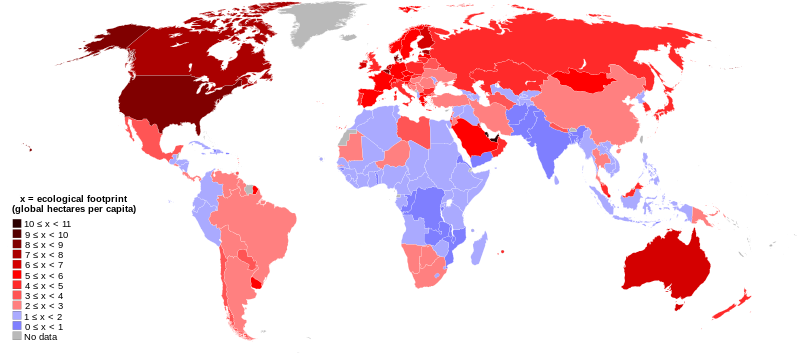
The Footprint tracks current human demand on nature in terms of the area required to supply the resources used and absorb the CO2 emitted in providing goods and services. Trade is accounted for by allocating this demand to the country that ultimately consumes these goods and services. This accounting reflects import and export flows, but makes no judgment regarding the benefits, disadvantages or fairness of trade. The Ecological Footprint is therefore neither pro- nor anti-trade.
As new technologies come on line that affect biocapacity and resource-efficiency, their impact on resource supply and demand are reflected in biocapacity and Footprint assessments. In other words, the Footprint and biocapacity results reported in any given year are in part a function of the technology used in that year. This accounting does not judge whether the use of a technology is positive or negative, but only shows how the technology impacts resource flows. Footprint assessments are historical rather than predictive, and make no judgment about the value of technologies that may become available in the future.
The Footprint approach is neither pro- nor anti-GDP. Gross Domestic Product (GDP) is an economic indicator used to track the annual value added to an economy. For a more comprehensive understanding of national trends, additional indicators are required--unemployment statistics, longevity figures, or ecological asset measures, for example. Global Footprint Network is working to have nations adopt the Ecological Footprint as a complement to, rather than as a substitute for, the GDP, and has set a specific goal in this regard--to have 10 nations adopt the Ecological Footprint by 2015 as a national indicator, in parallel with their use of the GDP.
Though they are often compared and contrasted, Ecological Footprints and Water Footprints are, as indicators, fundamentally incapable of being substituted. The Ecological Footprint does not, and is not intended to measure freshwater flows. Because this is nevertheless a vital renewable resource, in 2002, A.Y. Hoekstra proposed that the Water Footprint be created as a sustainable water use indicator measuring the total volume of freshwater directly or indirectly used by a population.
In essence, the Ecological Footprint measures the biological capacity a population uses and the Water Footprint measures the freshwater a population uses. They each provide a different piece of information in the sustainability puzzle. Instead of being seen as competing metrics, they should be seen as two complementary indicators of natural capital use in relation to human consumption.
For more information on the similarities and differences between the Ecological and Water Footprints, please consult A.Y. Hoeksta's recent article Human appropriation of natural capital: A comparison of ecological footprint and water footprint analysis.


diferent generations=diferent footprints
19 jul 2011
CRADLE TO CRADLE. CAPITULO 3. interview

You talk about the Next Industrial Revolution, where industry and environment come together in harmony. What does this look like?
It looks at the idea as Francis Crick said in 1962, that in order for something to be vital it has to have growth, it has to have a free form of energy, and it has to have an open system of chemicals. So if we think about a tree, it has to have some cells that grow, even for simple reproduction, and it has to have free energy from outside the system, in this case natural sunlight, and it needs an open system of chemicals that synthesize within its metabolism for the benefit of the organism, its reproduction, and its ecosystem.
It looks at the idea as Francis Crick said in 1962, that in order for something to be vital it has to have growth, it has to have a free form of energy, and it has to have an open system of chemicals. So if we think about a tree, it has to have some cells that grow, even for simple reproduction, and it has to have free energy from outside the system, in this case natural sunlight, and it needs an open system of chemicals that synthesize within its metabolism for the benefit of the organism, its reproduction, and its ecosystem.
If we saw human industry in a similar way we’d realize that there’s something relatively new in evolutionary terms that we call technical nutrition. Not just biological nutrition, which is the living thing powered by the sun and ‘consumed’ by other organisms as they breakdown (or, as we say, ‘waste equals food’), but actually seeing human artifice and technology as something that is put into the same kind of cycle. These are what we call technical nutrients. Take aluminum for example. Our species has made 680 million tons of aluminum since 1880 and we still know where 440 million tons are. So the idea would be that you would design two kinds of things, one is what we call ‘products of consumption’, those things that are literally biologically consumed and go back to soil, or ‘products of service’, things from which we want the service, but not necessarily the molecular potential. With something like a computer or a car or carpet, the user is a ‘customer’ not a ‘consumer’. These are services and in fact, when you finish with a synthetic carpet, for example, you should be able to either return it back to industry forever and remake carpets or other useful things. So biological and technical nutrition - that’s the protocol we initiated and have been continuously championing and developing.
What is the difference between eco-efficiency and what you call eco-effectiveness?
Eco-efficiency (doing more with less) as a strategy is well meaning but not necessarily adequate to the task. Being efficient means that you’re probably doing something right, in terms of using the least to do the most, but the problem is that if you’re doing the wrong thing, it might be pernicious because it perpetuates the wrong system with the erroneous thought that things are getting better. For someone to tell a company to be more eco-efficient and please make twice as many cardboard boxes out of the trees in Indonesia, sounds like a factor 2 efficiency. Even if they said make it factor 4 or factor 10, you still haven’t really solved the problem, because it’s still goodbye to Indonesian forests. Why would you use something as beautiful and as diverse as a tree for something as prosaic as a cardboard box that’s used once or even twice, and then put into a chlorine-laden ‘recycling’ loop that is actually continuously down-cycling all the materials and destroying water quality? From our design perspective, the question really needs to be, ‘With eco-efficiency, is being less bad being good, or is it simply being bad, just less so?’ With eco-effectiveness, on the other hand, we ask the question, ‘Am I doing the right thing?’ And then we start to do it efficiently, so we can create prosperity and growth.
Eco-efficiency (doing more with less) as a strategy is well meaning but not necessarily adequate to the task. Being efficient means that you’re probably doing something right, in terms of using the least to do the most, but the problem is that if you’re doing the wrong thing, it might be pernicious because it perpetuates the wrong system with the erroneous thought that things are getting better. For someone to tell a company to be more eco-efficient and please make twice as many cardboard boxes out of the trees in Indonesia, sounds like a factor 2 efficiency. Even if they said make it factor 4 or factor 10, you still haven’t really solved the problem, because it’s still goodbye to Indonesian forests. Why would you use something as beautiful and as diverse as a tree for something as prosaic as a cardboard box that’s used once or even twice, and then put into a chlorine-laden ‘recycling’ loop that is actually continuously down-cycling all the materials and destroying water quality? From our design perspective, the question really needs to be, ‘With eco-efficiency, is being less bad being good, or is it simply being bad, just less so?’ With eco-effectiveness, on the other hand, we ask the question, ‘Am I doing the right thing?’ And then we start to do it efficiently, so we can create prosperity and growth.
So we’re not interested in being less bad. We’re interested in being 100% good.
Right. That means you have to design with positive principles and positive goals. Modern industrial culture doesn’t seem to have principles, except something like: ‘If brute force isn’t working, you are not using enough of it.’ While its goals are unclear, its de facto goal appears to be to create ecological and human tragedy. If you play a game, you have to have a clear goal; in chess, you’re going to take a king. So we have an end game in mind because without this strategy becomes meaningless. What we seek is a delightfully diverse, safe, healthy and just world, with clean water, air, soil and power, that is economically, equitably, ecologically, and elegantly enjoyed.
Right. That means you have to design with positive principles and positive goals. Modern industrial culture doesn’t seem to have principles, except something like: ‘If brute force isn’t working, you are not using enough of it.’ While its goals are unclear, its de facto goal appears to be to create ecological and human tragedy. If you play a game, you have to have a clear goal; in chess, you’re going to take a king. So we have an end game in mind because without this strategy becomes meaningless. What we seek is a delightfully diverse, safe, healthy and just world, with clean water, air, soil and power, that is economically, equitably, ecologically, and elegantly enjoyed.
How did you get turned onto the idea of changing the world of design?
I grew up in Hong Kong, so I was in a place with four hours of water every fourth day during the dry season and six million people on forty square miles. I saw a lot of optimization of very precious resources. Then, as we went to the Pacific Northwest for the summers with my grandparents and saw astonishing abundance - fresh water, big forests, pure springs, salmon. I went from a world of extreme limits to a world of extreme abundance, and yet my grandparents were also very careful and kept the spring clean, composted organic waste, and saved rubber bands and aluminum foil and so on. So I always thought the world was something you took care of, and it hopefully got better because you were there. And I also saw in Chinese agriculture a perpetual agriculture: farmers for forty centuries farming the same piece of ground. So that was the context in which I grew up. When I came to the United States to live as a teenager, I entered a world of profligacy and seeming wanton abandon of things in a take-make-waste production system, with a cradle-to-grave ‘throw it away’ philosophy. I think this, in many ways, was the result of something I, personally, had not lived through - nuclear threat. While I was a child in Hong Kong, third graders in the U.S. were being taught how to dive under their desks because Armageddon may appear at any instant. When you sense that everything could end in an instant, you live as if there might not be a tomorrow. This became embedded in the culture - modern culture actually created geo-political and physical threats (global terrorism, weapons of mass destruction, biological warfare) that could destroy us all tomorrow - so many industrialized countries have a ‘get it while we can’ attitude rather than a continuous long-term prosperity in mind.
I grew up in Hong Kong, so I was in a place with four hours of water every fourth day during the dry season and six million people on forty square miles. I saw a lot of optimization of very precious resources. Then, as we went to the Pacific Northwest for the summers with my grandparents and saw astonishing abundance - fresh water, big forests, pure springs, salmon. I went from a world of extreme limits to a world of extreme abundance, and yet my grandparents were also very careful and kept the spring clean, composted organic waste, and saved rubber bands and aluminum foil and so on. So I always thought the world was something you took care of, and it hopefully got better because you were there. And I also saw in Chinese agriculture a perpetual agriculture: farmers for forty centuries farming the same piece of ground. So that was the context in which I grew up. When I came to the United States to live as a teenager, I entered a world of profligacy and seeming wanton abandon of things in a take-make-waste production system, with a cradle-to-grave ‘throw it away’ philosophy. I think this, in many ways, was the result of something I, personally, had not lived through - nuclear threat. While I was a child in Hong Kong, third graders in the U.S. were being taught how to dive under their desks because Armageddon may appear at any instant. When you sense that everything could end in an instant, you live as if there might not be a tomorrow. This became embedded in the culture - modern culture actually created geo-political and physical threats (global terrorism, weapons of mass destruction, biological warfare) that could destroy us all tomorrow - so many industrialized countries have a ‘get it while we can’ attitude rather than a continuous long-term prosperity in mind.
What goes on in a cradle-to-cradle cycle?
Cradle-to-cradle essentially says that you have an open metabolism of chemicals that are manifesting benefit for living systems or technical systems. They’re not contaminating each other and they are designed to either replace themselves in cycles or get better as they go through the system. Typically what we call recycling today is down-cycling in our lexicon. Things are actually getting lower in quality as they go through the process. Clear milk jugs will be transformed into a park bench that’s on its way to a landfill or an incinerator, getting contaminated by various additives and dyes and losing its quality through the system. We’ve been looking at nylon fibers, for example, that can be chemically recycled, and actually up-cycled. They get better as they come back and go through the new cycle because mechanical properties have been improved, thereby increasing the quality of the fiber. Essentially, cradle-to-cradle says that if things relate and can improve soil health, then we may return them to soil.
Cradle-to-cradle essentially says that you have an open metabolism of chemicals that are manifesting benefit for living systems or technical systems. They’re not contaminating each other and they are designed to either replace themselves in cycles or get better as they go through the system. Typically what we call recycling today is down-cycling in our lexicon. Things are actually getting lower in quality as they go through the process. Clear milk jugs will be transformed into a park bench that’s on its way to a landfill or an incinerator, getting contaminated by various additives and dyes and losing its quality through the system. We’ve been looking at nylon fibers, for example, that can be chemically recycled, and actually up-cycled. They get better as they come back and go through the new cycle because mechanical properties have been improved, thereby increasing the quality of the fiber. Essentially, cradle-to-cradle says that if things relate and can improve soil health, then we may return them to soil.
What does your fractal triangle diagram mean to you?
We use this triangle known as the Sierpinski gasket, or fractal tile, to be able to navigate the relationships between ecology, equity, and economy. It’s a fractal way of looking at the entire universe that’s self-similar. Cost, performance, and aesthetics meet life, liberty, and the pursuit of happiness!
We use this triangle known as the Sierpinski gasket, or fractal tile, to be able to navigate the relationships between ecology, equity, and economy. It’s a fractal way of looking at the entire universe that’s self-similar. Cost, performance, and aesthetics meet life, liberty, and the pursuit of happiness!
William McDonough is an architect and co-author of Cradle to Cradle with Michael Braungart.
William McDonough Interview. March 23, 2004 - four years old and very UltraFuture. From massivechange.com
14 jun 2011
O-MD: eco lab
Mobile ECO LAB

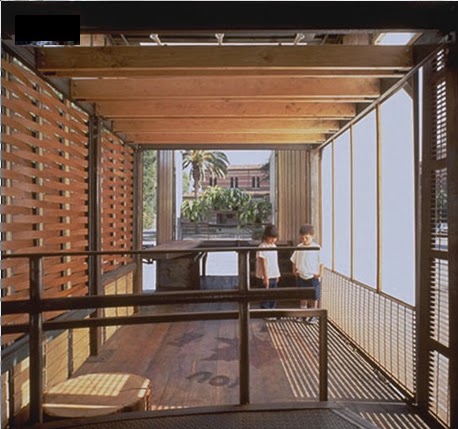


The mobile ECO LAB was built in collaboration with the Hollywood Beautification Team, a grassroots group founded with the mission to restore beauty and integrity to the Hollywood community. Design and construction work was based around a donated cargo truck trailer and cast-offs from film sets. The 8’ x 35’ trailer now travels throughout Los Angeles County to inform K-12 school-aged children about the importance of saving and protecting our planet.
As a working mobile classroom, the ECO LAB provides a base for a range of exhibitions all of which focus on ecology. A multimedia program explaining the "life of a tree" creates a path for discovery that weaves in and out of the space. A working art studio, local artists collaborate with the children to create facade-sized murals replacing graffiti at inner-city schools. School teachers use stage-platforms to discuss each child's role in the importance of planting trees and maintaining a sustainable environment. Like a circus tent, this mobile icon arrives at the schoolyard where elevated walkways fold down and slide out of the trailer's body. It is immediately recognizable as a place for interaction, discovery and fun.


Suscribirse a:
Entradas (Atom)