Mostrando entradas con la etiqueta huerto ecológico. Mostrar todas las entradas
Mostrando entradas con la etiqueta huerto ecológico. Mostrar todas las entradas
17 may 2012


18 mar 2012
permaculture (chapter 1)
What is permaculture?

Permaculture is an approach to designing human settlements and agricultural systems that mimic the relationships found in natural ecologies.
Permaculture is sustainable land use design. This is based on ecological and biological principles, often using patterns that occur in nature to maximise effect and minimise work. Permaculture aims to create stable, productive systems that provide for human needs, harmoniously integrating the land with its inhabitants. The ecological processes of plants, animals, their nutrient cycles, climatic factors and weather cycles are all part of the picture. Inhabitants’ needs are provided for using proven technologies for food, energy, shelter and infrastructure.
Elements in a system are viewed in relationship to other elements, where the outputs of one element become the inputs of another.
Within a Permaculture system, work is minimised, “wastes” become resources, productivity and yields increase, and environments are restored.
Permaculture principles can be applied to any environment, at any scale from dense urban settlements to individual homes, from farms to entire regions.

The origins of permaculture
Franklin Hiram King coined the term permanent agriculture in his
classic book from 1911, Farmers of Forty Centuries: Or Permanent
Agriculture in China, Korea and Japan. In this context, permanent
agriculture is understood as agriculture that can be sustained
indefinitely.
In 1929, Joseph Russell Smith took up the term as the subtitle for
Tree Crops: A Permanent Agriculture, a book in which he summed up his
long experience experimenting with fruits and nuts as crops for human
food and animal feed. A revised and updated edition was published in
1950.[2] Smith observed, "Forest -- field -- plow -- desert -- that is
the cycle of the hills under most plow agricultures... When we develop
an agriculture that fits this land, it will become an almost endless
vista of green, crop-yielding trees.". Smith saw the world as an
inter-related whole and suggested mixed systems of trees and crops
underneath.
The work of Howard T. Odum was also an early influence on
Permaculture, especially for Holmgren. Odum focused on system
ecology, in particular the maximum power principle, which claims that
natural systems tend to maximize the energy embodied in a system. For
example, the total calorific value of woodland is very high with its
multitude of plants and animals. It is an efficient converter of
sunlight into biomass. A wheat field, on the other hand, has much less
total energy and often requires a large energy input in terms of
fertilizer if the wheat and straw are harvested and removed from the
field.
The definition of permanent agriculture as that which can be
sustained indefinitely was supported by Australian P. A. Yeomans in the
1973 book "Water for Every Farm." who introduced an observation-based
approach to land use in Australia in the 1940s, based partially on his
understanding of geology. Yeomans introduced Keyline Design as a way of
managing water supply and distribution. Holmgren based his EcoVillage
design on the keyline principle, Other early
influences were the work of Esther Deans, who pioneered No-Dig Gardening
methods, and Masanobu Fukuoka who, in the late 1930s in Japan, began
advocating no-till orchards, gardens and natural philosophy.
Other recent influences include the Vegetable Aquaculture and Animal
enClosures (VAC) system in Vietnam which is a government-supported
system to recycle resources.
In the mid 1970s, Australians Bill Mollison and
David Holmgren started to develop ideas about stable agricultural
systems. This was a result of rapid growth of destructive
industrial-agricultural methods. They saw that these methods were
poisoning the land and water, reducing biodiversity, and removing
billions of tons of topsoil from previously fertile landscapes. They
announced their permaculture approach with the publication of
Permaculture One in 1978.
The term permaculture initially meant "permanent agriculture" but was
quickly expanded to also stand for "permanent culture" as it was seen
that social aspects were integral to a truly sustainable system.

After Permaculture One, Mollison further refined and developed the
ideas by designing hundreds of permaculture sites and organizing this
information into more detailed books. Mollison lectured in over 80
countries and taught his two-week Design Course to many hundreds of
students. By the early 1980s, the concept had broadened from
agricultural systems design towards complete, sustainable human
habitats.
By the mid 1980s, many of the students had become successful
practitioners and had themselves begun teaching the techniques they had
learned. In a short period of time permaculture groups, projects,
associations, and institutes were established in over one hundred
countries. In 1991 a four-part Television documentary by ABC productions
called "The Global Gardener" showed permaculture applied to a range of
worldwide situations, bringing the concept to a much broader public.
.
The first recorded modern practice of permaculture as a systematic
method was by Austrian farmer Sepp Holzer in the 1960s, but the method
was scientifically developed by Australians Bill Mollison and David
Holmgren and their associates during the 1970s in a series of
publications.
The word permaculture is described by Mollison as a portmanteau of
permanent agriculture, and permanent culture.
Both the mentor
(Mollison) and the student (Holmgren) developed concepts that can help
humans to create enduring agriculture systems. Since then it has been
constantly developed by a huge range of people in many different
countries and it is now a worldwide phenomenon with a multitude of
different strands and approaches.
The intent is that, by training individuals in a core set of design
principles, those individuals can design their own environments and
build increasingly self-sufficient human settlements — ones that reduce
society's reliance on industrial systems of production and distribution
that Mollison identified as fundamentally and systematically destroying
Earth's ecosystems.

While originating as an agro-ecological design theory, permaculture
has developed a large international following. This "permaculture
community" continues to expand on the original ideas, integrating a
range of ideas of alternative culture, through a network of
publications, permaculture gardens, intentional communities, training
programs, and internet forums. In this way, permaculture has become a
form of architecture of nature and ecology as well as an informal
institution of alternative social ideals.
The principles encompass those stated in Introduction to Permaculture, by Bill Mollison & Reny Mia Slay:
- Relative location.
- Each element performs many functions.
- Each important function is supported by many elements.
- Efficient energy planning: zone, sector and slope.
- Using biological resources.
- Cycling of energy, nutrients, resources.
- Small-scale intensive systems; including plant stacking and time stacking.
- Accelerating succession and evolution.
- Diversity; including guilds.
- Edge effects.
- Attitudinal principles: everything works both ways, and permaculture is information and imagination-intensive.
and those in Permaculture, a Designers' Manual, by Bill Mollison:
- Work with nature rather than against.
- The problem is the solution.
- Make the least change for the greatest possible effect.
- The yield of a system is theoretically unlimited (or only limited by the imagination and information of the designer).
- Everything gardens (or modifies its environment).

The Ethics of Permaculture
The ethics that underpin permaculture are:
- Earth care
- People care
- Fair shares
These ethics specifically maintain that we can develop systems where
the planet and its inhabitants achieve and develop a state of well-being
through using resources in a balanced way. In particular, resources
should not be simply frittered away in the name of personal gain and
individual profit which ultimately results in the depletion and
destruction of our natural eco systems.
Modern permaculture is a system design tool. It is a way of:
1. looking at a whole system or problem
2. observing how the parts
relate
3. planning to mend sick systems by applying ideas learned from
long-term sustainable working systems
4. seeing connections between key
parts
Why Use Permaculture?
A key question in the development of a Permanent Culture is why
permaculture should be central to its development and proliferation?
The answer to this is simple,
modern agricultural methods and methods of taking resources from the
natural world are very destructive and completely unsustainable in the
long term. They are detrimental towards the survival of the land, the
people, and flora and fauna that make the land their habitat. The
Permaculture way of doing things still provides us with our basic needs,
only without all of the profiteering, exploitation and ecological
degradation that is part and parcel of Capitalism and its control of
abuse of resources
Not only will permaculture and its tools help us to create
sustainable agricultural systems whilst enhancing the fertility of the
locale eco systems, but it is also capable of improving how we build our
homes in terms of ecological architecture and building design. There
are many examples of eco-build houses that work on the principles of
permaculture, indeed, as permaculture has flourished and gathered
momentum over the last 3 decades so too has sustainable low impact
houses. There are currently communities all over the UK living in low
impact homes, including the Lammas Project in Pembrokeshire, Land
Matters in Devon, Tinkers Bubble in Dorset, to name but a few.
Permaculture Creates Independence
When you have no control over the
basic resources that you need to survive, you are effectively a slave
reliant on others to meet these needs. Often these ‘others’ are large
corporations driven by money and profit and not by human needs and
compassion for people. This can be plainly seen with the recent
speculative trading on food that caused food riots by increasing the
cost of food, thereby making it inaccessible to many. Ironically, it is
often these very areas that produce large quantities of food for the
rest of the world, but then cannot afford to buy the food they produce.
Having a sound grasp of permaculture can help us extricate ourselves
from these issues and practices, as it provides a way to meet your needs
outside of the capitalist system whilst living an ecologically sound
existence. Permaculture has the ability to give us complete thus
reducing reliance on those organisations whose operations we have no
control over. Permaculture principles are not only about food: they can
also be applied to many aspects of life.
Permaculture in Action
There are many examples of why permaculture is a sustainable
alternative to the current system which has an underlying assumption of
there being an unlimited pool of natural resources.
One particular project that shows precisely why permaculture should
replace the capitalist model is the Greening
of the Desert project that is taking place in Jordan under the
guidance of Australian permaculture pioneer Geoff Lawton. This project
has reclaimed an area of extremely arid desert and converted it back
into fertile productive land. This land now provides members of the
local community with a new and sustainable supply of resources in an
area of land previously written off. The Greening of the desert project
really shows that permaculture can achieve results from the most extreme
landforms in terms of their usability both now and in the future.
Rising to the challenge: From built in obsolescence to a permanent culture
The temporary Culture of built-in obsolescence that is at the core of
consumer capitalism puts the profit motive of a few individuals before
planet and people, it takes no account of, and has no interest in the
extremely negative effects it has on the ecology of the planet, and the
well being of any of its inhabitants. The future cannot be a Capitalist
Neoliberal one, the continual and insatiable economic growth demanded to
maintain it’s economically would destroy the planet as the Banks and
global financiers ask us to pay off their Debts, these debts are three
times the size of our planets usable resources in terms of putting a
cost to them.
In order to move away from this
very serious mess that Capitalism and individual human greed has created
we need ideas and practices that are the exact opposite to that which
now enslaves us.
Built in obsolescence needs to be ‘Built to last’ local food groups
and collectives need to flourish and shove supermarkets out of their
respective areas, instead of being consumers, we should be looking at we
can stop consuming. Workers need to run and manage their places of work
and be valued for the experts that they are within their given field.
There are a lot of issues to address in terms of bringing about a
Permanent Culture, but these issues are pulled together and solutions
found within permacultures ever developing storehouse of knowledge and
practices.
In permaculture systems the fertility and health of a particular
system is not only maintained but it is also enhanced, this is the exact
opposite of agriculture where the soil loses its own fertility every
year and has to feed with oil based fertilizers.
Permaculture is able to
replicate natural eco systems, within a food growing context this means
less work for us as each part of the eco system works together to
maintain itself, less work means less energy use which equates to food
production without the need of fossil fuels.
Permaculture applications are not
quick-fix solutions. Its design principles insist on a slow and gradual
integration as a means of developing a sustainable and resilient
Permanent Culture. This makes the adoption of these models crucial as
the sooner people begin to utilise permaculture principles, the more
likely a smooth transition to a new way of living will occur. Within the
ethics and principles of permaculture there is a possible future that
is ours to mould, a future where division, exploitation and control are
things of the past. Any system of ideas that has the care of the earth
and people and the limitation of resources at its heart has the ability
transform societies and ways of thinking that are quite literally
evolutionary as opposed to the knuckle dragging savagery of Capitalism.

+ info:
http://www.permanentculturenow.com/introduction-to-permaculture/
http://codegreencommunity.com/page/permaculture-1 http://www.permaculture.org.uk/
30 dic 2011
mobile: Prinzessinnengarten
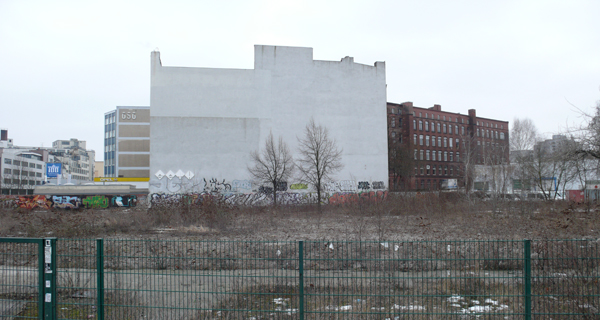

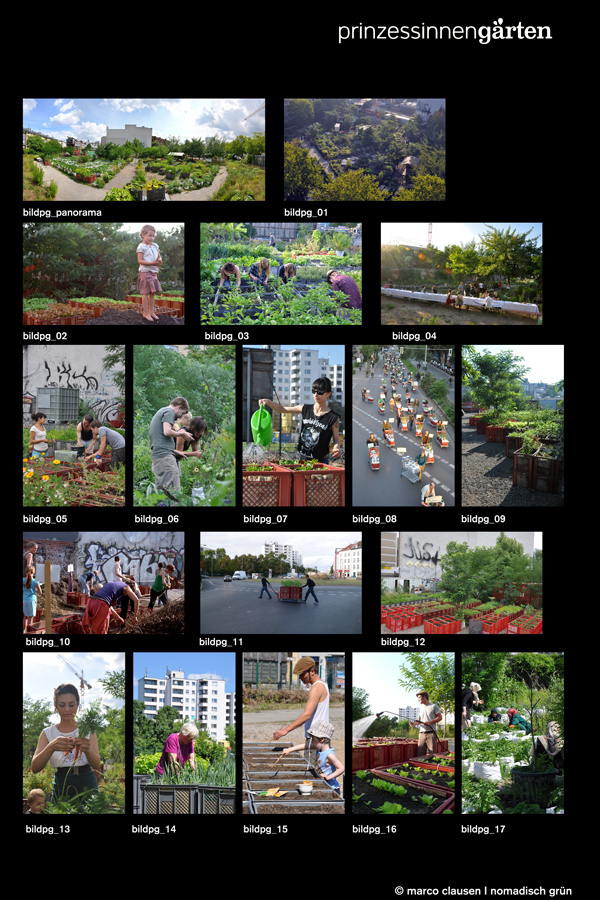
Nomadisch Grün (Nomadic Green) launched Prinzessinnengärten
(Princess gardens) as a pilot project in the summer of 2009 at
Moritzplatz in Berlin Kreuzberg, a site which had been a wasteland for
over half a century. Along with friends, fans, activists and neighbours,
the group cleared away rubbish, built transportable organic vegetable
plots and reaped the first fruits of their labour.
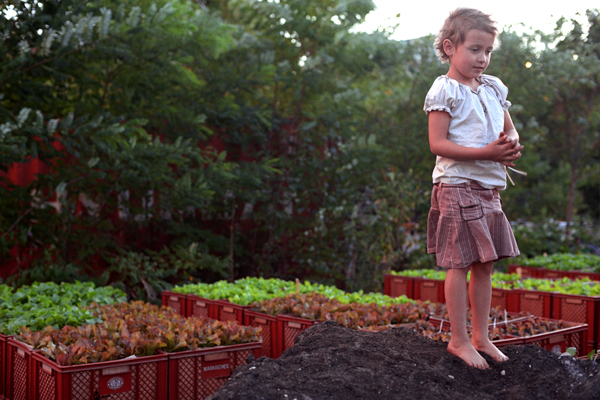
Imagine a future where
every available space in big cities is used to let new green spaces
bloom. Green spaces that local residents create themselves and use to
produce fresh and healthy food. The result would be increased biological
diversity, less CO2 and a better microclimate. The spaces would promote a sense
of community and the exchange of a wide variety of competencies and
forms of knowledge, and would help people lead more sustainable lives.
They would be a kind of miniature utopia, a place where a new style of
urban living can emerge, where people can work together, relax,
communicate and enjoy locally produced vegetables.
In future ever more people
will be living in cities rather than in rural areas. The city will
therefore become the decisive place for the development of more
sustainable ways of eating, living and moving. The city of the future
should be a climate-friendly, pleasant place to live, where every care
is taken to conserve our natural resources.
Prinzessinnengärten is a new urban place of learning. It is where locals can come
together to experiment and discover more about organic food production,
biodiversity and climate protection. The space will help them adapt to
climate change and learn about healthy eating, sustainable living and a
future-oriented urban lifestyle.
With this project Nomadisch Grün intends to increase biological, social and
cultural diversity in the neighbourhood and pioneer a new way of living
together in the city.
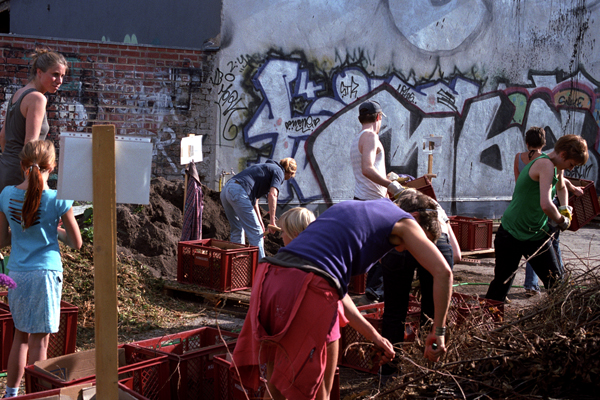
Urban agriculture on Moritzplatz
- The story so far -
For half a century
Moritzplatz hid in the shadows of the Berlin Wall.
This almost forgotten corner, once zoned as a motorway junction, is
now experiencing a new lease of life.
First it was just a vision: Sitting in the middle of our field at sunset, the wind rustling through the poplars, the air scented by ripe tomatoes and fresh herbs, chatting with our friends and neighbours, having a good time – right in the middle of the city !
First it was just a vision: Sitting in the middle of our field at sunset, the wind rustling through the poplars, the air scented by ripe tomatoes and fresh herbs, chatting with our friends and neighbours, having a good time – right in the middle of the city !
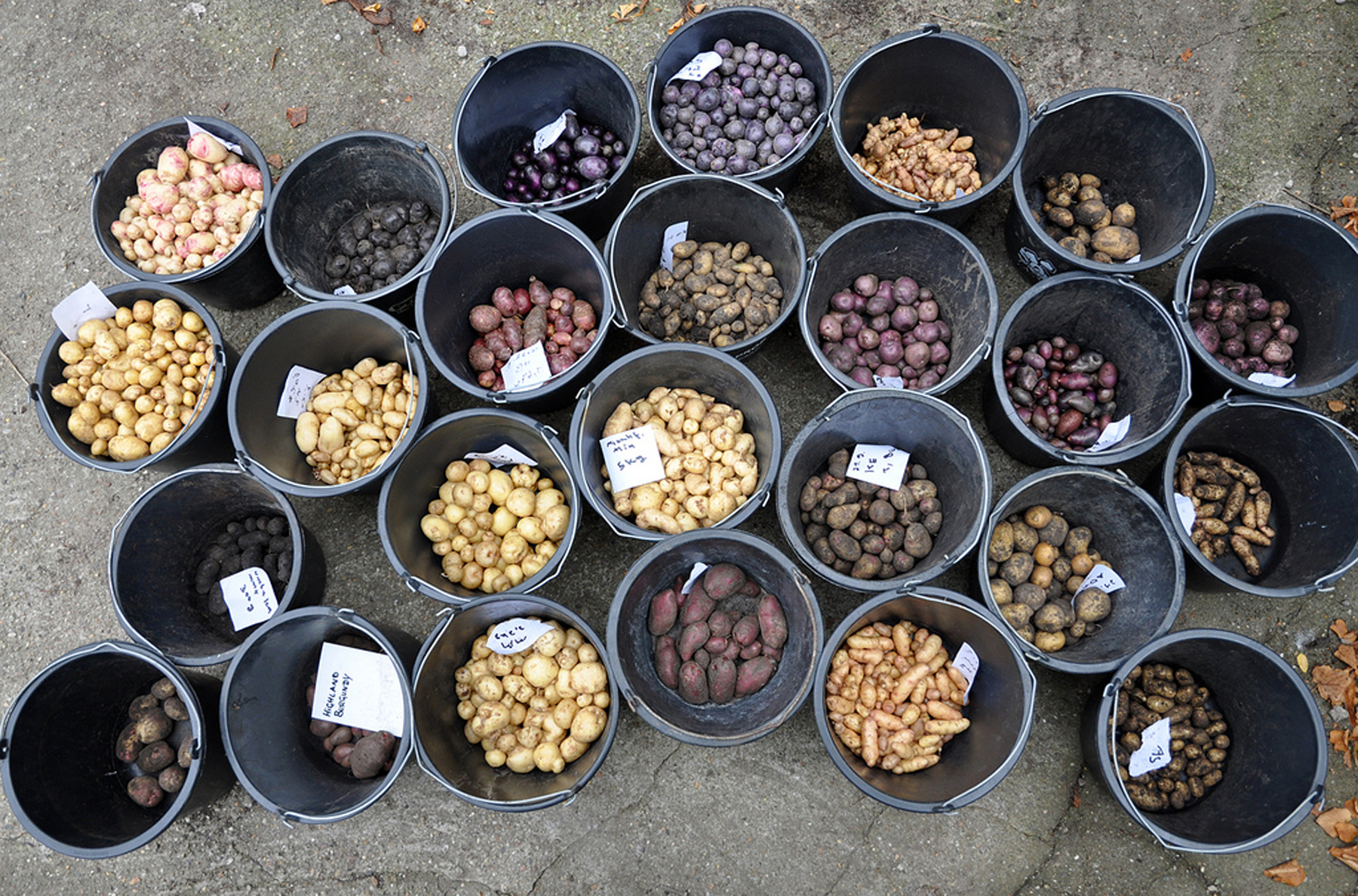
This was the picture Robert brought home to Berlin after a trip to Cuba. In Havana and other cities, agricultura urbana is not just about producing one’s own vegetables but more about creating an urban living-, working- and meetingplace. This is where neighbours would gather and adults would pass on their knowledge to children
as they relax over a cup of coffee.
“Let’s do it in Berlin!”, with this rallying call and the help of children, youth, neighbours and friends we are transforming Moritzplatz into an urban garden, café and place of working, learning and relaxing.
Nomadisch Grün (Nomadic Green)
Starting in the summer of 2009, the non-profit company „Nomadisch Grün“ has leased a site in Berlin/Kreuzberg in order to create a mobile urban farm:
Starting in the summer of 2009, the non-profit company „Nomadisch Grün“ has leased a site in Berlin/Kreuzberg in order to create a mobile urban farm:
The Prinzessinnengarten.
Locally grown organic vegetables
Our fresh, organic, locally produced herbs and vegetables are grown in raised compost beds without using any pesticides or artificial fertilisers.
Our fresh, organic, locally produced herbs and vegetables are grown in raised compost beds without using any pesticides or artificial fertilisers.
Mobile Gardening
Nomadisch Grün stands for mobile gardening. We temporarily
transform unused spaces such as buildingsites, car parks and roofs into urban farmland and green meeting places.
Nomadisch Grün stands for mobile gardening. We temporarily
transform unused spaces such as buildingsites, car parks and roofs into urban farmland and green meeting places.
Sustainable Living
The Prinzessinnengarten is a place of discovery where children, neighbours, experts and those curious about sustainable living can come together to about and explore alternative visions for our city.
The Prinzessinnengarten is a place of discovery where children, neighbours, experts and those curious about sustainable living can come together to about and explore alternative visions for our city.
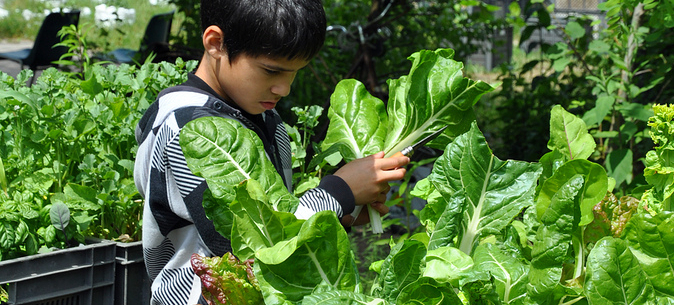
Hedonism as we understand it
Our garden is a place of pleasure and rejuvenation. Relax and enjoy watching the vegetables being harvested and freshly prepared in our small garden restaurant.
Our garden is a place of pleasure and rejuvenation. Relax and enjoy watching the vegetables being harvested and freshly prepared in our small garden restaurant.
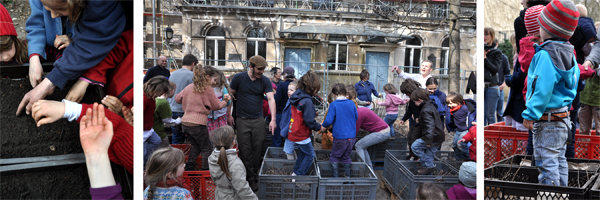
Help grow a new city: Join in.
We couldn’t wait, so we’ve already started.
Come along and find your role – together we are building the future of our city.
We couldn’t wait, so we’ve already started.
Come along and find your role – together we are building the future of our city.
+
23 jun 2011
MARIANO BUENO: EL HUERTO FAMILIAR ECOLÓGICO
EL HUERTO FAMILIAR ECOLÓGICO | ||||
 | ||||
Día a día nos damos cuenta de la importancia de consumir alimentos frescos, sanos y ecológicos. Continuas investigaciones en todo el planeta dejan claro, por un lado, los beneficios de una alimentación sana y equilibrada, con abundancia de verduras y frutas frescas, y, por otro lado, advierten de los serios peligros para la salud, a corto y largo plazo, de la presencia en los alimentos de restos de plaguicidas y de infinidad de sustancias tóxicas que se han ido añadiendo en los procesos de producción, transformación o comercialización. Escándalos como el de las vacas locas o los pollos con dioxinas son sólo la punta del iceberg de una industria agroalimentaria centrada en la obtención de los máximos beneficios al mínimo coste y basada en la mecanización de todos los procesos productivos y el uso y abuso de abonos químicos, herbicidas y plaguicidas, que fuerzan a la naturaleza a producir más allá de unos límites que permitirían mantener un mínimo equilibrio biológico y ecológico del entorno. A la negra marea de residuos tóxicos, cancerígenos o alteradores hormonales, con desastrosos efectos sobre la salud de los consumidores (y de los agricultores), se está añadiendo una larga lista de plantas modificadas genéticamente (OGM), con las que se promete aumentar la producción mundial de alimentos (aunque las experiencias de cultivos a gran escala demuestran que no es así), pero de las que se ignora por completo las posibles repercusiones negativas en cuanto a desequilibrios ecológicos y más aún en lo referente a la salud de los consumidores de tales productos. Todo ello nos lleva a plantearnos la necesidad de consumir alimentos con garantía de producción ecológica, si realmente estamos preocupados por nuestra salud, la de nuestros hijos y la del planeta en su conjunto. | |||||||
 | Se puede alegar que consumir productos biológicos o ecológicos resulta caro y no está al alcance de todos los bolsillos, pero hay que tener presente que los alimentos de producción convencional consiguen mantener precios bajos a base de mecanizar e industrializar los procesos de producción y, sobre todo, forzar las plantas cultivadas con infinidad de agroquímicos. | ||||||
Valga de ejemplo una simple y cotidiana lechuga, tan familiar en la mayor parte de las mesas. Su producción con métodos naturales (sin forzar) suele conllevar que tal lechuga permanezca un mínimo de dos o tres meses en la tierra (absorbiendo nutrientes vitales y realizando fotosíntesis a partir de la radiación solar), mientras que su homóloga de cultivo químico estará en la tienda a los 50 días, como máximo, gracias a un desarrollo acelerado forzado con nitratos, agua y fitohormonas de aceleración del crecimiento vegetal. Los desequilibrios ecológicos y biológicos a los que se ven sometidas las pobres lechugas (y el resto de cultivos) se traducirán en una gran propensión a padecer toda clase de plagas y enfermedades, que serán controladas con plaguicidas químicos, parte de los cuales permanecerán como residuos en la planta al ser cosechada y en el momento de consumirla. La competencia de las llamadas malas hierbas se controlará básicamente a base de herbicidas, de los que tanto se está abusando que sus residuos empiezan a detectarse en las capas freáticas subterráneas e incluso en el agua potable de la mayoría de zonas agrícolas. Por todo ello, el mayor precio de los productos ecológicos está más que justificado, pero cuando la precaria economía familiar no nos permite acceder a ellos nos queda el plantearnos su cultivo en función de nuestras posibilidades. Muchos pensarán que esto es difícil o imposible, pero lo cierto es que, cuando se desea y se dispone de un espacio, por pequeño que sea, de algunos ratitos al día o a la semana y de un mínimo de información básica, resulta algo tan sencillo como gratificante, e incluso terapéutico, ya que, además de producir alimentos sanos y ecológicos, las labores en el huerto o en el balcón comestible suponen un acercamiento y un contacto directo con la vida y la naturaleza, al tiempo que realizamos el ejercicio indispensable para mantenernos sanos y en buena forma. En la práctica, un huerto familiar no requiere ni demasiado tiempo ni demasiado esfuerzo, aunque sí exige un mínimo de ganas de trabajar y cierta sensibilidad hacia la naturaleza. | |||||||


 | Interesa que la parcela, balcón o terraza esté orientada al sur o, por lo menos, que reciba varias horas al día de luz solar, ya que las plantas necesitan sus radiaciones para realizar correctamente la fotosíntesis, de la que depende su desarrollo y el contenido de nutrientes y vitaminas que aprovecharemos al consumirlas. | ||||||
Si la parcela o terraza no recibe sol directo pero hay una pared cercana que refleje su radiación, puede ser suficiente -convendría pintar la pared de blanco para sacarle el máximo provecho-. Hay plantas que requieren mucha luz y mucho calor, como las solanáceas (tomates, pimientos, berenjenas) o las cucurbitáceas (melones, pepinos, calabacines, etc.), mientras que otras, como escarolas, acelgas, coles o espinacas, se desarrollan bien con menos luz y calor. | |||||||

 | Semillas y semilleros. La gran diversidad de plantas que puede albergar un huerto familiar -aunque sea de reducidas dimensiones- implica disponer de planteles o de semillas adecuadas. Aunque siempre puede empezarse por semillas comerciales estándar, lo más interesante es procurarse semillas con certificación de producción ecológica, que, por suerte, ya empiezan a estar disponibles en nuestro país. También podemos recurrir a los contactos con agricultores ecológicos y al intercambio de semillas que promueven algunas asociaciones o grupos de agricultura ecológica. Podemos realizar semilleros domésticos en pequeños recipientes reciclados -botes de yogur, cajas de envases desechables, etc.- y mantenerlos en el alféizar de la ventana de alguna habitación que le dé el sol y esté caldeada. | ||||||
El trasplante es una operación delicada pero fácil de realizar, en la que lo más importante es dañar lo menos posible las raíces y que no falte el riego hasta su nuevo enraizamiento en el huerto o en el macetero. En ocasiones podemos recurrir a las plantitas que venden los viveristas, aunque, a menudo, tanto la procedencia de las semillas como el uso de abonos químicos y plaguicidas las desvitaliza y es fácil que nos den problemas. | |||||||

El diseño y la planificación Diseñar el huerto es lo primero que debemos plantearnos, pues conviene realizar una buena distribución de los espacios disponibles a fin de aprovecharlos al máximo y conseguir los mejores resultados con el mínimo esfuerzo. Tan importante como el correcto diseño es el planificar los cultivos que deseamos realizar en el huerto; para ello será necesario que reflexionemos a fondo sobre nuestros gustos culinarios y las necesidades de consumo cotidiano. No tiene mucho sentido plantar veinte coles porque nos regalaron las plantitas si no solemos comer col más que ocasionalmente. | |||||||
En cambio, si todos los días comemos ensalada de lechuga, convendrá ir sembrando y plantando con regularidad -cada quince días o una vez al mes plantaremos unas quince o veinte lechugas-; con ello tendremos un cultivo escalonado a lo largo de los meses y nunca faltarán en la mesa. Con tres o cuatro matas de calabacín bastará para el consumo familiar, con más de diez matas nos veremos obligados a regalar kilos y kilos de calabacines. También hay cultivos complicados, como el de los melones o las sandías, que vale la pena dejar para cuando tengamos más experiencia o sólo si realmente nos sobra sitio, pues ocupan mucho espacio para los tres o cuatro melones que puede dar cada mata. Una buena planificación requiere conocer los ciclos de cultivo de cada planta o variedad y saber más o menos el tiempo que ocupará el terreno, ya que éste varía desde un mes, desde la siembra a la cosecha, en los humildes rabanitos, a los tres a cinco meses -incluso más- que ocupan el bancal unas zanahorias. Sin olvidarnos de que, para mantener la salud y fertilidad de nuestro huerto, sería interesante respetar las rotaciones de cultivos y no repetir en una determinada parcela una misma familia de plantas varios años seguidos, pues se especializan ciertos parásitos que a la larga podrían causar serios problemas; lo ideal es respetar rotaciones de cuatro años, como mínimo. | |||||||


Suscribirse a:
Entradas (Atom)