Climate
change is the result of breakdowns in the carbon cycle caused by us:
IT IS A DESIGN FAILURE.
*** ******
Anthropogenic greenhouse gases in the atmosphere make
airborne carbon a material in the wrong place, at the wrong dose and wrong
duration.
It is WE who have made carbon a toxin—like lead in our drinking
water. In the right place, carbon is a resource and tool.
The
world’s current carbon strategy aims to promote a goal of zero. Predominant
language currently includes words such as “low carbon,” “zero carbon,”
“negative carbon,” and even a “war on carbon.”
The
design world needs values-based language that reflects a safe, healthy and just
world. In this new paradigm, by building urban food systems and cultivating
closed-loop flows of carbon nutrients, carbon can be recognized as an asset
rather than a toxin, and the life-giving carbon cycle can become a model for
human designs.
*** ******
The
new language signals positive intentions, leading us to do more good rather
than simply less bad. It identifies three categories of carbon:
*** Living carbon:
organic, flowing in biological cycles, providing fresh food, healthy
forests and fertile soil; something we want to cultivate and grow
***Durable carbon:
locked in stable solids such as coal and limestone or recyclable polymers
that are used and reused; ranges from reusable fibers like paper and
cloth, to building and infrastructure elements that can last for
generations and then be reused
***Fugitive carbon: has
ended up somewhere unwanted and can be toxic; includes carbon dioxide
released into the atmosphere by burning fossil fuels, ‘waste to energy’
plants, methane leaks, deforestation, much industrial agriculture and
urban development
Working
carbon is a subset of all three categories and defined as a material being put
to human use. For example, working living carbon is cultivated in agricultural
systems. Working durable carbon is recycled, reused and reprocessed in circular
technical systems; and working fugitive carbon includes fossil fuels used for
power.
The
new language also identifies three strategies for carbon management and climate
change:
*** Carbon positive:
actions converting atmospheric carbon to forms that enhance soil nutrition
or to durable forms such as polymers and solid aggregates; also recycling
of carbon into nutrients from organic materials, food waste, compostable
polymers and sewers
*** Carbon neutral:
actions that transform or maintain carbon in durable Earth-bound forms and
cycles across generations; or renewable energy such as solar, wind and
hydropower that do not release carbon
*** Carbon negative:
actions that pollute the land, water and atmosphere with various forms of
carbon, for example, CO2 and methane into the atmosphere or plastics in
the ocean
Offering
an inspiring model for climate action begins with changing the way we talk
about carbon.
Our goal is for all to embrace this new language and work
toward a Carbon Positive design framework; and in doing so we may together
support a delightfully diverse, safe, healthy and just world—with clean air,
soil, water and energy—that is economical, equitable, ecological, and elegantly
enjoyed.
Kaedi is located in a remote sector of Mauritania, near the border of Senegal. Its hospital serves a rural population. The extension adds 120 beds to the hospital, an operating theater complex, pediatric, surgical and ophthalmic departments, a maternity and general medical unit, a laundry, kitchens, storerooms, a garage, and a workshop.
The architects were not to replicate the earlier hospital's conventional concrete-frame buildings; their brief was to house the planned facilities by developing new LOW COST TECHNIQUES of construction employing LOCAL MATERIALS AND SKILLS, that would be applicable to other building types within the region.
All workmen were local, TRAINED on the site to perform the new techniques. Although the use of brick is not a part of the local vernacular, the architects chose to develop a structural vocabulary of HAND MADE BRICK, fired in kilns built near the source of clay. The structural repertoire that emerged, after on-site experimentation with a number of domes and vaults, included simple domes, complex domes, conventional half-domes, pod-shaped spaces, and self-supporting pointed arches which form winding circulation corridors. The overall plan for the hospital extension was derived from these forms.
Adequate natural light enters the complex through glass blocks set into the brickwork and from interstices left between the brick arches. The response of both doctors and patients has been positive, and the COMMUNITY takes pride in the fact that the medical facility was built by their own people.
Recipient of the Aga Khan Award for Architecture, 1995
The jury believes that the innovative construction techniques introduced may have wide significance, particularly since the successful functioning of the hospital should encourage similar initiatives elsewhere.
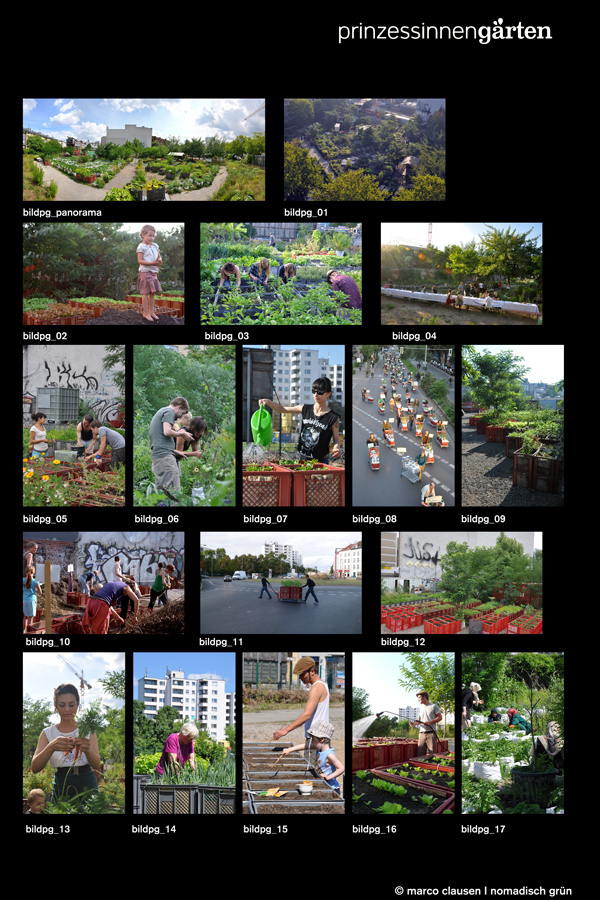
Nomadisch Grün (Nomadic Green) launched Prinzessinnengärten
(Princess gardens) as a pilot project in the summer of 2009 at
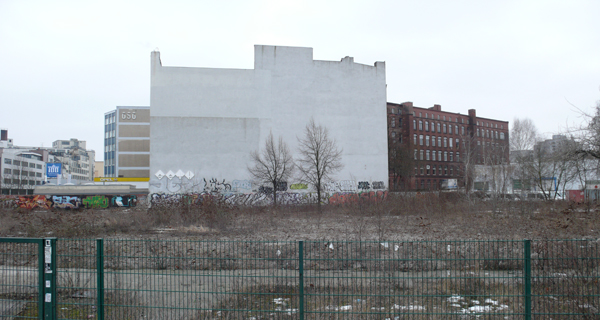
Moritzplatz in Berlin Kreuzberg, a site which had been a wasteland for
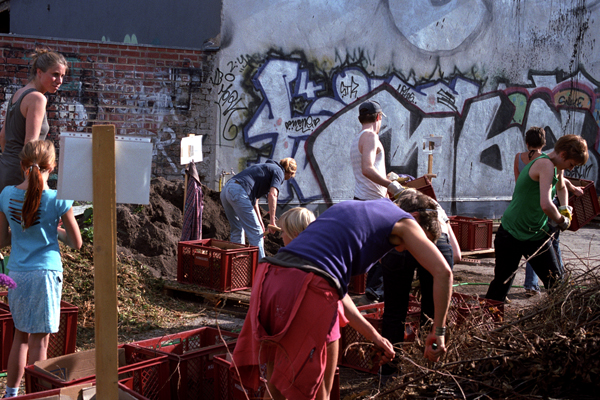
over half a century. Along with friends, fans, activists and neighbours,
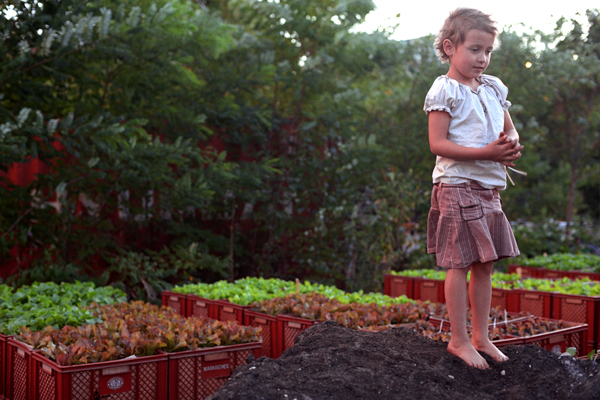
the group cleared away rubbish, built transportable organic vegetable
plots and reaped the first fruits of their labour.
Imagine a future where
every available space in big cities is used to let new green spaces
bloom. Green spaces that local residents create themselves and use to
produce fresh and healthy food. The result would be increased biological
diversity, less CO2 and a better microclimate. The spaces would promote a sense
of community and the exchange of a wide variety of competencies and
forms of knowledge, and would help people lead more sustainable lives.
They would be a kind of miniature utopia, a place where a new style of
urban living can emerge, where people can work together, relax,
communicate and enjoy locally produced vegetables.
In future ever more people
will be living in cities rather than in rural areas. The city will
therefore become the decisive place for the development of more
sustainable ways of eating, living and moving. The city of the future
should be a climate-friendly, pleasant place to live, where every care
is taken to conserve our natural resources.
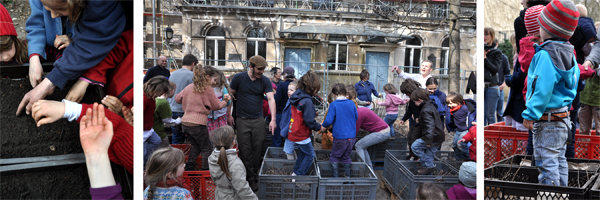
Prinzessinnengärten is a new urban place of learning. It is where locals can come
together to experiment and discover more about organic food production,
biodiversity and climate protection. The space will help them adapt to
climate change and learn about healthy eating, sustainable living and a
future-oriented urban lifestyle.
With this project Nomadisch Grün intends to increase biological, social and
cultural diversity in the neighbourhood and pioneer a new way of living
together in the city.
Urban agriculture on Moritzplatz
- The story so far -
For half a century
Moritzplatz hid in the shadows of the Berlin Wall.
This almost forgotten corner, once zoned as a motorway junction, is
now experiencing a new lease of life.
First it was just a vision: Sitting in the middle of our field at
sunset,
the wind rustling through the poplars, the air scented by ripe
tomatoes and fresh herbs, chatting with our friends and neighbours,
having a good time – right in the middle of the city !
This was the picture Robert brought home to Berlin after a trip to
Cuba. In Havana and other cities, agricultura urbana is not just
about producing one’s own vegetables but more about creating an
urban living-, working- and meetingplace. This is where neighbours
would gather and adults would pass on their knowledge to children
as they relax over a cup of coffee.
“Let’s do it in Berlin!”, with this rallying call and the help of
children,
youth, neighbours and friends we are transforming Moritzplatz into
an urban garden, café and place of working, learning and relaxing.
Nomadisch Grün (Nomadic Green)
Starting in the summer of 2009, the non-profit company „Nomadisch Grün“
has leased a site in Berlin/Kreuzberg in order to create a mobile
urban farm:
The Prinzessinnengarten.
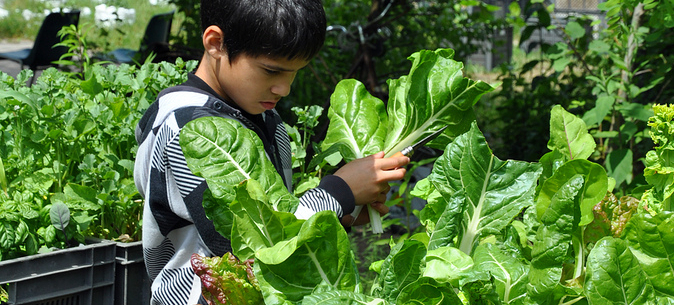
Locally grown organic vegetables
Our fresh, organic, locally produced herbs and vegetables are
grown in raised compost beds without using any pesticides or
artificial fertilisers.
Mobile Gardening
Nomadisch Grün stands for mobile gardening. We temporarily
transform unused spaces such as buildingsites, car parks and roofs
into urban farmland and green meeting places.
Sustainable Living
The Prinzessinnengarten is a place of discovery where children,
neighbours, experts and those curious about sustainable living can
come together to about and explore alternative visions for our city.
Hedonism as we understand it
Our garden is a place of pleasure and rejuvenation. Relax and enjoy
watching the vegetables being harvested and freshly prepared in
our small garden restaurant.
Help grow a new city: Join in.
We couldn’t wait, so we’ve already started.
Come along and find your role – together we are building the future
of our city.
The Ecological Footprint is a resource accounting tool used widely as a management and communication tool by governments, businesses, educational institutions and NGOs to answer a specific resource question: How much of the biological capacity of the planet is required by a given human activity or population?
What does the Ecological Footprint measure?
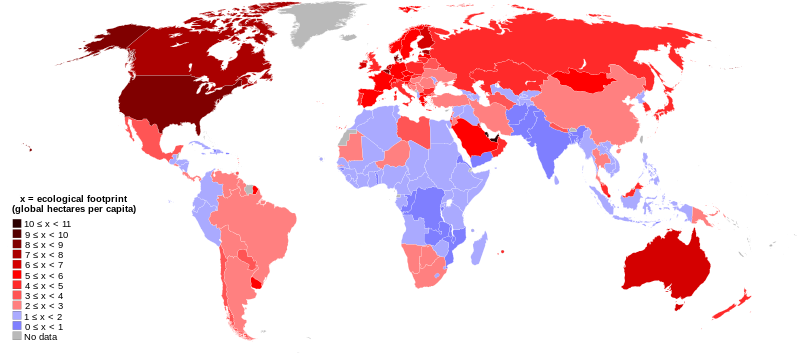
The Ecological Footprint measures the amount of biologically productive land and sea area an individual, a region, all of humanity, or a human activity requires to produce the resources it consumes and absorb the carbon dioxide emissions, and compares this measurement to how much land and sea area is available.
Biologically productive land and sea includes area that 1) supports human demand for food, fiber, timber, energy and space for infrastructure and 2) absorbs the carbon dioxide emissions from the human economy. Biologically productive areas include cropland, forest and fishing grounds, and do not include deserts, glaciers and the open ocean.
Current Ecological Footprint Standards (www.footprintstandards.org) use global hectares as a measurement unit – which makes data and results globally comparable.
Personal Footprint
You’ve probably heard of the Ecological Footprint - the metric that allows us to calculate human pressure on the planet and come up with facts, such as: If everyone lived the lifestyle of the average American we would need 5 planets.
How much land area does it take to support your lifestyle? Take this quiz to find out your Ecological Footprint, discover your biggest areas of resource consumption, and learn what you can do to tread more lightly on the earth.
There are a number of online Ecological Footprint calculators in use today. When evaluating other Ecological Footprint calculators, the most important consideration is whether the calculator is actually measuring the Ecological Footprint and not just using the term footprint as a proxy for general environmental impact. These calculators may offer interesting insights but they are not aligned with the international Ecological Footprint Standards, which were adopted in 2006 in order to ensure that Footprint studies were both credible and consistent.
The Ecological Footprint as defined by the Ecological Footprint standards calculates how much biologically productive area is required to produce the resources required by the human population and to absorb humanity's carbon dioxide emissions. Approximately 90 percent of all leading Ecological Footprint practitioners worldwide have joined Global Footprint Network and have agreed to adhere to these standards and to use a common set of data.
For globally comparable and credible Ecological Footprint calculator results, look for transparent information on the methodology used, and check to see if the calculator was created by a Global Footprint Network partner, as partnership requires compliance with Ecological Footprint standards.
What is biocapacity?
Biocapacity is shorthand for biological capacity, which is the ability of an ecosystem to produce useful biological materials and to absorb carbon dioxide emissions.
What is overshoot?
Overshoot, which in this context is shorthand for ecological overshoot, occurs when a population’s demand on an ecosystem exceeds the capacity of that ecosystem to regenerate the resources it consumes and to absorb its carbon dioxide emissions.
The Ecological Footprint is often used to calculate global ecological overshoot, which occurs when humanity’s demand on the biosphere exceeds the available biological capacity of the planet. By definition, overshoot leads to a depletion of the planet’s life supporting biological capital and/or to an accumulation of carbon dioxide emissions.
How is an Ecological Footprint calculated?
Ecological Footprints can be calculated for individuals, groups of people (such as a nation), and activities (such as manufacturing a product).
The Ecological Footprint of a person is calculated by considering all of the biological materials consumed and all of the carbon dioxide emissions generated by that person in a given year. All these materials and emissions are then individually translated into an equivalent number of global hectares.
To accomplish this, the amount of material consumed by that person (tonnes per year) is divided by the yield of the specific land or sea area (annual tonnes per hectare) from which it was harvested, or where its waste material was absorbed. The number of hectares that result from this calculation are then converted to global hectares using yield and equivalence factors. The sum of the global hectares needed to support the resource consumption and absorb their carbon dioxide emissions that person's Ecological Footprint.
The Ecological Footprint of a group of people, such as a city or a nation, is simply the sum of the Ecological Footprint of all the residents of that city or nation. It is also possible to construct an Ecological Footprint of production for a city or nation, which instead sums the Ecological Footprint of all resources extracted and CO2 emissions generated within the borders of the city or nation.
The Ecological Footprint of an activity, such as producing a good (an airplane) or service (providing insurance) in the human economy, is calculated by summing the Ecological Footprint of all of the material consumed and CO2 emitted during that activity. When calculating the Footprint of a business or an organization, the activities to be included within the boundaries of that organization must be clearly defined.
What is a global hectare?
A global hectare is a common unit that encompasses the average productivity of all the biologically productive land and sea area in the world in a given year. Biologically productive areas include cropland, forest and fishing grounds, and do not include deserts, glaciers and the open ocean.
Using a common unit, i.e., global hectares, allows for different types of land to be compared using a common denominator. Equivalence factors are used to convert physical hectares of different types of land, such as cropland and pasture, into the common unit of global hectares.
Global hectares can also be converted into global acres.
What is the proper way to use the term Ecological Footprint?
The term Ecological Footprint, capitalized, is a proper name referring to a specific research question: how much of the biological capacity of the planet is required by a given human activity or population? Often, the word ‘footprint’ is used generically to refer to human impact on the planet, or to a different research question. For example, the term ‘carbon footprint’ often refers to the number of tonnes of carbon emitted by a given person or business during a year, or to the tonnes of carbon emitted in the manufacture and transport of a product. There is a carbon component to the Ecological Footprint. It measures the amount of biological capacity, in global hectares, demanded by human emissions of fossil carbon dioxide.
The term Ecological Footprint has been deliberately excluded from trademark to encourage its widespread use. Global Footprint Network strives to maintain the value of this term by encouraging our partners and others using the word footprint or Ecological Footprint to apply the term consistently, using the definition found in the Ecological Footprint Standards (www.footprintstandards.org). Global Footprint Network encourages research answering different questions to be referred to as something other than Ecological Footprint.
How does the Ecological Footprint relate to carrying capacity?
Carrying capacity is a technical term that refers to the maximum population of a species that a given land or marine area can support. Many species have easily defined and consistent consumption needs, making carrying capacity relatively easy to define and calculate. For humans, however, carrying capacity estimates require assumptions about future per-person resource consumption, standards of living and “wants” (as distinct from “needs”), productivity of the biosphere, and advances in technology. An area’s carrying capacity for humans is thus inherently speculative and difficult to define.
Ecological Footprint accounts approach the carrying capacity question from a different angle. Ecological Footprints are not speculative estimates about a potential state, but rather are an accounting of the past. Instead of asking how many people coulddata sets. be supported on the planet, the Ecological Footprint asks the question in reverse and considers only present and past years. The Footprint asks how many planets were necessary to support all of the people that lived on the planet in a given year, under that year’s standard of living, biological production and technology. This is a scientific research and accounting question that can be answered through the analysis of documented, historical
Is the Ecological Footprint anti-trade, anti-technology, or anti-GDP?
The Footprint tracks current human demand on nature in terms of the area required to supply the resources used and absorb the CO2 emitted in providing goods and services. Trade is accounted for by allocating this demand to the country that ultimately consumes these goods and services. This accounting reflects import and export flows, but makes no judgment regarding the benefits, disadvantages or fairness of trade. The Ecological Footprint is therefore neither pro- nor anti-trade.
As new technologies come on line that affect biocapacity and resource-efficiency, their impact on resource supply and demand are reflected in biocapacity and Footprint assessments. In other words, the Footprint and biocapacity results reported in any given year are in part a function of the technology used in that year. This accounting does not judge whether the use of a technology is positive or negative, but only shows how the technology impacts resource flows. Footprint assessments are historical rather than predictive, and make no judgment about the value of technologies that may become available in the future.
The Footprint approach is neither pro- nor anti-GDP. Gross Domestic Product (GDP) is an economic indicator used to track the annual value added to an economy. For a more comprehensive understanding of national trends, additional indicators are required--unemployment statistics, longevity figures, or ecological asset measures, for example. Global Footprint Network is working to have nations adopt the Ecological Footprint as a complement to, rather than as a substitute for, the GDP, and has set a specific goal in this regard--to have 10 nations adopt the Ecological Footprint by 2015 as a national indicator, in parallel with their use of the GDP.
What is the Water Footprint, and how is it related to the Ecological Footprint?
Though they are often compared and contrasted, Ecological Footprints and Water Footprints are, as indicators, fundamentally incapable of being substituted. The Ecological Footprint does not, and is not intended to measure freshwater flows. Because this is nevertheless a vital renewable resource, in 2002, A.Y. Hoekstra proposed that the Water Footprint be created as a sustainable water use indicator measuring the total volume of freshwater directly or indirectly used by a population.
In essence, the Ecological Footprint measures the biological capacity a population uses and the Water Footprint measures the freshwater a population uses. They each provide a different piece of information in the sustainability puzzle. Instead of being seen as competing metrics, they should be seen as two complementary indicators of natural capital use in relation to human consumption.