Mostrando entradas con la etiqueta algae. Mostrar todas las entradas
Mostrando entradas con la etiqueta algae. Mostrar todas las entradas
20 oct 2022
more on biohacking >> fashion


12 sept 2020
The Coral
home algae farming
2019


PRESS || FastCompany / Mashable / DWELL / Dezeen / Designboom / Core77 / Inhabitat / and more…
AWARD || Dezeen Awards 2019 Longlist / Design that Educates 2020 / INDUSTART 2019
EXHIBITION || Dutch Design Week 2019, Dubai Design Week 2019, Elle Deco Italia
4 dic 2012
water technology

RIVER RESTORATION


RESULTS:
Improves dissolved oxygen
Low energy, chemical free treatment
Odour filtration
Aesthetic cleantech
Reduced algae
Advanced tratment standards for BOD, COD, NH3.
Natural Treatment
The Biomatrix system is an engineered floating ecology designed to
optimize powerful ecological treatment processes within an attractive
feature of the aquatic landscape. The Biomatrix combines the latest
developments in ecological engineering with new biofilm research and
traditional wastewater treatment processes. Whole system engineered
ecologies provide an energy efficient, low life cycle cost treatment
solution.
The Form

Floating Structures
The Biomatrix system can incorporate variable levels of buoyancy from
10kg/m2 to over 100 kg/m2. The use of different levels of buoyancy
allow areas of walkways, floating bridges, pavilions, boat docking sites
or public artworks to be integrated with the treatment system.
Biomatrix systems are ideally suited for contaminated canals, rivers,
lakes and reservoirs; as well as providing effective treatment of high
strength waste in purpose built lagoons and treatment cells.
The Biomatrix provides the foundation and the substrate to support a
diversity of life forms from many different phylogenetic kingdoms. These
include the bacteria, fungi, algae, protozoa, annelids, mollusks,
insects, vertebrates (including frogs and turtles), and higher plants.
This multitude of life forms, in concert, have the capability to treat
wastes, pathogens and toxins. The basic technological and scientific
principles governing the design of natural treatment systems have been
well articulated and subjected to scientific review.

TREATMENT PROCESSES WITHIN BIOMATRIX SYSTEMS CAN EFFECTIVELY:
-
Improve water clarity
-
Remove and stabilize nutrients
-
Reduce algae
-
Breakdown industrial chemicals
-
Remove Biological and Chemical Oxygen Demand
-
Filter out Suspended Solids and particulate
WASTEWATER TREATMENT

ECOLOGICAL TOOLBOX


3 oct 2012
Networking Nature




Year: 2012
Location: Palazzo Bembo, Venice
Typology: Installation for the Venice Architecture Biennale 2012
Strategy: Creating a self sufficient ecosystem where it is impossible to see the dividing line between living machines and artificial organisms
Design and making: Studiomobile
Water network automation: Angelo Semeraro
Location: Palazzo Bembo, Venice
Typology: Installation for the Venice Architecture Biennale 2012
Strategy: Creating a self sufficient ecosystem where it is impossible to see the dividing line between living machines and artificial organisms
Design and making: Studiomobile
Water network automation: Angelo Semeraro
" For the Venice Architecture Biennale 2012, Studiomobile
explores a future scenario where men are forced to live in an unusual
landscape shaped by environmental changes. At present, more than half
the world's population lives and works in a coastal strip 200 kilometres
wide, and in the near future sea is expected to characterize even more
urban settlements. But not only adaptation is required. Next strategy
will be assimilation, an approach characterized by embracing the
changing conditions and taking advantage of the resulting opportunities.
Frequently, changes perceived as negative open up new possibilities and
innovative opportunities. We imagine new communities based on
movement, living in flexible, self-sufficient, and nomadic
structures. We believe that seawater is poised to become soon a key
resource for urban environment
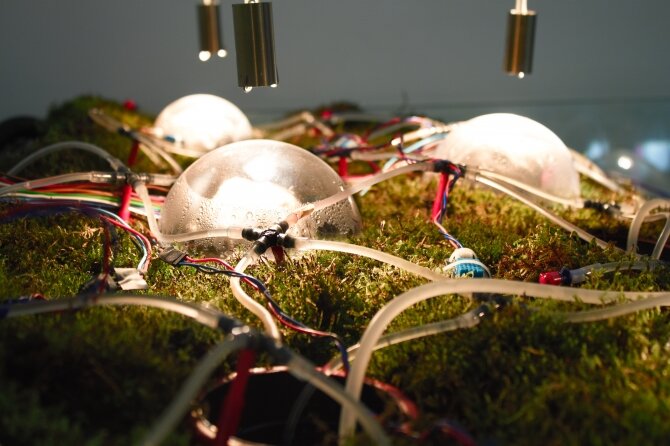
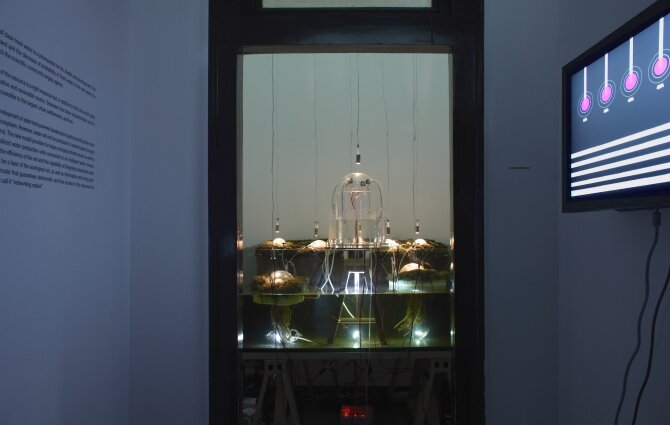
The ecosystem Networking Nature lives off
seawater. Within a glass tank filled with salt water, some solar stills
extract fresh water by exploiting the heat produced by small lamps.
Seawater evaporates and the steam condenses into fresh water, which is
collected in tanks and then supplied.
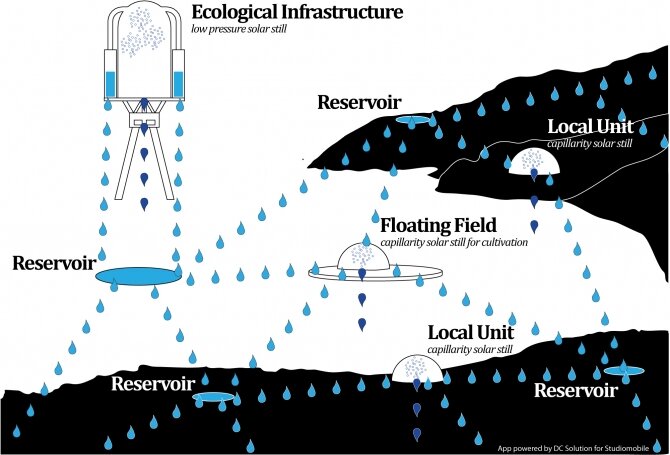
However, water is not produced in isolated systems under central
control. The new model provides for a large ecological infrastructure as
well as small local production units connected to a network able to
integrate the production of fresh water and to supply it where needed.
It's a Smart Water Network controlled by sensors that
read the local lack of water and, through an Arduino board, activate the
pumps providing the water where there is a peak of demand. The Smart
Water Network will be a layer of the ecological network as well as the
Smart Power Grid and the communications network. This strategy not only
gives response to the preservation of the environment, but it is also a
radically new model that ensures free and democratic access to the
resources to everybody.
Studiomobile's installations are working living machineswhere
nature and built landscape live in symbiosis. They suggest a future
immaginary where it is impossible to see the dividing line between
naturalized architecture and plugged nature and between living machines
and artificial organisms."
10 sept 2012
light is alive
1.Latro


Latro
2010
2010
In 2010, scientists from Yansei and Stanford University
pioneered a technique by where 30-nanometre wide gold electrodes were
inserted into the photosynthesising organs – chloroplasts – of algal
cells, thus managing to draw a small electrical current from algae
during photosynthesis. As advances in nanotechnology lead to
increasingly energy efficient products, plant life such as algae will
become attractive sources for tapping energy. Latro is a speculative
design concept responding to this potential future market.
Latro (latin for thief) incorporates the natural energy
potential of algae and the functionality of a hanging lamp into its
design. Synthesising both nature and technology in one form, Latro is a
living, breathing product. Algae are incredibly easy to cultivate,
requiring only sunlight, carbon dioxide (CO2) and water, offering a
remarkably simple way of producing energy. Breathing into the handle of
the lamp provides the algae with CO2, whilst the side spout allows the
addition of water and release of oxygen. Placing the lamp outside in the
daylight, the algae use sunlight to synthesize foods from CO2 and
water. A light sensor monitors the light intensity, only permitting the
leeching of electrons when the lux level passes the threshold – avoiding
algae malnourishment. Energy is subsequently stored in a battery ready
to be called upon during hours of darkness. Owners of Latro are required
to treat the algae like a pet – feeding and caring for the algae
rewarding them with light.
2. Trap Light


Trap Light
by Mike Thompson & Gionata Gatto
2011
by Mike Thompson & Gionata Gatto
2011
Trap Light is the result of an exciting collaboration between Gionata Gatto
(Pedalator, Urban Buds) and Mike Thompson (Latro, Blood Lamp), proposing
a radical new approach to lighting design. By utilising
photoluminescent pigments to capture escaping light, Trap Light converts
waste energy back into visible light.
Photoluminesence is a process in which energy absorbed by a
substance is gradually released as light. Using the Murano glass blowing
technique, the designers were able to embed photoluminescent pigments
into the glass body of the lamp. Through this process, Trap Light
becomes both shade and light source, emitting, absorbing, and
re-emitting light. 30 minutes ‘charge’ of recycled light from a
traditional incandescent or LED light bulb provides up to 8 hours of
ambient lighting.
With Trap Light, the designers illustrate, that by taking a
fresh approach to traditional production methods and existing materials,
they can create an engaging, new lighting experience whilst making the
most of energy.
3. Blood Lamp


Blood Lamp
2009
2009
What if power came at a cost to the individual?
The average American consumes 3383kwh of energy per year.
That’s equivalent to leaving the light on in 4 rooms for a whole year.
The simple flick of a switch allows us to power appliances and gadgets
24/7 without a thought to where it comes from and the cost to the
environment.
For the lamp to work one breaks the top off, dissolves the
powder, and uses their own blood to power a simple light. By creating a
lamp that can only be used once, the user must consider when light is
needed the most, forcing them to rethink how wasteful they are with
energy, and how precious it is.
+ info :
Mike Thopmson
info@miket.co.uk
+31 (0) 638584931
Kronehoefstraat 1, Eindhoven, NL
+31 (0) 638584931
Kronehoefstraat 1, Eindhoven, NL
Suscribirse a:
Entradas (Atom)