Mostrando entradas con la etiqueta huella ecológica. Mostrar todas las entradas

20 abr 2020

rob greenfield: Live simply and you will live free


Simple and Sustainable Living in My Tiny House 


Be the Change in the Messed up World | ​Rob ​Greenfield | TEDxIHEParis


My 44 Possessions: Everything I Own Fits in My Backpack | Minimalism


30 Days of Wearing My Trash


Rob Greenfield on Money, Health Insurance, Age and Death


Rob Greenfield is an adventurer, environmental activist, humanitarian, and dude making a difference. He is dedicated to leading the way to a more sustainable and just world.
Rob is the creator of The Food Waste Fiasco, a campaign that strives to end food waste and hunger in the U.S. He has dove into more than two thousand dumpsters across the United States to demonstrate how nearly half of all food in the U.S. is wasted while 50 million (1 in 7) Americans are food insecure.
Rob has cycled across the U.S. three times on a bamboo bicycle bringing his message of sustainability and earth-friendly living to the United States. His first bike ride across the U.S. is also a book, Dude Making a Difference.
In 2016 he landed in Rio, Brazil without a penny in his pocket. He was on a mission to travel to Panama, 7,000 miles and 7 countries away, while relying only on the goodness of humanity. This adventure is a six episode series called Free Ride on Discovery Channel playing worldwide. His travels have taken him to 6 continents and 45 countries.
Rob donates 100% of his media income to grassroots nonprofit organizations and his financial net worth is kept to a bare minimum. His financial vows are more than a list of resolutions, they speak to his steadfast commitment to live simply and live free. By living in this manner he aims to show that true happiness, health, and freedom do not come from an accumulation of money and possessions but rather from a deep connection to our surroundings, the earth’s resources that are freely available to us all, relationships, and love.
All of Rob’s extreme adventures and activism campaigns are meant to bring attention to important environmental and social issues and to inspire positive change. They may appear unattainable to some people but within them are an abundance of simple lessons and tips that can be adapted into any life to live in a manner that is beneficial to the earth, community, and self. Through his life he inspires others to make simple, small changes that grow into great change within them and society.
The Early Years
Rob grew up in the Northwoods of Wisconsin in the small town of Ashland and had a passion for the outdoors from a young age. He spent seven years in Boy Scouts and achieved the top rank of Eagle Scout. In 2005 he left his hometown to attend University of Wisconsin – La Crosse where he earned a Bachelors of Science with a major in Biology, minor in Chemistry, and a focus in Aquatic Science. During his summer breaks he worked 80+ hours per week selling educational books door-to-door and learned the skills of sales and marketing. In 2011 he moved to San Diego where he started his own marketing company, The Greenfield Group.
During much of Rob’s teens and early 20’s his life was focused on money, nice possessions, and the pursuit of women. He had the goal of being a millionaire by age 30. His life took a great turn when at the age of 24 he started to become aware of the environmental and social issues of his generation. He learned through books and documentaries that he was contributing to many of these problems through his daily actions including the food he was eating, the car he was driving, and the stuff he was buying and consuming. At that point he began his transformation from a Drunk Dude to Dude Making a Difference
He started with small changes such as shopping local, reducing the amount of trash he created, eating a more whole food, local diet, removing chemical products from his life, and using reusable bags and water bottles. Building on the success of these small changes he took greater leaps of change such as getting rid of his car, pulling all his money out of investments and banks harmful to the environment, and decreasing his dependency on money all together. Since he began his transformation he has adapted hundreds of small changes into his life in an effort to live for the benefit of many and to not harm the lives of any. In 2014 he canceled his last bill and since then has been living completely bill, debt, and credit card free. Over time he dissolved his company and started a nonprofit, Happy Healthy and Free.
Rob lived off the grid in a 50 square foot tiny home in San Diego, California. He grew his own food, lived purely on rain water (approximately two gallons per day), harnessed energy from the sun using solar panels, created near zero waste, and composted humanure (it is what it sounds like). After living this Teeny Greeny lifestyle for one year, Rob auctioned off his tiny house and raised enough money ($10,000) to build 10 tiny houses for people without homes in San Diego.
After five years of downsizing and simplifying his life he was down to just 111 possessions, all that fit into his backpack. He then traveled for two years in the service of others.
Rob is known by many as “The Trash man” for his month long project wherein he consumed like the average American for one month and wore all the trash he created.  The purpose of this project was to create a shocking visual of how much garbage just one person generates.
His third bike ride across the USA, Green Riders – Good Deeds on Bikes, was joined by over 30 others, planting gardens and doing good deeds across the USA.
In 2017 he moved to Orlando to embark on his current project to grow and forage 100% of his food for a year. He lives in a 100 square foot tiny house that he built with nearly exclusively second hand materials with friends. During this time, he illustrates alternatives to the wasteful globalized food system. He also explores whether it is possible to positively influence such a system while living outside it.
Rob’s adventures and his life have caught the attention of the world and he has been featured on thousands of media outlets including National Geographic, BBC, CBS This Morning, Discovery Channel, USA Today, LA Times, The Guardian, Huffington Post and many more.

Much more info at  robgreenfield.org

3 may 2013

naturally built by hand (1)


Lake Titicaca, Perú
The lives of the Aymara or Uros Indians who live at 4.000 m above sea level revolve around the totora reeds, wich provides them with land, homes, transportation and food. In the shallow areas of the lake they mound reed and earth on top of existing reeds to form inmense floating islands. The roots of the reeds keeps the islands from drafting. the natives navigate the lakes on canoes made from tapered boundles of reeds that are bound toguether with grass ropes and the reeds serve as walls and floors as well.


The islands and typical boats used by the Uros Tribe around the floating islands of Lake Titicaca


Built by Hand
Bill Steen, Athenea Steen & Eiko Komatsu


5 sept 2011

Bután: desarrollo sostenible y el Índice de Felicidad Interior Bruta


Desde ekuazion os invitamos a conocer un poquito más de Bután.


Un país que se desarrolla sin prisas, aprendiendo de los errores, tomando un camino diferente.... el camino del medio...


Su desarrollo sostenible se basa en el concepto del 

que se basa en los siguientes pilares:

Buena gestión de los asuntos públicos
Desarrollo económico equilibrado
Conservación del medio ambiente
Preservación y fomento de la cultura


Estos pilares recuerdan bastante al triángulo empleado por William McDonough en su teoría de "cradle to cradle":
ecology-economy-equity


4 ago 2011

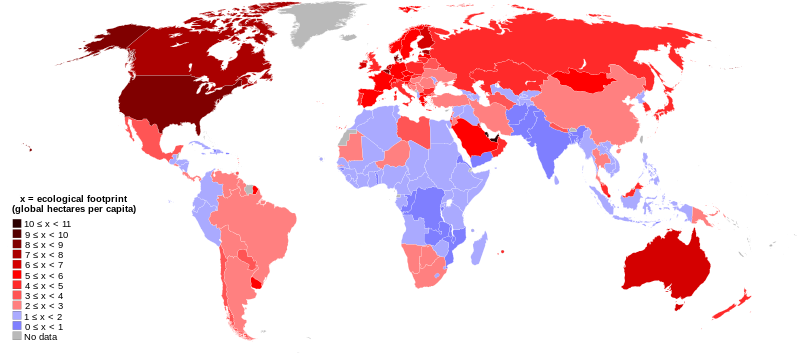
GLOBAL FOOTPRINT (1)


What is the Ecological Footprint? 
 
The Ecological Footprint is a resource accounting tool used widely as a management and communication tool by governments, businesses, educational institutions and NGOs to answer a specific resource question: How much of the biological capacity of the planet is required by a given human activity or population?

What does the Ecological Footprint measure? 

The Ecological Footprint measures the amount of biologically productive land and sea area an individual, a region, all of humanity, or a human activity requires to produce the resources it consumes and absorb the carbon dioxide emissions, and compares this measurement to how much land and sea area is available.
Biologically productive land and sea includes area that 1) supports human demand for food, fiber, timber, energy and space for infrastructure and 2) absorbs the carbon dioxide emissions from the human economy. Biologically productive areas include cropland, forest and fishing grounds, and do not include deserts, glaciers and the open ocean.
Current Ecological Footprint Standards (www.footprintstandards.org) use global hectares as a measurement unit – which makes data and results globally comparable.


Personal Footprint

You’ve probably heard of the Ecological Footprint - the metric that allows us to calculate human pressure on the planet and come up with facts, such as: If everyone lived the lifestyle of the average American we would need 5 planets.
How much land area does it take to support your lifestyle? Take this quiz to find out your Ecological Footprint, discover your biggest areas of resource consumption, and learn what you can do to tread more lightly on the earth.


Which Footprint calculator should I use? 

There are a number of online Ecological Footprint calculators in use today. When evaluating other Ecological Footprint calculators, the most important consideration is whether the calculator is actually measuring the Ecological Footprint and not just using the term footprint as a proxy for general environmental impact. These calculators may offer interesting insights but they are not aligned with the international Ecological Footprint Standards, which were adopted in 2006 in order to ensure that Footprint studies were both credible and consistent.
The Ecological Footprint as defined by the Ecological Footprint standards calculates how much biologically productive area is required to produce the resources required by the human population and to absorb humanity's carbon dioxide emissions. Approximately 90 percent of all leading Ecological Footprint practitioners worldwide have joined Global Footprint Network and have agreed to adhere to these standards and to use a common set of data.
For globally comparable and credible Ecological Footprint calculator results, look for transparent information on the methodology used, and check to see if the calculator was created by a Global Footprint Network partner, as partnership requires compliance with Ecological Footprint standards.

What is biocapacity? 

Biocapacity is shorthand for biological capacity, which is the ability of an ecosystem to produce useful biological materials and to absorb carbon dioxide emissions.

What is overshoot? 

Overshoot, which in this context is shorthand for ecological overshoot, occurs when a population’s demand on an ecosystem exceeds the capacity of that ecosystem to regenerate the resources it consumes and to absorb its carbon dioxide emissions.
The Ecological Footprint is often used to calculate global ecological overshoot, which occurs when humanity’s demand on the biosphere exceeds the available biological capacity of the planet. By definition, overshoot leads to a depletion of the planet’s life supporting biological capital and/or to an accumulation of carbon dioxide emissions. 

How is an Ecological Footprint calculated?

Ecological Footprints can be calculated for individuals, groups of people (such as a nation), and activities (such as manufacturing a product).
The Ecological Footprint of a person is calculated by considering all of the biological materials consumed and all of the carbon dioxide emissions generated by that person in a given year. All these materials and emissions are then individually translated into an equivalent number of global hectares.
To accomplish this, the amount of material consumed by that person (tonnes per year) is divided by the yield of the specific land or sea area (annual tonnes per hectare) from which it was harvested, or where its waste material was absorbed. The number of hectares that result from this calculation are then converted to global hectares using yield and equivalence factors. The sum of the global hectares needed to support the resource consumption and absorb their carbon dioxide emissions that person's Ecological Footprint.
The Ecological Footprint of a group of people, such as a city or a nation, is simply the sum of the Ecological Footprint of all the residents of that city or nation. It is also possible to construct an Ecological Footprint of production for a city or nation, which instead sums the Ecological Footprint of all resources extracted and CO2 emissions generated within the borders of the city or nation.
The Ecological Footprint of an activity, such as producing a good (an airplane) or service (providing insurance) in the human economy, is calculated by summing the Ecological Footprint of all of the material consumed and CO2 emitted during that activity. When calculating the Footprint of a business or an organization, the activities to be included within the boundaries of that organization must be clearly defined. 

What is a global hectare? 

A global hectare is a common unit that encompasses the average productivity of all the biologically productive land and sea area in the world in a given year. Biologically productive areas include cropland, forest and fishing grounds, and do not include deserts, glaciers and the open ocean.
Using a common unit, i.e., global hectares, allows for different types of land to be compared using a common denominator. Equivalence factors are used to convert physical hectares of different types of land, such as cropland and pasture, into the common unit of global hectares.
Global hectares can also be converted into global acres.

What is the proper way to use the term Ecological Footprint? 

The term Ecological Footprint, capitalized, is a proper name referring to a specific research question: how much of the biological capacity of the planet is required by a given human activity or population? Often, the word ‘footprint’ is used generically to refer to human impact on the planet, or to a different research question. For example, the term ‘carbon footprint’ often refers to the number of tonnes of carbon emitted by a given person or business during a year, or to the tonnes of carbon emitted in the manufacture and transport of a product. There is a carbon component to the Ecological Footprint. It measures the amount of biological capacity, in global hectares, demanded by human emissions of fossil carbon dioxide.
The term Ecological Footprint has been deliberately excluded from trademark to encourage its widespread use. Global Footprint Network strives to maintain the value of this term by encouraging our partners and others using the word footprint or Ecological Footprint to apply the term consistently, using the definition found in the Ecological Footprint Standards (www.footprintstandards.org). Global Footprint Network encourages research answering different questions to be referred to as something other than Ecological Footprint. 


How does the Ecological Footprint relate to carrying capacity? 

Carrying capacity is a technical term that refers to the maximum population of a species that a given land or marine area can support. Many species have easily defined and consistent consumption needs, making carrying capacity relatively easy to define and calculate. For humans, however, carrying capacity estimates require assumptions about future per-person resource consumption, standards of living and “wants” (as distinct from “needs”), productivity of the biosphere, and advances in technology. An area’s carrying capacity for humans is thus inherently speculative and difficult to define.
Ecological Footprint accounts approach the carrying capacity question from a different angle. Ecological Footprints are not speculative estimates about a potential state, but rather are an accounting of the past. Instead of asking how many people coulddata sets. be supported on the planet, the Ecological Footprint asks the question in reverse and considers only present and past years. The Footprint asks how many planets were necessary to support all of the people that lived on the planet in a given year, under that year’s standard of living, biological production and technology. This is a scientific research and accounting question that can be answered through the analysis of documented, historical 


Is the Ecological Footprint anti-trade, anti-technology, or anti-GDP?

The Footprint tracks current human demand on nature in terms of the area required to supply the resources used and absorb the CO2 emitted in providing goods and services. Trade is accounted for by allocating this demand to the country that ultimately consumes these goods and services. This accounting reflects import and export flows, but makes no judgment regarding the benefits, disadvantages or fairness of trade. The Ecological Footprint is therefore neither pro- nor anti-trade.
As new technologies come on line that affect biocapacity and resource-efficiency, their impact on resource supply and demand are reflected in biocapacity and Footprint assessments. In other words, the Footprint and biocapacity results reported in any given year are in part a function of the technology used in that year. This accounting does not judge whether the use of a technology is positive or negative, but only shows how the technology impacts resource flows. Footprint assessments are historical rather than predictive, and make no judgment about the value of technologies that may become available in the future.
The Footprint approach is neither pro- nor anti-GDP. Gross Domestic Product (GDP) is an economic indicator used to track the annual value added to an economy. For a more comprehensive understanding of national trends, additional indicators are required--unemployment statistics, longevity figures, or ecological asset measures, for example. Global Footprint Network is working to have nations adopt the Ecological Footprint as a complement to, rather than as a substitute for, the GDP, and has set a specific goal in this regard--to have 10 nations adopt the Ecological Footprint by 2015 as a national indicator, in parallel with their use of the GDP.

What is the Water Footprint, and how is it related to the Ecological Footprint?

Though they are often compared and contrasted, Ecological Footprints and Water Footprints are, as indicators, fundamentally incapable of being substituted. The Ecological Footprint does not, and is not intended to measure freshwater flows. Because this is nevertheless a vital renewable resource, in 2002, A.Y. Hoekstra proposed that the Water Footprint be created as a sustainable water use indicator measuring the total volume of freshwater directly or indirectly used by a population.
In essence, the Ecological Footprint measures the biological capacity a population uses and the Water Footprint measures the freshwater a population uses. They each provide a different piece of information in the sustainability puzzle. Instead of being seen as competing metrics, they should be seen as two complementary indicators of natural capital use in relation to human consumption.
For more information on the similarities and differences between the Ecological and Water Footprints, please consult A.Y. Hoeksta's recent article Human appropriation of natural capital: A comparison of ecological footprint and water footprint analysis.


diferent generations=diferent footprints