Mostrando entradas con la etiqueta plantas. Mostrar todas las entradas

15 ene 2015

LOVE WINE by tomokazu hayakawa architects


...carefully selected flowers to enjoy from below :)
Dahlia, Hibiscus, English ivy, Beech, Ceropegia, Sugarvine, and String-of-pearls

足立区綾瀬のレストラン・バーの内装設計。既存の曲線天井を生かしながら有機的な空間を作った。アフターファイブのサラリーマンが、首を回し椅子に浅く座って、ワインを飲みながらボーと天井を眺めて時間を過ごせる空間をイメージした。ダリア、ハイビスカス、イングリッシュアイビー、ブナ、ハートカズラ、シュガーバイン、グリーンネックレスなど下から見て楽しめる花を注意深く選定した。
YEAR : 2012
CATEGORY : BAR, RESTAURANT
AREA : 50SQM
PLACE : ADACHI TOKYO JAPAN

3 may 2013

naturally built by hand (1)


Lake Titicaca, Perú
The lives of the Aymara or Uros Indians who live at 4.000 m above sea level revolve around the totora reeds, wich provides them with land, homes, transportation and food. In the shallow areas of the lake they mound reed and earth on top of existing reeds to form inmense floating islands. The roots of the reeds keeps the islands from drafting. the natives navigate the lakes on canoes made from tapered boundles of reeds that are bound toguether with grass ropes and the reeds serve as walls and floors as well.


The islands and typical boats used by the Uros Tribe around the floating islands of Lake Titicaca


Built by Hand
Bill Steen, Athenea Steen & Eiko Komatsu


4 dic 2012

water technology


microorganism


RIVER RESTORATION

veden_taika


RESULTS:

Improves dissolved oxygen

Low energy, chemical free treatment

Odour filtration

Aesthetic cleantech

Reduced algae

Advanced tratment standards for BOD, COD, NH3.


Natural Treatment

The Biomatrix system is an engineered floating ecology designed to optimize powerful ecological treatment processes within an attractive feature of the aquatic landscape.  The Biomatrix combines the latest developments in ecological engineering with new biofilm research and traditional wastewater treatment processes.  Whole system engineered ecologies provide an energy efficient, low life cycle cost treatment solution.


The Form

img_6961

The systems are designed in sections, which can be configured in attractive natural shapes.  The Biomatrix unit can be designed to blend with the existing waterscape in strategic locations where performance can be optimized.  The system can be configured along the edge of the waterway, or centrally as islands or archipelagos.

Floating Structures

The Biomatrix system can incorporate variable levels of buoyancy from 10kg/m2 to over 100 kg/m2. The use of different levels of buoyancy allow areas of walkways, floating bridges, pavilions, boat docking sites or public artworks to be integrated with the treatment system.

Biomatrix systems are ideally suited for contaminated canals, rivers, lakes and reservoirs; as well as providing effective treatment of high strength waste in purpose built lagoons and treatment cells.

The Biomatrix provides the foundation and the substrate to support a diversity of life forms from many different phylogenetic kingdoms. These include the bacteria, fungi, algae, protozoa, annelids, mollusks, insects, vertebrates (including frogs and turtles), and higher plants. This multitude of life forms, in concert, have the capability to treat wastes, pathogens and toxins. The basic technological and scientific principles governing the design of natural treatment systems have been well articulated and subjected to scientific review.

salo-biomatrix 
TREATMENT PROCESSES WITHIN BIOMATRIX SYSTEMS CAN EFFECTIVELY:
  • Improve water clarity
  • Remove and stabilize nutrients
  • Reduce algae
  • Breakdown industrial chemicals
  • Remove Biological and Chemical Oxygen Demand
  • Filter out Suspended Solids and particulate
     
     
 WASTEWATER TREATMENT

six1


ECOLOGICAL TOOLBOX

ecological-toolbox

3 oct 2012

Networking Nature


Year: 2012
Location: Palazzo Bembo, Venice
Typology: Installation for the Venice Architecture Biennale 2012
Strategy: Creating a self sufficient ecosystem where it is impossible to see the dividing line between living machines and artificial organisms
Design and making: Studiomobile
Water network automation: Angelo Semeraro

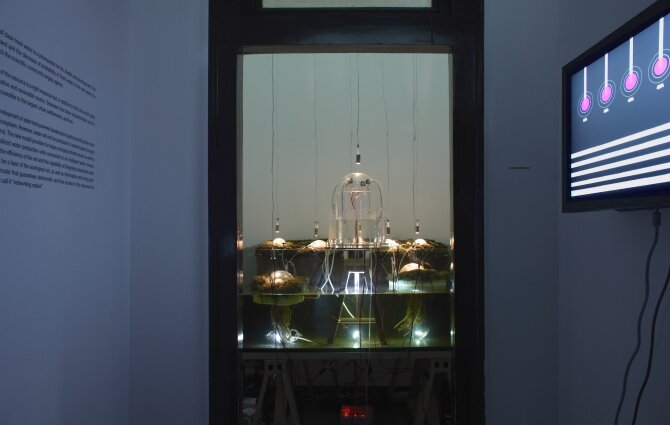
" For the Venice Architecture Biennale 2012, Studiomobile explores a future scenario where men are forced to live in an unusual landscape shaped by environmental changes. At present, more than half the world's population lives and works in a coastal strip 200 kilometres wide, and in the near future sea is expected to characterize even more urban settlements. But not only adaptation is required. Next strategy will be assimilation, an approach characterized by embracing the changing conditions and taking advantage of the resulting opportunities. Frequently, changes perceived as negative open up new possibilities and innovative opportunities. We imagine new communities based on movement, living in flexible, self-sufficient, and nomadic structures. We believe that seawater is poised to become soon a key resource for urban environment
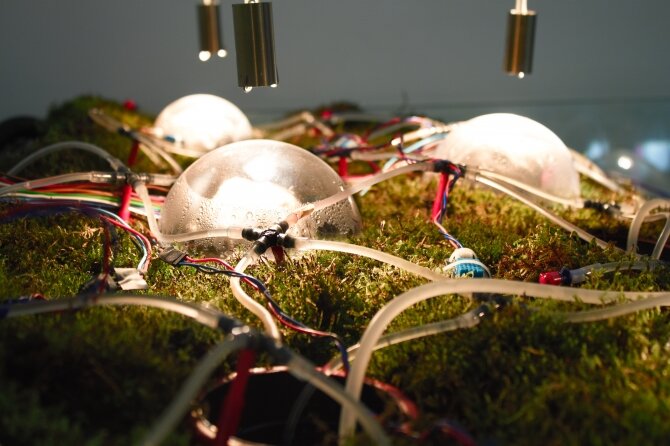
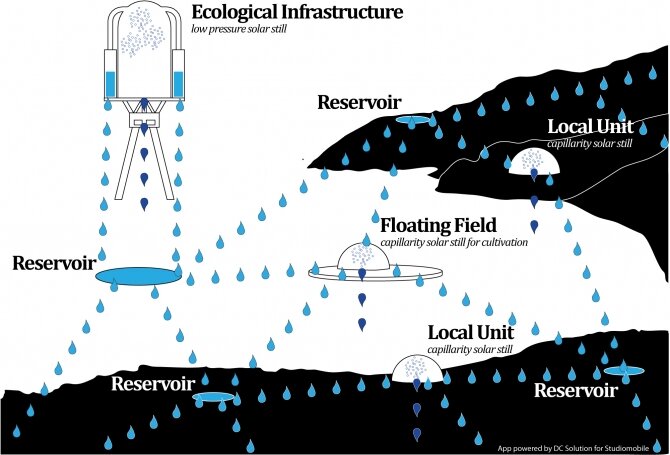
The ecosystem Networking Nature lives off seawater. Within a glass tank filled with salt water, some solar stills extract fresh water by exploiting the heat produced by small lamps. Seawater evaporates and the steam condenses into fresh water, which is collected in tanks and then supplied. 
However, water is not produced in isolated systems under central control. The new model provides for a large ecological infrastructure as well as small local production units connected to a network able to integrate the production of fresh water and to supply it where needed. It's a Smart Water Network controlled by sensors that read the local lack of water and, through an Arduino board, activate the pumps providing the water where there is a peak of demand. The Smart Water Network will be a layer of the ecological network as well as the Smart Power Grid and the communications network. This strategy not only gives response to the preservation of the environment, but it is also a radically new model that ensures free and democratic access to the resources to everybody.
Studiomobile's installations are working living machineswhere nature and built landscape live in symbiosis. They suggest a future immaginary where it is impossible to see the dividing line between naturalized architecture and plugged nature and between living machines and artificial organisms."


22 ago 2012

vertical aquaponic veggie & fish farm

AQUAPONICS:

Aquaponics is an integrated form of a re-circulating aquaculture system (usually, freshwater fish farming) and hydroponics. In these systems, plants within hydroponic components utilize nutrient rich fish waste as fertilizer. In doing so the plant grow area filters the wastewater — allowing for its reuse in the fish-rearing component.


This low-cost vertical aquaponic system can grow leafy greens, herbs and raise fish for a small family year round, and it fits in a 5' by 3' space. Sean Brady, the aquaponics projects coordinator at the Center for Sustainable Aquaponics and Nourish the Planet in Loveland, Colo., showed us how to build a system from scrap he found around the greenhouse. We published a version of this how-to guide at engineeringforchange.org, and it's one of the good ones, so we'd like to share it with Instructables, too.

What it is
A vertical aquaponic system grows vegetables without soil in columns above a fish tank. By growing vertically, you can produce about twice the amount of plants as you can with a hydroponic system of the same area. One five-foot tower can produce more than 200 heads of lettuce per year. And it uses a small fraction of the water needed to grow crops in soil.

The system puts fish waste to work as fertilizer for crops. A small pump draws nutrient-rich water from the fish tank to the tops of the vertical columns. The water trickles down through the roots of the plants, gathering oxygen from the air as it falls back into the tank. It releases almost no waste and, because it's soil free, there's no need for fertilizer or most pesticides.
You do have to replace lost water as needed, power the pump and feed the fish. Try raising crickets for fish food, or buy them flakes. It might not be too hard to power one of these pumps with a small solar panel or some other renewable energy. If anyone has an idea, please share.
 
For more information on aquaponics, please see CSA's and NTP's sites. 

9 abr 2012

Indian Man Single-Handedly Plants a Forest


Way back in 1953, French author Jean Giono wrote the epic tale The Man Who Planted Trees. It seemed so real that readers thought the central character, Elzeard Bouffier , was a living individual until the author clarified he had created the person only to make his readers fall in love with trees. 

Assam's Jadav Payeng has never heard of Giono's book. But he could be Bouffier. He has single-handedly grown a sprawling forest on a 550-hectare sandbar in the middle of the Brahmaputra. It now has many endangered animals, including at least five tigers, one of which bore two cubs recently.


The place lies in Jorhat, some 350 km from Guwahati by roadt. At one point on the stretch, a smaller road has to be taken for some 30 km to reach the riverbank. There, if one is lucky, boatmen will ferry you across to the north bank. A trek of another 7 km will then land you near Payeng's door. Locals call the place 'Molai Kathoni' (Molai's woods) after Payeng's pet name, Molai.

A little over 30 years ago, a teenager named Jadav "Molai" Payeng began burying seeds along a barren sandbar near his birthplace in northern India's Assam region to grow a refuge for wildlife. Not long after, he decided to dedicate his life to this endeavor, so he moved to the site where he could work full-time creating a lush new forest ecosystem. Incredibly, the spot today hosts a sprawling 1,360 acre of jungle that Payeng planted single-handedly.


The Times of India recently caught up with Payeng in his remote forest lodge to learn more about how he came to leave such an indelible mark on the landscape:

It all started way back in 1979 when floods washed a large number of snakes ashore on the sandbar. One day, after the waters had receded, Payeng , only 16 then, found the place dotted with the dead reptiles. That was the turning point of his life.


"The snakes died in the heat, without any tree cover. I sat down and wept over their lifeless forms. It was carnage . I alerted the forest department and asked them if they could grow trees there. They said nothing would grow there. Instead, they asked me to try growing bamboo. It was painful, but I did it. There was nobody to help me. Nobody was interested," says Payeng, now 47.


He watered the plants morning and evening and pruned them. After a few years, the sandbar was transformed into a bamboo thicket. "I then decided to grow proper trees. I collected and planted them. I also transported red ants from my village, and was stung many times. Red ants change the soil's properties . That was an experience," Payeng says, laughing.


Soon, there were a variety of flora and fauna which burst in the sandbar, including endangered animals like the one-horned rhino and Royal Bengal tiger. "After 12 years, we've seen vultures. Migratory birds, too, have started flocking here. Deer and cattle have attracted predators," claims Payeng . He says locals recently killed a rhino which was seen in his forest at another forest in Sibsagar district.


Payeng talks like a trained conservationist. "Nature has made a food chain; why can't we stick to it? Who would protect these animals if we, as superior beings, start hunting them?"

The Assam state forest department learnt about Payeng's forest only in 2008 when a herd of some 100 wild elephants strayed into it after a marauding spree in villages nearby. They also destroyed Payeng's hutment . It was then that assistant conservator of forests Gunin Saikia met Payeng for the first time.


"We were surprised to find such a dense forest on the sandbar. Locals, whose homes had been destroyed by the pachyderms, wanted to cut down the forest, but Payeng dared them to kill him instead. He treats the trees and animals like his own children. Seeing this, we, too, decided to pitch in," says Saikia. "We're amazed at Payeng. He has been at it for 30 years. Had he been in any other country, he would have been made a hero."


30 dic 2011

mobile: Prinzessinnengarten


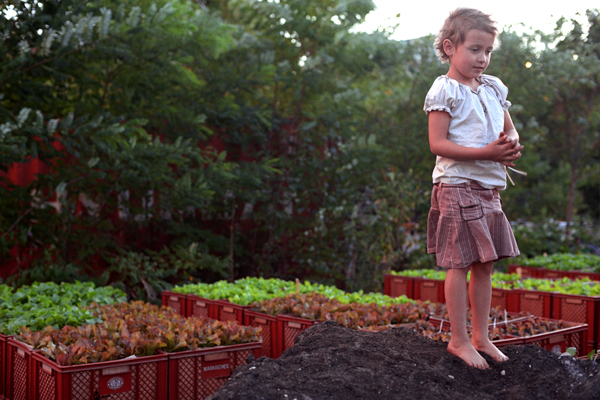
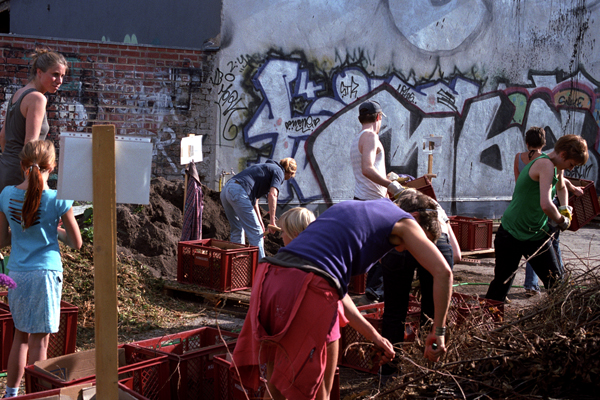
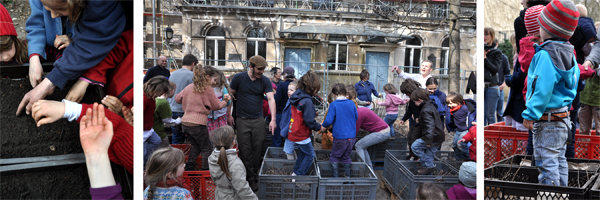
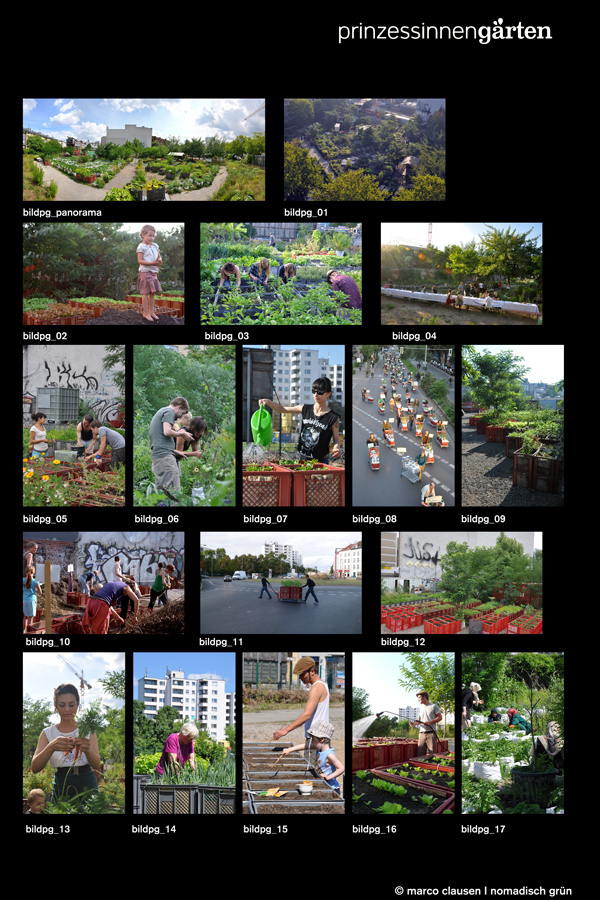
Nomadisch Grün (Nomadic Green) launched Prinzessinnengärten (Princess gardens) as a pilot project in the summer of 2009 at Moritzplatz in Berlin Kreuzberg, a site which had been a wasteland for over half a century. Along with friends, fans, activists and neighbours, the group cleared away rubbish, built transportable organic vegetable plots and reaped the first fruits of their labour.


Imagine a future where every available space in big cities is used to let new green spaces bloom. Green spaces that local residents create themselves and use to produce fresh and healthy food. The result would be increased biological diversity, less CO2 and a better microclimate. The spaces would promote a sense of community and the exchange of a wide variety of competencies and forms of knowledge, and would help people lead more sustainable lives. They would be a kind of miniature utopia, a place where a new style of urban living can emerge, where people can work together, relax, communicate and enjoy locally produced vegetables.
In future ever more people will be living in cities rather than in rural areas. The city will therefore become the decisive place for the development of more sustainable ways of eating, living and moving. The city of the future should be a climate-friendly, pleasant place to live, where every care is taken to conserve our natural resources. 


Prinzessinnengärten is a new urban place of learning. It is where locals can come together to experiment and discover more about organic food production, biodiversity and climate protection. The space will help them adapt to climate change and learn about healthy eating, sustainable living and a future-oriented urban lifestyle.
With this project Nomadisch Grün intends to increase biological, social and cultural diversity in the neighbourhood and pioneer a new way of living together in the city.


Urban agriculture on Moritzplatz
 
- The story so far -

For half a century Moritzplatz hid in the shadows of the Berlin Wall. This almost forgotten corner, once zoned as a motorway junction, is now experiencing a new lease of life.
First it was just a vision: Sitting in the middle of our field at sunset, the wind rustling through the poplars, the air scented by ripe tomatoes and fresh herbs, chatting with our friends and neighbours, having a good time – right in the middle of the city !

This was the picture Robert brought home to Berlin after a trip to Cuba. In Havana and other cities, agricultura urbana is not just about producing one’s own vegetables but more about creating an urban living-, working- and meetingplace. This is where neighbours would gather and adults would pass on their knowledge to children
as they relax over a cup of coffee.
“Let’s do it in Berlin!”, with this rallying call and the help of children, youth, neighbours and friends we are transforming Moritzplatz into an urban garden, café and place of working, learning and relaxing.


Nomadisch Grün (Nomadic Green)
Starting in the summer of 2009, the non-profit company „Nomadisch Grün“ has leased a site in Berlin/Kreuzberg in order to create a mobile urban farm:
The Prinzessinnengarten.

Locally grown organic vegetables
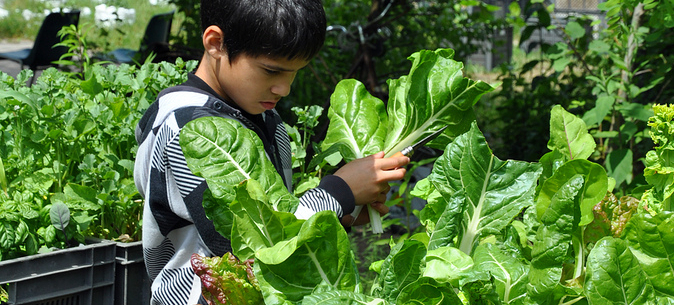
Our fresh, organic, locally produced herbs and vegetables are grown in raised compost beds without using any pesticides or artificial fertilisers.


Mobile Gardening
Nomadisch Grün stands for mobile gardening. We temporarily
transform unused spaces such as buildingsites, car parks and roofs into urban farmland and green meeting places.


Sustainable Living
The Prinzessinnengarten is a place of discovery where children, neighbours, experts and those curious about sustainable living can come together to about and explore alternative visions for our city.


Hedonism as we understand it
Our garden is a place of pleasure and rejuvenation. Relax and enjoy watching the vegetables being harvested and freshly prepared in our small garden restaurant.

Help grow a new city: Join in.
We couldn’t wait, so we’ve already started.
Come along and find your role – together we are building the future of our city.


+